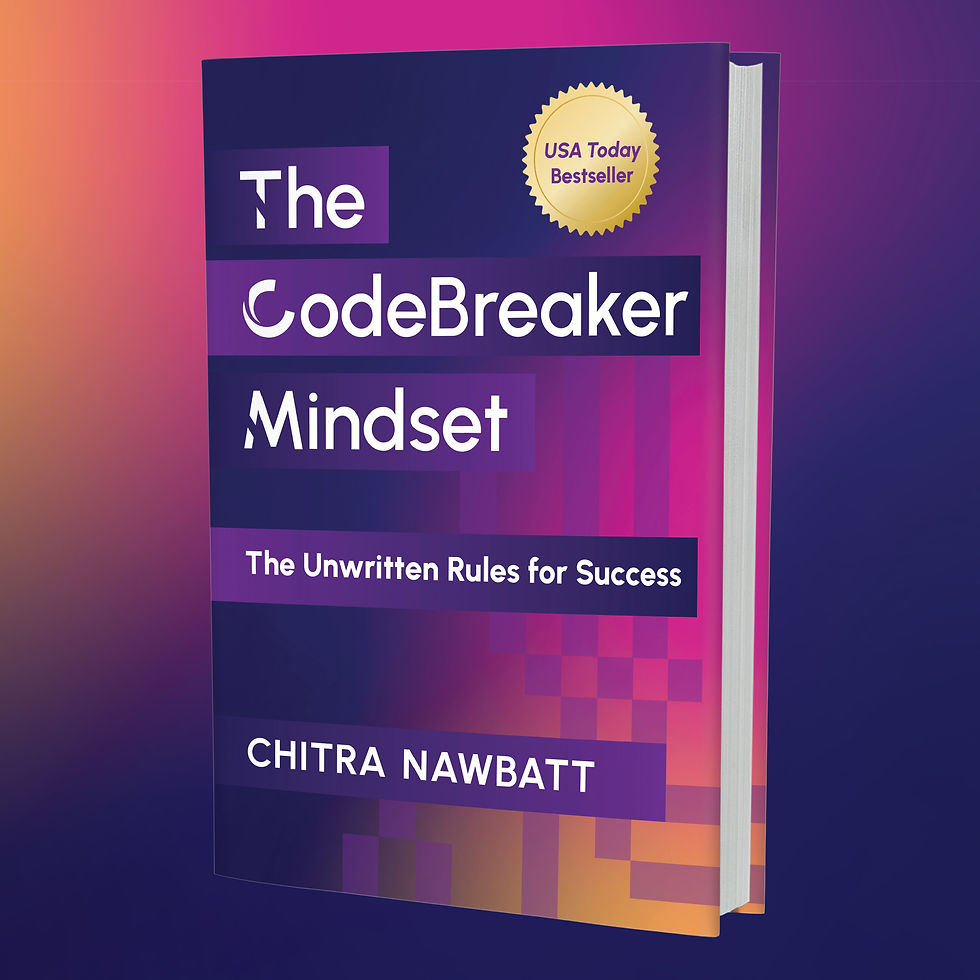
The CodeBreaker Mindset™ Ft. Mindy Grossman, Consello, Partner & Vice Chair; Fanatics, Board Member


Mindy Grossman shares her remarkable journey through leadership roles at various iconic brands, emphasizing the importance of risk-taking, self-awareness, and building authentic relationships. She discusses the written and unwritten rules of being a CEO, the significance of resilience in transformation, and the necessity of curiosity in leadership. Mindy also highlights her experiences with notable leaders and the strategies she employs to navigate complex relationships and prepare for impactful conversations. Mindy shares her insights on navigating board dynamics, overcoming self-sabotage, and the importance of proactive pivots in business strategy. She emphasizes the need for data-driven decision-making in retail and discusses the future of sports and consumer engagement. Mindy also reflects on the roles of serendipity and intuition in her career, the significance of cultivating The CodeBreaker Mindset™, and the importance of living with passion, purpose, and impact.
Chapters
(00:11) Introduction
(00:34) Mindy Grossman's Journey to Leadership
(10:09) The Rules of Being a CEO
(14:17) Unwritten Rules and Self-Awareness
(17:51) Building Relationships with Iconic Leaders
(23:34) Brand Building and Networking
(29:38) Dealing with Rejection and Preparation
(34:23) Navigating Board Dynamics and Responsibilities
(37:05) The Pivots - Overcoming Self-Sabotage and External Challenges
(44:31) Proactive Pivots in Business Strategy
(51:24) Data-Driven Decision-Making in Retail
(55:41) The Future of Sports and Consumer Engagement
(58:23) The Role of Serendipity and Intuition in Success
(1:03:52) Cultivating The CodeBreaker Mindset™
(1:06:37) Living with Passion, Purpose, and Impact
Episode Resources
Mindy Grossman | Bio
Chitra Nawbatt | Bio
The CodeBreaker Mindset™ book order here: Amazon | Barnes & Noble
The CodeBreaker Mindset™ Ft. Mindy Grossman, Consello, Partner and Vice Chair, and former CEO of WW
Chitra Nawbatt [00:00:11]:
Welcome to The CodeBreaker Mindset™ where leaders and influencers share the rules, pivots and serendipity to achieving goals and dreams. I'm your host, Chitra Nawbatt. Joining us today is Mindy Grossman, Consello, Partner and Vice-Chair, and former CEO of WW. Mindy, welcome. Thank you for joining us.
Mindy Grossman [00:00:31]:
Thrilled to be here. Great to see you as always.
Chitra Nawbatt [00:00:34]:
Mindy, I've had the privilege and I'm grateful to have known you for more than a decade. You're a distinguished leader in the consumer goods retail industry. A three-time CEO of WW, HSNi (Home Shopping Network), Polo Jeans Company. You’ve had leadership roles at iconic brands such as IAC, Nike, Ralph Lauren, Tommy Hilfiger. Take us through your journey to becoming a three-time CEO.
Mindy Grossman [00:01:04]:
Well, Chitra, what I like to say is that my CEO journey actually began when I was three days old. Hard to believe. I was an adopted child of parents who tried for a very long time to have a child and could not. My mom was not able to finish high school. My father finished high school, went into the army and worked nights in the produce business. And after 12 years of trying, they couldn't afford to adopt a child. My father went into work one night and his boss came in and said, I can't see you like this and handed him an envelope with a check to be able to adopt a child. And I'm the child. So from the time I can remember, my parents said to me, you can be anything you want, you can do anything you want. You've been given a gift, but you have to use that gift and create impact. So I was very, very serious growing up. I finished high school as a junior. I started college at 16. I got engaged when I was 19. I was preparing to be a lawyer and going to law school in the fall after my senior year of college. And as I'm about to go into my senior year of college, I had a complete epiphany that this wasn't the right thing for me. That may be what I'd wanted years ago was not what I wanted today.
So in one fell swoop, I called my parents, if you could just imagine, said, I have something to tell you. I'm breaking my engagement. I'm not getting married, I'm not going to law school in the fall and I'm moving to New York and I'm going to be in business. I'm not sure what business, but it's definitely going to have a creative element to it. And with that, I literally picked up and moved to New York to figure it out. And my first job ended up being in the men's apparel industry with Manhattan Industries. There were very, very few women, very few women in the industry as a whole. Actually, there were no women running women's apparel companies at the time. It was all men. And that was really the start of my journey. And that's why you'll hear me talk all the time about risk-taking and boldness and how often not taking a risk is actually riskier than taking the risk and taking the path. And going through that experience at such a young age really defined a lot of the elements, not only of my leadership but of my decision-making throughout my career. So I ended up being very focused. I only stayed at my first job for about a year because I realized that a woman was not going to be able to get the kind of roles that I wanted. Ended up going to work for another men's apparel company. And I was very fortunate to have worked for an incredible group of designers, very diverse designers in those days. Jeffrey Banks, Ron Chereskin, Willi Smith. So it really helped inform me also about the power of diversity. Willi for example. Fashion just doesn't come from couture. It comes from the street up, which everybody knows today. Then I had the opportunity to join Tommy Hilfiger and then ended up working for Ralph for 10 years. Perhaps Ralph Lauren. Ran new business development and then started Polo Jeans company, which was an incredible experience. I said, I have an incredible admiration for entrepreneurs because I started a business from scratch, but I had someone else's money behind me. I didn't have to raise the capital. It was incredible experience. But the company got acquired. We went from zero to almost $500 million dollars in less than five years. And I decided that the new company who acquired was not the right one for me. So once again made a pivot decision and got a call from Phil Knight when he was coming back into Nike, when the company was having some issues and putting in a whole new leadership team. And I joined to run their global apparel business. And it was incredible to come in at a time when they were really defining their new mission and vision. But I actually turned the job down at first because I couldn't move to Portland. And he called me back and said, can we make it work? And ended up having a meeting. My husband, my daughter, my nanny, who I had for 20 years and said, can we make that work? And we did for six years. Incredible experience. I started their first women's leadership council. Really had the global experience of transforming a business.
And after six years, it was getting to be a bit much or I'd probably still be there. And I had an idea that something was happening in retail that was changing the complete dynamic. Mobile was becoming the most powerful means of communication, but not yet in the United States, but I was spending a lot of time in Asia. So I said, I want something that could take advantage of mobility. Brands were becoming distribution captive because of consolidation. So new brands, it was hard to give them a format. Consumers were consuming content very different. I wanted to be a CEO, and I really wanted a company that I could transform. And so when I got a call from someone that said, I have what you want. You need to have lunch with Barry Diller and run IAC Retail, I said, that's fantastic. I'd love to have lunch with Barry Diller, but what is IAC Retail? I had never heard of it. They said, well, it's Home Shopping Network and a whole portfolio of catalog businesses, all direct to consumer. And I said, okay, give me two weeks, because I at least have to have a thesis if I'm really going to do this. And all I did was absorb what it was. And I said, I don't understand what I do. This is just people yelling at people to try and buy something. But then all of a sudden, I had another epiphany. I was watching Food Network, which at the time was really about cooking, not game shows.
Chitra Nawbatt [00:08:21]:
Yep.
Mindy Grossman [00:08:22]:
And then I turned on HSN and Wolfgang Puck was on, and he was entertaining and funny, and you wanted to buy the product, and he was cooking and engaging. And I said, I've got it. I think there's a new type of editorial program, commerce that we can envision for the future. And it's what everybody's talking about right now, about social commerce. But this was in 2006, and I had lunch with Barry and pitched him like a VC. And he said, go forth. And I was the eighth CEO in 10 years. Turnaround in transformation. But it was an incredible journey. I spun the company out two years later and took it public and was there another nine years and then made another pivot to join Oprah to take over the transformation of Weight Watchers not only as the leading weight loss community but to also have it be around the future of health span and wellness. And that was also an incredible experience of transformation. And now I'm transforming one more time in a completely different world. So after 45 years of the consumer being my client and myself being the client, I'm now part of Consello, which is an Investment and CEO advisory firm and globally, and I'm Vice Chairman, you know, across the firm. And so it's just another different experience in my life.
The Rules of the Game
Chitra Nawbatt [00:10:09]:
So to say wow to everything that you've just said is like is a massive understatement. There's so many wonderful things that we're going to dig into. And let's start with the rules of the game, because there's going to be written and unwritten rules to the many elements of what you just talked about. So share with us the written rules and the unwritten rules to being a CEO, and not only to getting that first CEO role, but three times CEO, enduring, sustaining.
Mindy Grossman [00:10:47]:
So I would say a couple of things. As you heard, almost my entire career, or my entire career has been working for visionary founders. And I like to think of myself as an intrapreneur because of that and really understanding the power of vision, the power of marrying right, the EQ, the IQ and the ability to use analysis and put that all together as a leader. Because you're not just the CEO, right? You are leading a culture, you are leading a business. You have a myriad of stakeholders within that. So the elements that are really critical have to be there. And resilience is another one, particularly in today's environment. And when I think of the qualities of leadership they fall into, you have to have the vision, you have to have the strategy, you have to be able to build a culture. You have to be able to invest in other success to make the company successful. You know, when I talk about other elements of leadership, over 10 years ago, I talked about vulnerability. And everybody said, oh, it's because you're a woman. And then COVID happened, and now, you know, one of the key elements of leadership, the ability to be open, to be honest, to be thoughtful, all of those things are very critical. But you also have to be able to focus. You have to be able to block out the noise and really focus if you're going to achieve that vision. And for me, being known as someone who loves transformation, it's that much more important because transformation has become the most overused word in business. People think they write a big statement on the wall and they're transformed. It's not. It's large, wholesale, radical change. And you've got to be able to create the vision. You have to have the strategy that supports that vision. You have to have a culture and a workforce completely aligned against that vision. You have to have the support of your board, you have to have investment dollars, and you have to have resilience. And I've taught classes on this. And when I talk about resilience, I show a slide. And on the left side of the slide are all of these articles on how brilliant I am. And on the right side of the slide are articles about how I'm a disaster. Because it's never going to be a linear journey when you're in transformation. And most people don't have patience, you know, and it's not overnight. And if you look today at businesses who are performing well, who've been transformed, it didn't happen in a year. It may be only when people start noticing it. But it does take time, and you have to be able to block out the noise.
Chitra Nawbatt [00:14:17]:
Is there an unwritten rule that you wish. Geez, I wish somebody had told me this earlier. What was it? And how did you. And how did you discover it?
Mindy Grossman [00:14:31]:
So I would say the unwritten rule, and I quote this all the time, is there's really a couple of superpowers you need to have. One is self belief. Because if you're not going to believe in yourself and you know your capabilities, why is anyone else going to believe in you? And you have to be able to project that. You have to be able to feel that it's really critical. And then I would say another thing that's really important is self-awareness. What is the impact that you have on others? And I was very fortunate to work with an executive coach for 20 years. But the power of that self-awareness, especially as a leader, has been very, very critical because you need to know your impact on other people and what they're thinking and how they're thinking about, about you and how you're going to impact them. So those two things I wish I had known from day one, but they came about over that time period.
Chitra Nawbatt [00:15:56]:
And you know, when you said your executive coach was one source of helping you discover that. And therefore that unwritten rule, if you will, are there other folks or how did you figure out these written and unwritten rules? Is it some of the iconic leaders you worked with?
Mindy Grossman [00:16:14]:
100%. You know, I am at my heart, soul and core, a brand person. I believe in the emotional connection of brands, the power of brands, the authenticity of brands. And I'm very fortunate to have worked for entrepreneurs who feel the same way. You know Ralph Lauren, right? Mindy, tell me why it's Ralph before you put the logo on it. Right. You know, Oprah, it's more important what you say no to than what you say yes to. And you need to have a purpose filter to build around that. Phil Knight, certainly the power of culture, the power of brand and authenticity. And you know, really also around, I'd say if you looked at their, you know, new mission for many, many years, to bring inspiration, innovation to every athlete. If you have a body, you're an athlete. The power of being inclusive, right? And to be able to connect to everyone, you know, Barry, you know, Barry, you know, takes no prisoners, right? You've got to be real. You're not going to sell him. You've got to be authentic. You've got to have really done the work to be able to do the business.
Chitra Nawbatt [00:17:51]:
And you know, all of those amazing leaders that you've just talked about. Mindy, what do you think it is about you and your track record that made you have such a high phenomenal hit rate with these iconic leaders and brands? Not everyone gets to work with all of those legends in their industry. Barry Diller (IAC), Phil Knight (Nike), Ralph Lauren, Tommy Hilfiger, Oprah Winfrey when you were CEO at WW. Those names are in the, one of the, you know, those names are all in the, the elitest stratosphere on planet Earth, globally. What is it about you and your track record that got you that kind of a hit rate, that kind of an ecosystem?
Mindy Grossman [00:18:37]:
Well, I think you have to start at the why did I take those roles? And I'm very, very thoughtful and meticulous. I'm also known to be a serial list maker and all of these things. So there was a lot of thought that went into the why I took those roles at different points in my life and my career. Right? And that's what that purpose filter. I think everyone should have a personal one and one from a career perspective because it allows you to decide what you don't want and block out the noise and focus on what you do want. Every one of those instances, I went to certainly work with and for the person. But I had a thesis on what I could bring to the role, what needed to happen. I did the all had all the conversations about will I have the resources, the capabilities and the ability to actually do what needs to be done? Because again, I said before, transformation is not always easy, right? And I knew that I would have their ultimate support, assuming we were on the track to success. And then more importantly, I needed to know that I would be able to surround myself with the right talent that was going to be needed to get the thesis to become reality. So it wasn't, I'm going to work for Phil because he's Phil, right? I was going there because it was a huge opportunity to change the dynamic of a company being known as a footwear company that makes some apparel to really becoming an apparel company that was leading the industry in innovation, in labor practices, in sustainability, you know, really building out the women's side of the business, not just the men's sports side. And so it had taken all my prior experience, but now it brought it to another level globally, which was an important element that I wanted for my next step. So, again, it's a combination of many things, but a lot of thought went into each one.
Chitra Nawbatt [00:21:41]:
And when you talk about the combination of many things, share with us how you approach building relationships. Because these are very complex, nuanced stakeholders, each strong personality, different industries. If you could bring to life for us, you know, how you build deep, meaningful relationships, especially with iconic leaders like these. Oprah, Barry Diller, Ralph Lauren.
Mindy Grossman [00:22:11]:
So I am at my core, a relationship person. And I would say that one of the elements of my being able to be successful has been because of the relationships that I have built across industries, across businesses for all of 47, almost 48 years, if you think about it. But, you know, just like transformation can be used in overused words, relationship can be. Relationships truly need to be authentic. You both need to respect one another, but you also have to have trust. So you're also able to have what I call conversations that feel like productive discomfort. Because if it's a real relationship, you're going to have hard conversations. So you have to build the essence of ultimate trust within each one of them to be able to ultimately both work together, build teams together, build culture together, and have it lead to business success.
Chitra Nawbatt [00:23:34]:
And how do you think about the intersection of building your brand and track record in terms of your portfolio of accomplishments and building your network and ecosystem? Because you talked about earlier, you get a phone call to have lunch with Barry Diller and then to talk that which, which is about the opportunity for the Home Shopping Network. Not everyone gets a phone call like that to go and have lunch with Barry Diller, to potentially be a leader in one of his, one of his companies. So how do you think about building that, your brand reputation, your portfolio of accomplishments, as well as building your ecosystem of relationships where you're going to get that phone call or be known and sought after?
Mindy Grossman [00:24:19]:
Yeah, well, honestly, they're not two different things. They're. They're the same thing. You know, your, Your brand is certainly your integrity, right? Your ability to create those relationships, your ability to have, you know, the honest conversations. And I'd say The other thing that's very important is when you're thinking of relationship building or you're thinking of what's going to be beneficial. I think one of the other major assets actually of leadership is innate curiosity and not staying in your own bubble. I remember when I went to run HSN and I joke around that I was totally not qualified for the role because I had no television experience, no media experience, no experience in most of the businesses that we were in because apparel was only a portion of it. I didn't understand, you know, the kind of idea of channels and network and all of that, but I knew what the consumer was going to want and I knew that I could work backwards on that. But that's also about building relationships. It's not just people that you want in your aura. It's building relationships with every group of stakeholders that you're going to interact with. And that's what really both builds your brand. Right. And helps those relationships. And I remember we were in the beauty business. I had never been in the beauty business. So I joined a number of groups in the beauty business. And at one point I had to deliver a fireside chat at one of the big events. And I was talking just about this topic of how every sector affects each other. And I said to the room, how many people in this room have been to the Consumer Electronics Show? And this was probably in 2009, eight something. And like, nobody raised their hand. I said, the biggest disruption in beauty is going to come from technology. And fast forward, that's a lot of what has happened today. And you really have to think of getting out of your lane and being able to have many different experiences and build networks across different platforms, different industries. I also bring up the curiosity piece. So I allocate a certain amount of time every week to either meet someone I've never met before or experience something I've never experienced before. And what I like to say to people is, a lot of people I'll say, have you ever met so and so. And they said, no. And I said, well, why don't you reach out? Well, I can't reach out. I go, yeah, you can. What is the worst thing that could happen? They won't want to meet with you, but you can try. And I use the example when Adam Grant came out with his first book, Give and Take, and I heard him speak probably on one of the news channels. I said, that book aligns with my vision of leadership. I have to meet this guy. Well, I ended up getting introduced to his book agent. I asked his book agent for his email. I contacted him by email to tell him what I thought of the book. I checked out his tour because he was on tour with the book. I saw he was going to be in Orlando. I was in St. Petersburg running HSN. I sent him a note and I said, I see you're in Orlando. You have a break after this tour stop. Would you come to St. Pete? I'd love to take you out to dinner. And you just wrote a book called Give and Take.
Chitra Nawbatt [00:28:59]:
Yeah.
Mindy Grossman [00:29:00]:
So he did. And to this day now, not everything is going to work out like that. But this idea that you can have these experiences and if there's something that's passionate to you. Right. Why don't you pursue it? And too many people don't have the self-belief to do that. And I'm okay with rejection, but in a lot of cases, it takes you forward and gives you opportunity.
Chitra Nawbatt [00:29:38]:
How do you deal with rejection?
Mindy Grossman [00:29:42]:
You know, look, rejection is never comfortable. Right. So you kind of have to be comfortable with discomfort. The question you have to ask yourself is why is it just that the people didn't have time for you or it wasn't what they could consume at the point or if it didn't seem as relevant to them. I do think that doing the work to kind of sit back and understand, was there something you could have done differently or not?
Chitra Nawbatt [00:30:21]:
Yeah.
Mindy Grossman [00:30:21]:
And then you just have to move on. You can't dwell. Dwell is not a good word.
Chitra Nawbatt [00:30:30]:
And before we actually get into the next section around pivots and getting more into rejection, something you said around this notion of EQ self-awareness and that ties into being able to read people when you're having to prepare. You've similarly when you've dealt with many of these leaders, your team, etc. Give us an example and maybe use Oprah. Just because so many people know her around the world, you're going to prepare to meet her for the first time. How do you read her? Read the situation in terms of your preparation. Because you talked about, you go in with the thesis, you've done your homework. Right.
Mindy Grossman [00:31:15]:
So I do think preparation is critical. I think too many people think they have a formula. There is no formula. Right. Like in today, in my, my role. Right. We, we deal with CEOs. Well, every CEO is different. Yeah, right. Their personalities are different, their missions are different, their experiences are different. And you have to do the work to have as great an understanding as possible around what motivates people, how they like to interact. I mean, in today's world, you can find out pretty much anything and everything about people to get a sense. Right. And the way you have to approach things is all relevant to the homework that you've done. Now, when I went to meet Oprah for the first time, I flew to California and met her. And I had done a lot of work really understanding why she decided to be part of the company and be on the board and be an investor and what her belief was that this company could be even more than what it was today and it could change the lives of people, especially in an environment where it's so needed, given the state of health and wellness in the world. So I spent a lot of time in advance, I actually wrote a manifesto of what I thought the brand and the business and its impact on humans could be. And so in doing that, it opened up a bigger aperture of conversation around what we could accomplish together and change lives. That's a very specific thing. It was very different than explaining to Barry what I thought HSN needed to be. So again, it's really trying to have a deeper understanding and do as much as possible to understand others’ motivations.
Chitra Nawbatt [00:34:00]:
And all that about others motivations. You've dealt with public company board of directors and you've had activist investors on. On the board. When you were at WW, what's your approach? You know, the written, the unwritten rules in terms of having productive relationship with board members and especially activist investors.
Mindy Grossman [00:34:23]:
Yeah, we didn't have activist investors in any of the companies that I was a CEO, but I've been on boards that have had activist investors. You know, I think the most important thing as you go in is you really try to assume positive intent. What you want to avoid is vitriol or animosity. You want to have the right conversations, you know, so take the activist aside for the moment, but just in the boardroom in general. I've been on public boards, private boards, philanthropic boards for 25 years. Right. And board dynamics are very important and I think are equated to business success along with the CEO and the team and the culture. And I'm going to go back to when I was speaking before about integrity, trust, the ability to have productive discomfort and, but still have respect for one another. All of that is so important in the boardroom. I'd say the other thing that's critical in the boardroom, no different than when I was talking about preparation. As a board member, you have a very deep responsibility to doing the work and really understanding the business and really having to have all the stakeholders in mind. So you can, you know, make the right decisions on behalf of, of the company. It's not something to be taken lightly. You know, I speak a lot on, you know, for people that want to get on, on boards. I said, you know, you have to remember this is not a nice to have because you want it on your resume. This is, this is a big responsibility and this is work. And you have to be able to understand that and be able to. Because to your point, you don't know when you're going to have an activist. You don't know when you're going to go from having, you know, a board meeting five times a year and some intersection to all of a sudden have it be very consuming because of what you're going through. And you have to be able to live up to that.
The Pivots
Chitra Nawbatt [00:37:05]:
So let's get into the pivots. What's a critical situation where you were hijacked by yourself? Self sabotage and a situation where you were hijacked by somebody else and how did you recover? And that somebody else could be another person. Market dynamic. But this notion of being hijacked first by yourself and then by somebody or something else.
Mindy Grossman [00:37:32]:
Yeah, well, the one, you know, I can, I can talk to and I'm certainly not the only person that had to do this. You know, I was in year three of my role at which was then WW and we were so excited. We were poised to have the biggest year in the company's history. We were kicking off an incredible nine-city arena tour with Oprah and it was incredible. Well, we kicked off the tour in January 2020 and we filled stadiums with 20 to 40,000 people for a full day. Where she really inspired people through storytelling and to all the elements that we integrated how they could live their best, most fulfilled, healthiest lives. And I saw people leave at the end of the day, their lives changed. It was an incredible experience. Well, the tour ended March 9th in Denver, flew back to New York March 10th, and on March 12th, I had to shut the offices and I had to get ready to shut everything down. And this was a brand and a business that had 30,000 in-person workshops a week in 13 different countries. And I remember that moment. And I said I have to think beyond the business implications. I have to think of our member. I have to think of how I can't leave that member without their community. I can't leave that member alone. Wow. I remember calling Eric Yuan Wan at Zoom and saying, I need your help. And we had been a Zoom company and I took the entire product team the operations team, the entire focus team. And in six days we converted every one of those workshops to virtual. And again, I knew that the workshops weren't necessarily going to attract new members. They most likely be digital and there was a big difference in price point. And there would be some business implications, of course, but I had to stay focused on the most important element. And because we did that, we kept the retention. So I think when you go through these intense situations, you have to say, okay, what is the best outcome? I can't get a perfect outcome, but what is the best outcome? That's one. I'd say the second. The summer of 2008 was when my CFO Judy and I were on the roadshow to take HSNI public as the spin-out from IAC. And you know what was starting to happen in the world then from an economic point of view. But we got ...
Chitra Nawbatt [00:41:07]:
The financial crisis.
Mindy Grossman [00:41:08]:
Yes. And we took the company public, the end of August. Two weeks, actually it was two weeks before the Lehman bankruptcy. Right. And we came out and went public. Chitra. We couldn't even get coverage. Right. The stock came out at 10 and you know, it wasn't going to go anywhere from there. And I remember I had first time company, public, company CEO, first time with a new board. Right. And a business that was starting to be a rocket ship because when we relaunched the brand, it immediately connected with the audience. And I remember going to the board and I said, look, this is going to be a tough period, but I believe that HSN could actually grow in this timeframe. I think I will have a harder time with my very high-end catalog businesses. So I'm here are the things that I need to do that are proactive around the business. But here's what we have to make sure to protect. I need to protect my entire investment fund around mobile, around video content, because when we come out of this, we can be a leader. And I got the support of the board. And that year I think we came out at about $10. And by December the stock was under $2 and our market cap was smaller than our receivable balance. But HSN business was doing well. And so when we came out and things, you know, the light started shining again, our business took off like crazy because we kept the emotional relationship with our audience. And I remember saying, you know, I don't care if they can't even buy something. I want them to know that this is a place for them, for them to have a distraction to not hear any bad news. Right. To come and the business, not only did the business take off, but we ended up being the first company to do video commerce on an iPhone.
Chitra Nawbatt [00:43:53]:
Wow.
Mindy Grossman [00:43:54]:
Because we protected what was going to be the most valuable. And there's been studies done that the companies in both of those time frames who leaned in and said, what do we want to look like coming out of this? What things can we maybe do differently? How do we reallocate our resources? Those are the companies who came out of it stronger versus the companies who just hunkered down and froze. They did not come out stronger. So a big learning from that.
Chitra Nawbatt [00:44:31]:
Well, and on that, I think that's just a very powerful, powerful point right around a proactive pivot, if you will. And maybe using WW. You know, earlier you talked about having a thesis, Nike having a thesis when you went to go see Barry around mobile and what was happening Home Shopping Network. What you just talked about being the first to do video commerce. Right. And so when you, using WW as an example, when you're pivoting that company, talk us through your inspiration. What are the data, the signals, the pattern recognition that informed the strategy and the execution of how you pivoted WW into more wellness, the media tour you talked about with Oprah, that big media component and other elements?
Mindy Grossman [00:45:22]:
Well, the first thing that you really have to think about is, you know, what was happening in the world. You know, our life expectancy, particularly in the US was going backwards. The one thing that probably hit me the most, and it was after I'd had my first grandchildren, that a study came out that today's three-year-old has a better chance of being obese and unhealthy than living a healthy life. And we actually saw it during COVID The number one cause of COVID death was obesity. And so the purpose factor, you know, I have a trifecta of kind of words, passion, purpose, impact. Am I really passionate about what I'm, I'm going to be doing? Is it purposeful at any given period in my life and will it have impact? And the reason I made the decision to leave HSNi and do this was I was at a point where I wanted to not just have financial impact, I really wanted to have a human impact and truly believed that if we could not only enable people with the capabilities, from a scientific point of view to lose weight, but also empower them to live all aspects of a healthier life, whether that was fitness, mental health, certainly, you know, body health, how are they going to take care of themselves? How are they thinking about what a best life is? And that's where I became, you know, very focused on this idea of health span, not just lifespan, because not only do you want to live longer, you want to live better longer. And so that was at the core of everything that we did and how we were thinking through it. And that was the North Star. And when you have a North Star that you could galvanize the entire organization against and you can connect with consumers in a very different way, that's very powerful. And that's what we did.
Chitra Nawbatt [00:47:58]:
And you know, on that consumer, retail media businesses, high velocity, a lot of change. What's your mechanism to understand what is just a passing trend versus something that is going to endure that you actually want to act on?
Mindy Grossman [00:48:17]:
Because exactly to your point, you have to use data to inform everything that's happening. And then you have to overlay the qualitative with the quantitative. I mean, it's, it's critical. It's critical. And you know, it's funny, I remember it was 2017, Seth Stephens-Davidowitz came out with a book called Everybody Lies. And he had been at Google Search. And similar to my Adam Grant story, I read the book and basically it talks about when you get into polarizing topics, right? Politics, race, gender, weight, all of this. You know, people don't always tell the truth when they're asked. It's why polls, as we recently saw, do not work. And I tracked him down and I said, I want you to come speak at my leadership summit. I want to do a fireside chat with you because I am trying to get the organization to be a data-driven organization. And we need to use that data as a tool to make decisions around how we're going to be able to impact consumers in the right way. And he came, and another person I've stayed friendly with this whole time. But I do think that the data element and utilizing that is very critical. And I learned a lot at HSN because when I first got there, I literally would sit in a producer booth for hours and hours of time because we measured the business in dollars per minute, gross margin per minute, and customer acquisition per minute. And you would have a chart in front of you and you would have a host and a guest and they'd be showing, showcasing a product. And you would have a chart that showed the progression of sales. And while you were watching it, all of a sudden you'd either see the sales go down or the sales go up. And you'd have to think what happened to make that happen. And it was a study in human behavior. And you have to understand human behavior if you want to sell someone something, right, it has to service a need and what is the need at different points and who is the person? That's data. So I think it's a critical importance and even more so today, especially with the tools that we have and our capabilities to be able to do that.
Chitra Nawbatt [00:51:24]:
Well. And given the complexity and the elements of what you just talked about, what is your pattern recognition on the necessary ingredients to build and scale profitable tech and AI-enabled consumer retail companies, especially in the backdrop of consumer goods retail, as you know better than I. Margins can be thin, consumer tastes change rapidly, the consumer seems never satisfied. You need a media component. It's frenzy, right?
Mindy Grossman [00:51:52]:
Well, it's two things. One, you have to be able to constantly know what's happening in real-time, in real-time. And you have to have the systems, you have to have the capabilities, people to do that. But in addition to that, you have to also have the same capabilities to be able to forecast change, right? And to see the trends so early on that you've got the ability to react to them. In terms of business, if you look at traditional retail, what in many cases is the number one can be the number one negative. It's inventory management, right? So the more you can enable the tools for forecasting, for example, and use technology and use data and use capabilities to shorten supply chains, the more successful you'll be able to be. So I think it's a matter of looking at every element of the business and understanding what capabilities exist to allow you to have greater efficacy across every element.
Chitra Nawbatt [00:53:15]:
How do you think the role of media will change in that equation and the use of celebrities, influencers? You know, at first, 20 years ago, 15 years ago, the way it was used was varied. Now it's the norm. Now it's the norm even for B2B companies, right? Not only just consumer, consumer retail companies, B2B companies use celebrities and influencers. How do you think the role of celebrities, influencers, media, social media, the next horizon?
Mindy Grossman [00:53:45]:
Social commerce is the future, but the entire 360-degree experience of a brand is also the future. And you can't bifurcate these things. They have to be part of an overall strategy. So you can have an incredible physical experience, you can have an incredible digital experience, you can have an incredible virtual experience, you can have an incredible social commerce experience. It's how it all comes together around who your brand is. And one of the things that's very important, and again I spoke to it very early on, is authenticity. You also have to Decide what's right for your brand. And we've seen a lot of businesses and a lot of companies and the expression I always use it's okay to be provocative. You cannot be polarizing because you want to keep who you have as you're looking to grow and have more. So you have to be very cognizant of what's right for your brand as you kind of look at all these elements of, you know, alternative ways for the consumer to interface with your brand.
Chitra Nawbatt [00:55:09]:
Let's talk a little bit about sports because sports is this wonderful intersection. You sit on the board of Fanatics, the innovative diversified sports company and sports is that intersection of consumer, retail, media, live events, all elements that you have a lot of experience in. And so what's your pattern recognition on the necessary ingredients to build and scale profitable tech AI-enabled sports companies?
Mindy Grossman [00:55:41]:
So you know, I've been very fortunate certainly to have had the experience at Nike and to have been. I've been on the Fanatics board for almost eight years and I have to say that Michael Rubin is truly one of the greatest visionaries I've worked with. Who sees what's not there yet and what it could be and to really see the transformation of the business from a vertical commerce platform to a complete horizontal platform of global sports for fans. And that for fans is very important because that fan is the soul, that fan is the soul. So once you have the fan, what more can you give that fan that they're going to love whether it's around their sport or around their team? So today there's commerce, the collectables business has been fantastic, betting and gaming events, Fanatics Fest which was this August, their first one at the Javits Center. Over 70,000 fans. 70,000 fans, first-time event and content. So again it goes back to what is going to engender emotion, what is important to people, what do you want to give them? And if you look at sports, it's one of the most passionate cohorts you can imagine, right? And that's what's important. You got to go to the core of what is going to create the passion, the relationship, the motivation. And again certainly sports is one of those categories and they're very inclusive. It's for everyone. For everyone. Whether you're a child and your dad or your mom is taking you to your first game or you're in college and you're an, or you're an athlete. Whatever it is, it's emotional and it inspires and I think that's why we all have such a love.
The Magic
Chitra Nawbatt [00:58:23]:
Love, let's get in to. You use the word love. Let's get into the magic. How do you define serendipity and intuition?
Mindy Grossman [00:58:33]:
So my favourite word that I am known for, when I was growing up, my mother always used this word, and it's a Yiddish word called Bashert. And in Yiddish, it means "it was meant to be". So if a boy broke up with me, it was Bashert. He wasn't good enough for you. If something great happened, you know, it was Bashert. And when I think of, you know, serendipity, you know, why do things happen? And the reason why I believe in Bashert, that it's meant to be, is the reason why I don't look backwards. I look forwards. Now, are there times I wish an outcome would have been different? Of course. But there's a reason for everything that has to keep you moving forward. And you have to be able to deal with those elements of change. And it's probably why I had, you know, the nerve to blow up my life in college or to do some of the things that I've done and make some of the shifts. Because I do believe that if you have the right intention, right, you'll keep moving forward. Something happens, you have to be able to pivot. You have to have the creative capabilities to be able to do that. And I think that's been, you know, a personal element of my success.
Chitra Nawbatt [01:00:10]: Great social clip 2 also
And what's an example of where serendipity played a critical role for you in business, life?
Mindy Grossman [01:00:20]:
You know, there's probably been, you know, too many to mention, you know. You know, I would say I was heartbroken having to leave Nike. I loved being there, but my parents got very ill and I had to get back to the east coast. And. But I said, you know what? I can't change this. Yeah, I can't change this. So what can I do to make whatever I do next even more powerful or even more unique? And, Chitra, I surprised everybody taking that role at IAC. As a matter of fact, there were people that thought I was insane, that I had ruined my career, because, you know, I joke around when you're at Nike and you're one of the number twos, and you go to a cocktail party and they go, who do you work for? What do you do? And you go, I run the global apparel business, Nike. Oh, you're like the cool kid. And then I went to say, well, what do you do? And I said, well, I just took over as CEO of Home Shopping Network. And they went, what? And you know, there were people who were somewhat dismissive, which you don't forget that. Right. I'm a person that's always rooting for people's success, especially if they've taken the path. The path less taken. Right. And. But it was meant to be, and it was one of the most, you know, exciting 11 years of my career, you know, just doing things that were groundbreaking and getting into the entertainment business and, you know, doing things that were not expected. So, you know, sometimes you have to look at the path forward as an opportunity, no matter what.
Chitra Nawbatt [01:02:27]:
And what's your take on intuition and where intuition has guided you?
Mindy Grossman [01:02:33]:
You know, I think intuition has to be a combination of vision and analytics. Right. You know, you've got. You've got to be able to have the capabilities to have that intuition that's telling you what is the right thing to do. I think it's really important, but it can't be frivolous. Right. You have to have thought that goes into that and then use that extra mile of intuition to take you forward.
Chitra Nawbatt [01:03:10]:
Mindy, what's your take on The CodeBreaker Mindset™?
Mindy Grossman [01:03:16]:
Well, I think it's what very much what, you know, we. We just talked about. It's about the analytical and visionary. It's about what your personal strategy is for success. It's about being able to, you know, use risk-taking and boldness as the essence of transformations. It's the ability to really push yourself into what I call discomfort zones, but at the end of the day, to see just not what's in front of you, but to see what could be. And I think that, to me, is what code breaking has to do.
Chitra Nawbatt [01:03:52]:
And what's your advice on how to cultivate The CodeBreaker Mindset™?
Mindy Grossman [01:03:58]:
Well, it goes back to knowing enough to ask the right questions about everything. It's about having the curiosity. It's about putting yourself into situations where you're not entirely comfortable to be able to look for what's not there yet and to be able to surround yourself and build relationships with people that you know are like that as well.
Chitra Nawbatt [01:04:42]:
And finally, Mindy, do you view yourself to be a force in nature? What does that mean to you? And how have you, you know, have you embraced that? Do you operate from that type of a., type of an intentionality, that type of a perspective?
Mindy Grossman [01:04:50]:
So, you know, I don't know if I've used the term force of nature. Right. I think I've always operated as someone who's genuinely authentic, who, again, is not afraid to take risks, but knows the difference between risk and suicide, who's willing to push harder and to break rules sometimes if I have to, but only within parameters that really make sense. And that goes for both my personal life and my business life. You know, I, you know, am very focused on being a mom and now a Mimi or a grand mom, being, you know, a wife to my husband. Having an incredible dynamic within the family as well as within the business. I don't bifurcate my personal, and my business life. I think women for a long time thought they had to be two different people. And I always said it's hard enough to be one. Mindy, nevertheless, have to be two. And I just want to, you know, I'd say keep doing what gives me joy on one hand and what uses both my intellectual and my emotional capabilities.
Chitra Nawbatt [01:06:37]:
And the very last question is, how do you keep yourself replenished and living in possibility? Because from everything you've described, you are beyond battle-tested. Endured, succeeded through many wars, dramas, whether business, corporate, persona,l life, so many different elements. How do you and you and others may be fortunate to have a supportive life partner, children, grandchildren, some may not.
Mindy Grossman [01:06:58]:
Right.
Chitra Nawbatt [01:07:09]:
How did you keep yourself replenished having that bandwidth to live in possibility, to see possibility, to continue to create?
Mindy Grossman [01:07:19]:
Chitra, I do what I love. I go back to the passion, purpose and impact. And the impact piece is very important to me. What impact can I have on others? And you know, people ask you what your legacy is. And I remember on the Oprah tour she told a story and what it came down to is your legacy is every human you've ever touched. And that to me is what impact is. And how can I have as much impact as possible as long as I'm capable of having impact?
Chitra Nawbatt [01:08:07]:
Mindy, thank you so much for joining us. You've definitely touched me because I've learned a lot from you over the years. Thank you so much for joining us.
Mindy Grossman [01:08:16]:
Well, always a great conversation with you, Chitra, you know that.
Chitra Nawbatt [01:08:21]:
Thank you.
Chitra Nawbatt (01:08:33)
Thank you for supporting The CodeBreaker Mindset™. For more episodes go to www.chitranawbatt.com to like and subscribe. Connect with me on social media @ChitraNawbatt.
The CodeBreaker Mindset™ Ft. Mindy Grossman, Consello, Partner and Vice Chair, and former CEO of WW
Chitra Nawbatt [00:00:11]:
Welcome to The CodeBreaker Mindset™ where leaders and influencers share the rules, pivots and serendipity to achieving goals and dreams. I'm your host, Chitra Nawbatt. Joining us today is Mindy Grossman, Consello, Partner and Vice-Chair, and former CEO of WW. Mindy, welcome. Thank you for joining us.
Mindy Grossman [00:00:31]:
Thrilled to be here. Great to see you as always.
Chitra Nawbatt [00:00:34]:
Mindy, I've had the privilege and I'm grateful to have known you for more than a decade. You're a distinguished leader in the consumer goods retail industry. A three-time CEO of WW, HSNi (Home Shopping Network), Polo Jeans Company. You’ve had leadership roles at iconic brands such as IAC, Nike, Ralph Lauren, Tommy Hilfiger. Take us through your journey to becoming a three-time CEO.
Mindy Grossman [00:01:04]:
Well, Chitra, what I like to say is that my CEO journey actually began when I was three days old. Hard to believe. I was an adopted child of parents who tried for a very long time to have a child and could not. My mom was not able to finish high school. My father finished high school, went into the army and worked nights in the produce business. And after 12 years of trying, they couldn't afford to adopt a child. My father went into work one night and his boss came in and said, I can't see you like this and handed him an envelope with a check to be able to adopt a child. And I'm the child. So from the time I can remember, my parents said to me, you can be anything you want, you can do anything you want. You've been given a gift, but you have to use that gift and create impact. So I was very, very serious growing up. I finished high school as a junior. I started college at 16. I got engaged when I was 19. I was preparing to be a lawyer and going to law school in the fall after my senior year of college. And as I'm about to go into my senior year of college, I had a complete epiphany that this wasn't the right thing for me. That may be what I'd wanted years ago was not what I wanted today.
So in one fell swoop, I called my parents, if you could just imagine, said, I have something to tell you. I'm breaking my engagement. I'm not getting married, I'm not going to law school in the fall and I'm moving to New York and I'm going to be in business. I'm not sure what business, but it's definitely going to have a creative element to it. And with that, I literally picked up and moved to New York to figure it out. And my first job ended up being in the men's apparel industry with Manhattan Industries. There were very, very few women, very few women in the industry as a whole. Actually, there were no women running women's apparel companies at the time. It was all men. And that was really the start of my journey. And that's why you'll hear me talk all the time about risk-taking and boldness and how often not taking a risk is actually riskier than taking the risk and taking the path. And going through that experience at such a young age really defined a lot of the elements, not only of my leadership but of my decision-making throughout my career. So I ended up being very focused. I only stayed at my first job for about a year because I realized that a woman was not going to be able to get the kind of roles that I wanted. Ended up going to work for another men's apparel company. And I was very fortunate to have worked for an incredible group of designers, very diverse designers in those days. Jeffrey Banks, Ron Chereskin, Willi Smith. So it really helped inform me also about the power of diversity. Willi for example. Fashion just doesn't come from couture. It comes from the street up, which everybody knows today. Then I had the opportunity to join Tommy Hilfiger and then ended up working for Ralph for 10 years. Perhaps Ralph Lauren. Ran new business development and then started Polo Jeans company, which was an incredible experience. I said, I have an incredible admiration for entrepreneurs because I started a business from scratch, but I had someone else's money behind me. I didn't have to raise the capital. It was incredible experience. But the company got acquired. We went from zero to almost $500 million dollars in less than five years. And I decided that the new company who acquired was not the right one for me. So once again made a pivot decision and got a call from Phil Knight when he was coming back into Nike, when the company was having some issues and putting in a whole new leadership team. And I joined to run their global apparel business. And it was incredible to come in at a time when they were really defining their new mission and vision. But I actually turned the job down at first because I couldn't move to Portland. And he called me back and said, can we make it work? And ended up having a meeting. My husband, my daughter, my nanny, who I had for 20 years and said, can we make that work? And we did for six years. Incredible experience. I started their first women's leadership council. Really had the global experience of transforming a business.
And after six years, it was getting to be a bit much or I'd probably still be there. And I had an idea that something was happening in retail that was changing the complete dynamic. Mobile was becoming the most powerful means of communication, but not yet in the United States, but I was spending a lot of time in Asia. So I said, I want something that could take advantage of mobility. Brands were becoming distribution captive because of consolidation. So new brands, it was hard to give them a format. Consumers were consuming content very different. I wanted to be a CEO, and I really wanted a company that I could transform. And so when I got a call from someone that said, I have what you want. You need to have lunch with Barry Diller and run IAC Retail, I said, that's fantastic. I'd love to have lunch with Barry Diller, but what is IAC Retail? I had never heard of it. They said, well, it's Home Shopping Network and a whole portfolio of catalog businesses, all direct to consumer. And I said, okay, give me two weeks, because I at least have to have a thesis if I'm really going to do this. And all I did was absorb what it was. And I said, I don't understand what I do. This is just people yelling at people to try and buy something. But then all of a sudden, I had another epiphany. I was watching Food Network, which at the time was really about cooking, not game shows.
Chitra Nawbatt [00:08:21]:
Yep.
Mindy Grossman [00:08:22]:
And then I turned on HSN and Wolfgang Puck was on, and he was entertaining and funny, and you wanted to buy the product, and he was cooking and engaging. And I said, I've got it. I think there's a new type of editorial program, commerce that we can envision for the future. And it's what everybody's talking about right now, about social commerce. But this was in 2006, and I had lunch with Barry and pitched him like a VC. And he said, go forth. And I was the eighth CEO in 10 years. Turnaround in transformation. But it was an incredible journey. I spun the company out two years later and took it public and was there another nine years and then made another pivot to join Oprah to take over the transformation of Weight Watchers not only as the leading weight loss community but to also have it be around the future of health span and wellness. And that was also an incredible experience of transformation. And now I'm transforming one more time in a completely different world. So after 45 years of the consumer being my client and myself being the client, I'm now part of Consello, which is an Investment and CEO advisory firm and globally, and I'm Vice Chairman, you know, across the firm. And so it's just another different experience in my life.
The Rules of the Game
Chitra Nawbatt [00:10:09]:
So to say wow to everything that you've just said is like is a massive understatement. There's so many wonderful things that we're going to dig into. And let's start with the rules of the game, because there's going to be written and unwritten rules to the many elements of what you just talked about. So share with us the written rules and the unwritten rules to being a CEO, and not only to getting that first CEO role, but three times CEO, enduring, sustaining.
Mindy Grossman [00:10:47]:
So I would say a couple of things. As you heard, almost my entire career, or my entire career has been working for visionary founders. And I like to think of myself as an intrapreneur because of that and really understanding the power of vision, the power of marrying right, the EQ, the IQ and the ability to use analysis and put that all together as a leader. Because you're not just the CEO, right? You are leading a culture, you are leading a business. You have a myriad of stakeholders within that. So the elements that are really critical have to be there. And resilience is another one, particularly in today's environment. And when I think of the qualities of leadership they fall into, you have to have the vision, you have to have the strategy, you have to be able to build a culture. You have to be able to invest in other success to make the company successful. You know, when I talk about other elements of leadership, over 10 years ago, I talked about vulnerability. And everybody said, oh, it's because you're a woman. And then COVID happened, and now, you know, one of the key elements of leadership, the ability to be open, to be honest, to be thoughtful, all of those things are very critical. But you also have to be able to focus. You have to be able to block out the noise and really focus if you're going to achieve that vision. And for me, being known as someone who loves transformation, it's that much more important because transformation has become the most overused word in business. People think they write a big statement on the wall and they're transformed. It's not. It's large, wholesale, radical change. And you've got to be able to create the vision. You have to have the strategy that supports that vision. You have to have a culture and a workforce completely aligned against that vision. You have to have the support of your board, you have to have investment dollars, and you have to have resilience. And I've taught classes on this. And when I talk about resilience, I show a slide. And on the left side of the slide are all of these articles on how brilliant I am. And on the right side of the slide are articles about how I'm a disaster. Because it's never going to be a linear journey when you're in transformation. And most people don't have patience, you know, and it's not overnight. And if you look today at businesses who are performing well, who've been transformed, it didn't happen in a year. It may be only when people start noticing it. But it does take time, and you have to be able to block out the noise.
Chitra Nawbatt [00:14:17]:
Is there an unwritten rule that you wish. Geez, I wish somebody had told me this earlier. What was it? And how did you. And how did you discover it?
Mindy Grossman [00:14:31]:
So I would say the unwritten rule, and I quote this all the time, is there's really a couple of superpowers you need to have. One is self belief. Because if you're not going to believe in yourself and you know your capabilities, why is anyone else going to believe in you? And you have to be able to project that. You have to be able to feel that it's really critical. And then I would say another thing that's really important is self-awareness. What is the impact that you have on others? And I was very fortunate to work with an executive coach for 20 years. But the power of that self-awareness, especially as a leader, has been very, very critical because you need to know your impact on other people and what they're thinking and how they're thinking about, about you and how you're going to impact them. So those two things I wish I had known from day one, but they came about over that time period.
Chitra Nawbatt [00:15:56]:
And you know, when you said your executive coach was one source of helping you discover that. And therefore that unwritten rule, if you will, are there other folks or how did you figure out these written and unwritten rules? Is it some of the iconic leaders you worked with?
Mindy Grossman [00:16:14]:
100%. You know, I am at my heart, soul and core, a brand person. I believe in the emotional connection of brands, the power of brands, the authenticity of brands. And I'm very fortunate to have worked for entrepreneurs who feel the same way. You know Ralph Lauren, right? Mindy, tell me why it's Ralph before you put the logo on it. Right. You know, Oprah, it's more important what you say no to than what you say yes to. And you need to have a purpose filter to build around that. Phil Knight, certainly the power of culture, the power of brand and authenticity. And you know, really also around, I'd say if you looked at their, you know, new mission for many, many years, to bring inspiration, innovation to every athlete. If you have a body, you're an athlete. The power of being inclusive, right? And to be able to connect to everyone, you know, Barry, you know, Barry, you know, takes no prisoners, right? You've got to be real. You're not going to sell him. You've got to be authentic. You've got to have really done the work to be able to do the business.
Chitra Nawbatt [00:17:51]:
And you know, all of those amazing leaders that you've just talked about. Mindy, what do you think it is about you and your track record that made you have such a high phenomenal hit rate with these iconic leaders and brands? Not everyone gets to work with all of those legends in their industry. Barry Diller (IAC), Phil Knight (Nike), Ralph Lauren, Tommy Hilfiger, Oprah Winfrey when you were CEO at WW. Those names are in the, one of the, you know, those names are all in the, the elitest stratosphere on planet Earth, globally. What is it about you and your track record that got you that kind of a hit rate, that kind of an ecosystem?
Mindy Grossman [00:18:37]:
Well, I think you have to start at the why did I take those roles? And I'm very, very thoughtful and meticulous. I'm also known to be a serial list maker and all of these things. So there was a lot of thought that went into the why I took those roles at different points in my life and my career. Right? And that's what that purpose filter. I think everyone should have a personal one and one from a career perspective because it allows you to decide what you don't want and block out the noise and focus on what you do want. Every one of those instances, I went to certainly work with and for the person. But I had a thesis on what I could bring to the role, what needed to happen. I did the all had all the conversations about will I have the resources, the capabilities and the ability to actually do what needs to be done? Because again, I said before, transformation is not always easy, right? And I knew that I would have their ultimate support, assuming we were on the track to success. And then more importantly, I needed to know that I would be able to surround myself with the right talent that was going to be needed to get the thesis to become reality. So it wasn't, I'm going to work for Phil because he's Phil, right? I was going there because it was a huge opportunity to change the dynamic of a company being known as a footwear company that makes some apparel to really becoming an apparel company that was leading the industry in innovation, in labor practices, in sustainability, you know, really building out the women's side of the business, not just the men's sports side. And so it had taken all my prior experience, but now it brought it to another level globally, which was an important element that I wanted for my next step. So, again, it's a combination of many things, but a lot of thought went into each one.
Chitra Nawbatt [00:21:41]:
And when you talk about the combination of many things, share with us how you approach building relationships. Because these are very complex, nuanced stakeholders, each strong personality, different industries. If you could bring to life for us, you know, how you build deep, meaningful relationships, especially with iconic leaders like these. Oprah, Barry Diller, Ralph Lauren.
Mindy Grossman [00:22:11]:
So I am at my core, a relationship person. And I would say that one of the elements of my being able to be successful has been because of the relationships that I have built across industries, across businesses for all of 47, almost 48 years, if you think about it. But, you know, just like transformation can be used in overused words, relationship can be. Relationships truly need to be authentic. You both need to respect one another, but you also have to have trust. So you're also able to have what I call conversations that feel like productive discomfort. Because if it's a real relationship, you're going to have hard conversations. So you have to build the essence of ultimate trust within each one of them to be able to ultimately both work together, build teams together, build culture together, and have it lead to business success.
Chitra Nawbatt [00:23:34]:
And how do you think about the intersection of building your brand and track record in terms of your portfolio of accomplishments and building your network and ecosystem? Because you talked about earlier, you get a phone call to have lunch with Barry Diller and then to talk that which, which is about the opportunity for the Home Shopping Network. Not everyone gets a phone call like that to go and have lunch with Barry Diller, to potentially be a leader in one of his, one of his companies. So how do you think about building that, your brand reputation, your portfolio of accomplishments, as well as building your ecosystem of relationships where you're going to get that phone call or be known and sought after?
Mindy Grossman [00:24:19]:
Yeah, well, honestly, they're not two different things. They're. They're the same thing. You know, your, Your brand is certainly your integrity, right? Your ability to create those relationships, your ability to have, you know, the honest conversations. And I'd say The other thing that's very important is when you're thinking of relationship building or you're thinking of what's going to be beneficial. I think one of the other major assets actually of leadership is innate curiosity and not staying in your own bubble. I remember when I went to run HSN and I joke around that I was totally not qualified for the role because I had no television experience, no media experience, no experience in most of the businesses that we were in because apparel was only a portion of it. I didn't understand, you know, the kind of idea of channels and network and all of that, but I knew what the consumer was going to want and I knew that I could work backwards on that. But that's also about building relationships. It's not just people that you want in your aura. It's building relationships with every group of stakeholders that you're going to interact with. And that's what really both builds your brand. Right. And helps those relationships. And I remember we were in the beauty business. I had never been in the beauty business. So I joined a number of groups in the beauty business. And at one point I had to deliver a fireside chat at one of the big events. And I was talking just about this topic of how every sector affects each other. And I said to the room, how many people in this room have been to the Consumer Electronics Show? And this was probably in 2009, eight something. And like, nobody raised their hand. I said, the biggest disruption in beauty is going to come from technology. And fast forward, that's a lot of what has happened today. And you really have to think of getting out of your lane and being able to have many different experiences and build networks across different platforms, different industries. I also bring up the curiosity piece. So I allocate a certain amount of time every week to either meet someone I've never met before or experience something I've never experienced before. And what I like to say to people is, a lot of people I'll say, have you ever met so and so. And they said, no. And I said, well, why don't you reach out? Well, I can't reach out. I go, yeah, you can. What is the worst thing that could happen? They won't want to meet with you, but you can try. And I use the example when Adam Grant came out with his first book, Give and Take, and I heard him speak probably on one of the news channels. I said, that book aligns with my vision of leadership. I have to meet this guy. Well, I ended up getting introduced to his book agent. I asked his book agent for his email. I contacted him by email to tell him what I thought of the book. I checked out his tour because he was on tour with the book. I saw he was going to be in Orlando. I was in St. Petersburg running HSN. I sent him a note and I said, I see you're in Orlando. You have a break after this tour stop. Would you come to St. Pete? I'd love to take you out to dinner. And you just wrote a book called Give and Take.
Chitra Nawbatt [00:28:59]:
Yeah.
Mindy Grossman [00:29:00]:
So he did. And to this day now, not everything is going to work out like that. But this idea that you can have these experiences and if there's something that's passionate to you. Right. Why don't you pursue it? And too many people don't have the self-belief to do that. And I'm okay with rejection, but in a lot of cases, it takes you forward and gives you opportunity.
Chitra Nawbatt [00:29:38]:
How do you deal with rejection?
Mindy Grossman [00:29:42]:
You know, look, rejection is never comfortable. Right. So you kind of have to be comfortable with discomfort. The question you have to ask yourself is why is it just that the people didn't have time for you or it wasn't what they could consume at the point or if it didn't seem as relevant to them. I do think that doing the work to kind of sit back and understand, was there something you could have done differently or not?
Chitra Nawbatt [00:30:21]:
Yeah.
Mindy Grossman [00:30:21]:
And then you just have to move on. You can't dwell. Dwell is not a good word.
Chitra Nawbatt [00:30:30]:
And before we actually get into the next section around pivots and getting more into rejection, something you said around this notion of EQ self-awareness and that ties into being able to read people when you're having to prepare. You've similarly when you've dealt with many of these leaders, your team, etc. Give us an example and maybe use Oprah. Just because so many people know her around the world, you're going to prepare to meet her for the first time. How do you read her? Read the situation in terms of your preparation. Because you talked about, you go in with the thesis, you've done your homework. Right.
Mindy Grossman [00:31:15]:
So I do think preparation is critical. I think too many people think they have a formula. There is no formula. Right. Like in today, in my, my role. Right. We, we deal with CEOs. Well, every CEO is different. Yeah, right. Their personalities are different, their missions are different, their experiences are different. And you have to do the work to have as great an understanding as possible around what motivates people, how they like to interact. I mean, in today's world, you can find out pretty much anything and everything about people to get a sense. Right. And the way you have to approach things is all relevant to the homework that you've done. Now, when I went to meet Oprah for the first time, I flew to California and met her. And I had done a lot of work really understanding why she decided to be part of the company and be on the board and be an investor and what her belief was that this company could be even more than what it was today and it could change the lives of people, especially in an environment where it's so needed, given the state of health and wellness in the world. So I spent a lot of time in advance, I actually wrote a manifesto of what I thought the brand and the business and its impact on humans could be. And so in doing that, it opened up a bigger aperture of conversation around what we could accomplish together and change lives. That's a very specific thing. It was very different than explaining to Barry what I thought HSN needed to be. So again, it's really trying to have a deeper understanding and do as much as possible to understand others’ motivations.
Chitra Nawbatt [00:34:00]:
And all that about others motivations. You've dealt with public company board of directors and you've had activist investors on. On the board. When you were at WW, what's your approach? You know, the written, the unwritten rules in terms of having productive relationship with board members and especially activist investors.
Mindy Grossman [00:34:23]:
Yeah, we didn't have activist investors in any of the companies that I was a CEO, but I've been on boards that have had activist investors. You know, I think the most important thing as you go in is you really try to assume positive intent. What you want to avoid is vitriol or animosity. You want to have the right conversations, you know, so take the activist aside for the moment, but just in the boardroom in general. I've been on public boards, private boards, philanthropic boards for 25 years. Right. And board dynamics are very important and I think are equated to business success along with the CEO and the team and the culture. And I'm going to go back to when I was speaking before about integrity, trust, the ability to have productive discomfort and, but still have respect for one another. All of that is so important in the boardroom. I'd say the other thing that's critical in the boardroom, no different than when I was talking about preparation. As a board member, you have a very deep responsibility to doing the work and really understanding the business and really having to have all the stakeholders in mind. So you can, you know, make the right decisions on behalf of, of the company. It's not something to be taken lightly. You know, I speak a lot on, you know, for people that want to get on, on boards. I said, you know, you have to remember this is not a nice to have because you want it on your resume. This is, this is a big responsibility and this is work. And you have to be able to understand that and be able to. Because to your point, you don't know when you're going to have an activist. You don't know when you're going to go from having, you know, a board meeting five times a year and some intersection to all of a sudden have it be very consuming because of what you're going through. And you have to be able to live up to that.
The Pivots
Chitra Nawbatt [00:37:05]:
So let's get into the pivots. What's a critical situation where you were hijacked by yourself? Self sabotage and a situation where you were hijacked by somebody else and how did you recover? And that somebody else could be another person. Market dynamic. But this notion of being hijacked first by yourself and then by somebody or something else.
Mindy Grossman [00:37:32]:
Yeah, well, the one, you know, I can, I can talk to and I'm certainly not the only person that had to do this. You know, I was in year three of my role at which was then WW and we were so excited. We were poised to have the biggest year in the company's history. We were kicking off an incredible nine-city arena tour with Oprah and it was incredible. Well, we kicked off the tour in January 2020 and we filled stadiums with 20 to 40,000 people for a full day. Where she really inspired people through storytelling and to all the elements that we integrated how they could live their best, most fulfilled, healthiest lives. And I saw people leave at the end of the day, their lives changed. It was an incredible experience. Well, the tour ended March 9th in Denver, flew back to New York March 10th, and on March 12th, I had to shut the offices and I had to get ready to shut everything down. And this was a brand and a business that had 30,000 in-person workshops a week in 13 different countries. And I remember that moment. And I said I have to think beyond the business implications. I have to think of our member. I have to think of how I can't leave that member without their community. I can't leave that member alone. Wow. I remember calling Eric Yuan Wan at Zoom and saying, I need your help. And we had been a Zoom company and I took the entire product team the operations team, the entire focus team. And in six days we converted every one of those workshops to virtual. And again, I knew that the workshops weren't necessarily going to attract new members. They most likely be digital and there was a big difference in price point. And there would be some business implications, of course, but I had to stay focused on the most important element. And because we did that, we kept the retention. So I think when you go through these intense situations, you have to say, okay, what is the best outcome? I can't get a perfect outcome, but what is the best outcome? That's one. I'd say the second. The summer of 2008 was when my CFO Judy and I were on the roadshow to take HSNI public as the spin-out from IAC. And you know what was starting to happen in the world then from an economic point of view. But we got ...
Chitra Nawbatt [00:41:07]:
The financial crisis.
Mindy Grossman [00:41:08]:
Yes. And we took the company public, the end of August. Two weeks, actually it was two weeks before the Lehman bankruptcy. Right. And we came out and went public. Chitra. We couldn't even get coverage. Right. The stock came out at 10 and you know, it wasn't going to go anywhere from there. And I remember I had first time company, public, company CEO, first time with a new board. Right. And a business that was starting to be a rocket ship because when we relaunched the brand, it immediately connected with the audience. And I remember going to the board and I said, look, this is going to be a tough period, but I believe that HSN could actually grow in this timeframe. I think I will have a harder time with my very high-end catalog businesses. So I'm here are the things that I need to do that are proactive around the business. But here's what we have to make sure to protect. I need to protect my entire investment fund around mobile, around video content, because when we come out of this, we can be a leader. And I got the support of the board. And that year I think we came out at about $10. And by December the stock was under $2 and our market cap was smaller than our receivable balance. But HSN business was doing well. And so when we came out and things, you know, the light started shining again, our business took off like crazy because we kept the emotional relationship with our audience. And I remember saying, you know, I don't care if they can't even buy something. I want them to know that this is a place for them, for them to have a distraction to not hear any bad news. Right. To come and the business, not only did the business take off, but we ended up being the first company to do video commerce on an iPhone.
Chitra Nawbatt [00:43:53]:
Wow.
Mindy Grossman [00:43:54]:
Because we protected what was going to be the most valuable. And there's been studies done that the companies in both of those time frames who leaned in and said, what do we want to look like coming out of this? What things can we maybe do differently? How do we reallocate our resources? Those are the companies who came out of it stronger versus the companies who just hunkered down and froze. They did not come out stronger. So a big learning from that.
Chitra Nawbatt [00:44:31]:
Well, and on that, I think that's just a very powerful, powerful point right around a proactive pivot, if you will. And maybe using WW. You know, earlier you talked about having a thesis, Nike having a thesis when you went to go see Barry around mobile and what was happening Home Shopping Network. What you just talked about being the first to do video commerce. Right. And so when you, using WW as an example, when you're pivoting that company, talk us through your inspiration. What are the data, the signals, the pattern recognition that informed the strategy and the execution of how you pivoted WW into more wellness, the media tour you talked about with Oprah, that big media component and other elements?
Mindy Grossman [00:45:22]:
Well, the first thing that you really have to think about is, you know, what was happening in the world. You know, our life expectancy, particularly in the US was going backwards. The one thing that probably hit me the most, and it was after I'd had my first grandchildren, that a study came out that today's three-year-old has a better chance of being obese and unhealthy than living a healthy life. And we actually saw it during COVID The number one cause of COVID death was obesity. And so the purpose factor, you know, I have a trifecta of kind of words, passion, purpose, impact. Am I really passionate about what I'm, I'm going to be doing? Is it purposeful at any given period in my life and will it have impact? And the reason I made the decision to leave HSNi and do this was I was at a point where I wanted to not just have financial impact, I really wanted to have a human impact and truly believed that if we could not only enable people with the capabilities, from a scientific point of view to lose weight, but also empower them to live all aspects of a healthier life, whether that was fitness, mental health, certainly, you know, body health, how are they going to take care of themselves? How are they thinking about what a best life is? And that's where I became, you know, very focused on this idea of health span, not just lifespan, because not only do you want to live longer, you want to live better longer. And so that was at the core of everything that we did and how we were thinking through it. And that was the North Star. And when you have a North Star that you could galvanize the entire organization against and you can connect with consumers in a very different way, that's very powerful. And that's what we did.
Chitra Nawbatt [00:47:58]:
And you know, on that consumer, retail media businesses, high velocity, a lot of change. What's your mechanism to understand what is just a passing trend versus something that is going to endure that you actually want to act on?
Mindy Grossman [00:48:17]:
Because exactly to your point, you have to use data to inform everything that's happening. And then you have to overlay the qualitative with the quantitative. I mean, it's, it's critical. It's critical. And you know, it's funny, I remember it was 2017, Seth Stephens-Davidowitz came out with a book called Everybody Lies. And he had been at Google Search. And similar to my Adam Grant story, I read the book and basically it talks about when you get into polarizing topics, right? Politics, race, gender, weight, all of this. You know, people don't always tell the truth when they're asked. It's why polls, as we recently saw, do not work. And I tracked him down and I said, I want you to come speak at my leadership summit. I want to do a fireside chat with you because I am trying to get the organization to be a data-driven organization. And we need to use that data as a tool to make decisions around how we're going to be able to impact consumers in the right way. And he came, and another person I've stayed friendly with this whole time. But I do think that the data element and utilizing that is very critical. And I learned a lot at HSN because when I first got there, I literally would sit in a producer booth for hours and hours of time because we measured the business in dollars per minute, gross margin per minute, and customer acquisition per minute. And you would have a chart in front of you and you would have a host and a guest and they'd be showing, showcasing a product. And you would have a chart that showed the progression of sales. And while you were watching it, all of a sudden you'd either see the sales go down or the sales go up. And you'd have to think what happened to make that happen. And it was a study in human behavior. And you have to understand human behavior if you want to sell someone something, right, it has to service a need and what is the need at different points and who is the person? That's data. So I think it's a critical importance and even more so today, especially with the tools that we have and our capabilities to be able to do that.
Chitra Nawbatt [00:51:24]:
Well. And given the complexity and the elements of what you just talked about, what is your pattern recognition on the necessary ingredients to build and scale profitable tech and AI-enabled consumer retail companies, especially in the backdrop of consumer goods retail, as you know better than I. Margins can be thin, consumer tastes change rapidly, the consumer seems never satisfied. You need a media component. It's frenzy, right?
Mindy Grossman [00:51:52]:
Well, it's two things. One, you have to be able to constantly know what's happening in real-time, in real-time. And you have to have the systems, you have to have the capabilities, people to do that. But in addition to that, you have to also have the same capabilities to be able to forecast change, right? And to see the trends so early on that you've got the ability to react to them. In terms of business, if you look at traditional retail, what in many cases is the number one can be the number one negative. It's inventory management, right? So the more you can enable the tools for forecasting, for example, and use technology and use data and use capabilities to shorten supply chains, the more successful you'll be able to be. So I think it's a matter of looking at every element of the business and understanding what capabilities exist to allow you to have greater efficacy across every element.
Chitra Nawbatt [00:53:15]:
How do you think the role of media will change in that equation and the use of celebrities, influencers? You know, at first, 20 years ago, 15 years ago, the way it was used was varied. Now it's the norm. Now it's the norm even for B2B companies, right? Not only just consumer, consumer retail companies, B2B companies use celebrities and influencers. How do you think the role of celebrities, influencers, media, social media, the next horizon?
Mindy Grossman [00:53:45]:
Social commerce is the future, but the entire 360-degree experience of a brand is also the future. And you can't bifurcate these things. They have to be part of an overall strategy. So you can have an incredible physical experience, you can have an incredible digital experience, you can have an incredible virtual experience, you can have an incredible social commerce experience. It's how it all comes together around who your brand is. And one of the things that's very important, and again I spoke to it very early on, is authenticity. You also have to Decide what's right for your brand. And we've seen a lot of businesses and a lot of companies and the expression I always use it's okay to be provocative. You cannot be polarizing because you want to keep who you have as you're looking to grow and have more. So you have to be very cognizant of what's right for your brand as you kind of look at all these elements of, you know, alternative ways for the consumer to interface with your brand.
Chitra Nawbatt [00:55:09]:
Let's talk a little bit about sports because sports is this wonderful intersection. You sit on the board of Fanatics, the innovative diversified sports company and sports is that intersection of consumer, retail, media, live events, all elements that you have a lot of experience in. And so what's your pattern recognition on the necessary ingredients to build and scale profitable tech AI-enabled sports companies?
Mindy Grossman [00:55:41]:
So you know, I've been very fortunate certainly to have had the experience at Nike and to have been. I've been on the Fanatics board for almost eight years and I have to say that Michael Rubin is truly one of the greatest visionaries I've worked with. Who sees what's not there yet and what it could be and to really see the transformation of the business from a vertical commerce platform to a complete horizontal platform of global sports for fans. And that for fans is very important because that fan is the soul, that fan is the soul. So once you have the fan, what more can you give that fan that they're going to love whether it's around their sport or around their team? So today there's commerce, the collectables business has been fantastic, betting and gaming events, Fanatics Fest which was this August, their first one at the Javits Center. Over 70,000 fans. 70,000 fans, first-time event and content. So again it goes back to what is going to engender emotion, what is important to people, what do you want to give them? And if you look at sports, it's one of the most passionate cohorts you can imagine, right? And that's what's important. You got to go to the core of what is going to create the passion, the relationship, the motivation. And again certainly sports is one of those categories and they're very inclusive. It's for everyone. For everyone. Whether you're a child and your dad or your mom is taking you to your first game or you're in college and you're an, or you're an athlete. Whatever it is, it's emotional and it inspires and I think that's why we all have such a love.
The Magic
Chitra Nawbatt [00:58:23]:
Love, let's get in to. You use the word love. Let's get into the magic. How do you define serendipity and intuition?
Mindy Grossman [00:58:33]:
So my favourite word that I am known for, when I was growing up, my mother always used this word, and it's a Yiddish word called Bashert. And in Yiddish, it means "it was meant to be". So if a boy broke up with me, it was Bashert. He wasn't good enough for you. If something great happened, you know, it was Bashert. And when I think of, you know, serendipity, you know, why do things happen? And the reason why I believe in Bashert, that it's meant to be, is the reason why I don't look backwards. I look forwards. Now, are there times I wish an outcome would have been different? Of course. But there's a reason for everything that has to keep you moving forward. And you have to be able to deal with those elements of change. And it's probably why I had, you know, the nerve to blow up my life in college or to do some of the things that I've done and make some of the shifts. Because I do believe that if you have the right intention, right, you'll keep moving forward. Something happens, you have to be able to pivot. You have to have the creative capabilities to be able to do that. And I think that's been, you know, a personal element of my success.
Chitra Nawbatt [01:00:10]: Great social clip 2 also
And what's an example of where serendipity played a critical role for you in business, life?
Mindy Grossman [01:00:20]:
You know, there's probably been, you know, too many to mention, you know. You know, I would say I was heartbroken having to leave Nike. I loved being there, but my parents got very ill and I had to get back to the east coast. And. But I said, you know what? I can't change this. Yeah, I can't change this. So what can I do to make whatever I do next even more powerful or even more unique? And, Chitra, I surprised everybody taking that role at IAC. As a matter of fact, there were people that thought I was insane, that I had ruined my career, because, you know, I joke around when you're at Nike and you're one of the number twos, and you go to a cocktail party and they go, who do you work for? What do you do? And you go, I run the global apparel business, Nike. Oh, you're like the cool kid. And then I went to say, well, what do you do? And I said, well, I just took over as CEO of Home Shopping Network. And they went, what? And you know, there were people who were somewhat dismissive, which you don't forget that. Right. I'm a person that's always rooting for people's success, especially if they've taken the path. The path less taken. Right. And. But it was meant to be, and it was one of the most, you know, exciting 11 years of my career, you know, just doing things that were groundbreaking and getting into the entertainment business and, you know, doing things that were not expected. So, you know, sometimes you have to look at the path forward as an opportunity, no matter what.
Chitra Nawbatt [01:02:27]:
And what's your take on intuition and where intuition has guided you?
Mindy Grossman [01:02:33]:
You know, I think intuition has to be a combination of vision and analytics. Right. You know, you've got. You've got to be able to have the capabilities to have that intuition that's telling you what is the right thing to do. I think it's really important, but it can't be frivolous. Right. You have to have thought that goes into that and then use that extra mile of intuition to take you forward.
Chitra Nawbatt [01:03:10]:
Mindy, what's your take on The CodeBreaker Mindset™?
Mindy Grossman [01:03:16]:
Well, I think it's what very much what, you know, we. We just talked about. It's about the analytical and visionary. It's about what your personal strategy is for success. It's about being able to, you know, use risk-taking and boldness as the essence of transformations. It's the ability to really push yourself into what I call discomfort zones, but at the end of the day, to see just not what's in front of you, but to see what could be. And I think that, to me, is what code breaking has to do.
Chitra Nawbatt [01:03:52]:
And what's your advice on how to cultivate The CodeBreaker Mindset™?
Mindy Grossman [01:03:58]:
Well, it goes back to knowing enough to ask the right questions about everything. It's about having the curiosity. It's about putting yourself into situations where you're not entirely comfortable to be able to look for what's not there yet and to be able to surround yourself and build relationships with people that you know are like that as well.
Chitra Nawbatt [01:04:42]:
And finally, Mindy, do you view yourself to be a force in nature? What does that mean to you? And how have you, you know, have you embraced that? Do you operate from that type of a., type of an intentionality, that type of a perspective?
Mindy Grossman [01:04:50]:
So, you know, I don't know if I've used the term force of nature. Right. I think I've always operated as someone who's genuinely authentic, who, again, is not afraid to take risks, but knows the difference between risk and suicide, who's willing to push harder and to break rules sometimes if I have to, but only within parameters that really make sense. And that goes for both my personal life and my business life. You know, I, you know, am very focused on being a mom and now a Mimi or a grand mom, being, you know, a wife to my husband. Having an incredible dynamic within the family as well as within the business. I don't bifurcate my personal, and my business life. I think women for a long time thought they had to be two different people. And I always said it's hard enough to be one. Mindy, nevertheless, have to be two. And I just want to, you know, I'd say keep doing what gives me joy on one hand and what uses both my intellectual and my emotional capabilities.
Chitra Nawbatt [01:06:37]:
And the very last question is, how do you keep yourself replenished and living in possibility? Because from everything you've described, you are beyond battle-tested. Endured, succeeded through many wars, dramas, whether business, corporate, persona,l life, so many different elements. How do you and you and others may be fortunate to have a supportive life partner, children, grandchildren, some may not.
Mindy Grossman [01:06:58]:
Right.
Chitra Nawbatt [01:07:09]:
How did you keep yourself replenished having that bandwidth to live in possibility, to see possibility, to continue to create?
Mindy Grossman [01:07:19]:
Chitra, I do what I love. I go back to the passion, purpose and impact. And the impact piece is very important to me. What impact can I have on others? And you know, people ask you what your legacy is. And I remember on the Oprah tour she told a story and what it came down to is your legacy is every human you've ever touched. And that to me is what impact is. And how can I have as much impact as possible as long as I'm capable of having impact?
Chitra Nawbatt [01:08:07]:
Mindy, thank you so much for joining us. You've definitely touched me because I've learned a lot from you over the years. Thank you so much for joining us.
Mindy Grossman [01:08:16]:
Well, always a great conversation with you, Chitra, you know that.
Chitra Nawbatt [01:08:21]:
Thank you.
Chitra Nawbatt (01:08:33)
Thank you for supporting The CodeBreaker Mindset™. For more episodes go to www.chitranawbatt.com to like and subscribe. Connect with me on social media @ChitraNawbatt.
Disclaimer: the show notes and transcript are powered by artificial intelligence (AI).
Featured Episodes and Insights