The CodeBreaker Mindset™ Ft. Tracy Harris, Bally's, Board Member


In this episode of the The CodeBreaker Mindset™, host Chitra Nawbatt interviews Tracy Harris, a board member at Bally's and CareFirst Blue Cross Blue Shield, discussing her transition from CFO to board member, the unwritten rules of effective board membership, navigating business risks, the impact of AI, and the importance of cultivating a growth mindset. Tracy emphasizes the need for preparation, understanding dynamic risks, and learning from failures as key components of success in leadership roles.
Chapters
(00:00) Introduction to Tracy Harris and Her Journey
(03:02) Transitioning from CFO to Board Member
(06:00) The Rules of Effective Board Membership
(08:56) Navigating Business Risks and Pivots
(07:55) The Role of AI in Business
(09:20) Cultivating The CodeBreaker Mindset™
Episode Resources
Tracy Harris | Bio
Chitra Nawbatt | Bio
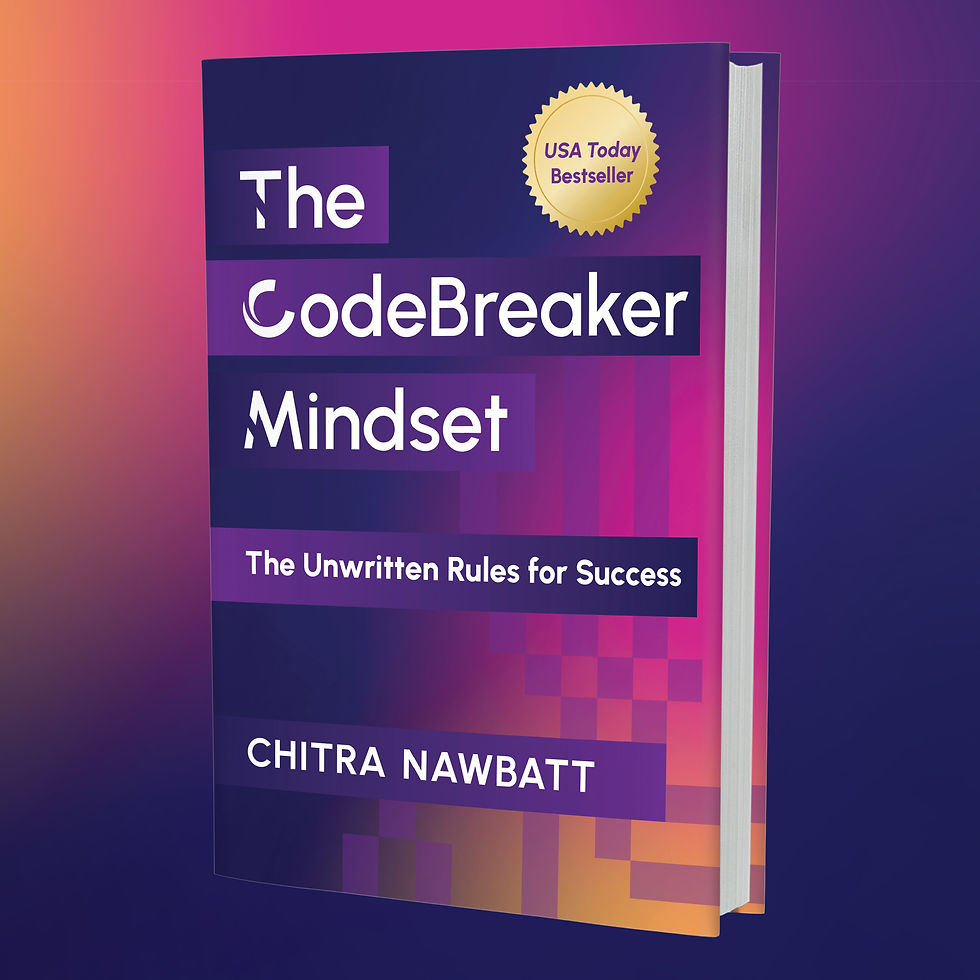
The CodeBreaker Mindset™ book order here: Amazon | Barnes & Noble
The CodeBreaker Mindset™ Ft. Tracy Harris, Bally's, Board Member
Chitra Nawbatt (00:11)
Welcome to The CodeBreaker Mindset™, where leaders share the unwritten rules for success. I'm your host, Chitra Nawbatt. Joining us today is Tracy Harris, Valley's board member. Tracy, welcome. Thank you for joining us.
Tracy Harris (00:24)
Thank you for having me.
Chitra Nawbatt (00:25)
You actually sit on a couple of boards. Bally's, which is the casino, casino, entertainment, public company with roughly $2.5 billion in revenue. And health insurance company Carefirst Blue Cross Blue Shield at approximately 12 billion plus in revenue. You chaired the audit committee for Bally's. You're on the audit committee for Carefirst Blue Cross Blue Shield. How do you go from being a CFO for 20 plus years, including now for a social impact consulting firm? How do you go from that to two boards?
Tracy Harris (01:01)
It wasn't difficult transition because as a CFO you serve the board, right. So you're always in those executive committee. So after 20 years, making that transition to board service was really quite easy for me. And if you will finance being on the audit committees is is a breeze.
Chitra Nawbatt (01:18)
How did you do it?
Tracy Harris (01:20)
You know, getting a board position, I think that's a more challenging role. Takes a lot of networking, takes a lot of kind of getting to find out what's available to you. So getting out there, getting to know people, talking about what you want, expressing that you want to be on a board is really critical if you want to be on a board.
People need to know when they see you that that's what you're looking for. You need to be very specific about the industry that you're interested in and what you bring to the board.
Chitra Nawbatt (01:45)
How did you orient the conversation differently when talking to as you talk about networking? So how did you orient the conversation differently from being an operator, CFO, operator to what what people would be listening out for as they're evaluating you for for boards?
Tracy Harris (02:05)
I think there are two tracks. There's one that's just a straight CFO track where you're saying, hey, if you need an audit committee chair, I've got all of the experience. I'm sec qualified to sit on your chair and be the audit committee chair. But you also want to talk about industry expertise and what you're interested in, because board work should also be enjoyable.
And so it should be an industry that you enjoy and that you like participating in, you know, being in a global gaming casino. Company is just it's a really interesting we're doing lots of interesting things. We're trying to build a hotel in and, New York, we've just demolished a Tropicana in Las Vegas. We've got a huge interactive program, which is a global gaming interactive program that we're working with.
So there's just so much to do, in that area. And I've got a background in economic development. I've got a background in, hotels. I worked at the convention center as a CFO. So I did something that was really interesting to me. From my real estate public policy background. So that was fun. And then in the healthcare space, you know, I'm on the board of Blue Cross Blue Shield care for, you know, in DC, Maryland and Virginia.
So it's more of a regional blue. And, I care about our community, and it's a mission based organization that cares about what it does and how it impacts the community that it serves. And so that was something that was really interesting to me personally.
Chitra Nawbatt (03:28)
Let's get into the rules of the game. And what do you think those what are those written and unwritten rules to being effective as a board member?
The Rules of the Game
Tracy Harris (03:38)
I think the biggest rule that I could say is show up prepared and ready to do the work. I mean, that's how you kind of stake your place in the boardroom. You come prepared, you know what you're doing and you're you're you speak about the things that are important to you, and you ask the questions.
Chitra Nawbatt (03:57)
You're on the audit committee of both of those organizations talk about is it one audit committee the same as the other? Talk about how it's similar, how it's different?
Tracy Harris (04:06)
Well, I think when you're the chair, as I am at Bally's of the audit committee, you're responsible for a lot more work behind the scenes to get ready to get your other members up to speed, and to prepare the agenda for the audit committee. And you need to talk to all of the people that inform the audit committee, which is a little bit different than just being a participant, at Carefirst where you're coming, you're getting the materials, but you're not necessarily dealing with auditors or the internal control people or things like that.
So this is a little different job. But at the same time, I think, you know, when you when you sit on an audit committee, you're coming with a certain set of skills anyway that they want you to have to be prepared to understand the financials, to understand the, you know, the internal control environment, the risk environment of the organization.
So I think both of those types of organizations share that in common.
Chitra Nawbatt (04:52)
You talked about showing up prepared. So let's talk about in the context of Bally's, you're chair of the audit committee. Talk about how you govern and how you steward this organization through the context of, you know, top tailwind and headwind this company's facing. So if you could talk a little bit about that context in terms of top headwind and tailwind and your chair of the audit committee, your role in how you help your organization.
Tracy Harris (05:21)
If you're going to sit on the audit committee, the best thing you can do is make sure that the books and records are perfect. And so that's that's my goal, is to make sure that we're disclosing the things we need to disclose. We are protecting the assets of the organization, and they're all put to very good and productive use, and that our auditors are able to look at our organization and give the market a clean opinion about what we're doing and how we're operating.
Chitra Nawbatt (05:47)
Let's get into the pivots. Talk about a significant business pivot that you've had to either lead or shepherd. As a as a board member.
The Pivots
Tracy Harris (06:00)
As a board member, I think, you know, things change dramatically. Look at where we are right now with the whole cybersecurity situation and how we've had to change the way we share information and the way we allow people to access data within the organization and the risks, appetites that we have to think about as we get into enterprise risk management.
All of those things are pivots because risk is changing all the time. And so one thing that wasn't risky was, hey, an employee coming to work every day. Now that people are remote, you've got a whole set of risk associated with people staying at home. So, you know, risks are dynamic and they are constantly changing. And the best thing you can do as a board member, I think, is to keep up with what's going on within the greater context of business.
Chitra Nawbatt (06:44)
How do you do that? Because you just talked about enterprise risk management. Risk is dynamic. Risk has changed. You've been a CFO plus for 20 plus years. So whatever were the risk metrics or signals 20 years ago, 15 years ago, ten years ago versus what it is today? Talk about those signals, your pattern recognition and how you see it evolving.
Tracy Harris (07:09)
I don't know if you can even say there's a pattern to some of the risks that we're facing right now, especially some of the social and geopolitical risks that are evident. And supply chain risks that are evident throughout most businesses these days. I think you just have to keep abreast of what's going on, and you have to think about things and and different ways, like the for example, if you're in a business and you've got concerns or thoughts about implementing AI within your organization, we don't know what the risks are associated with that new technology yet.
Right? So you really have to keep your ear to the ground and understand the operation and understand the things that might impact different parts of that operation.
Chitra Nawbatt (07:55)
You mentioned I so artificial intelligence talk about what you're seeing, in the boardroom, the organizations you're involved with in terms of top use cases at scale. What those, what those outcomes will be, how that will impact stakeholder experience.
Tracy Harris (08:14)
I think people are just now focusing directly on AI and implementation into their organizations, because it's such a new technology. Not a lot of firms have accurately implemented this technology. You know, people say, I use Microsoft Copilot, okay, that's not the kind of generative AI that I think is going to be, game changing, taking us from, you know, the industrial revolution into the technological revolution.
We're talking about AI to scale where it's going to be smarter than your average employee, your average lawyer, or your average doctor. What do you do in those cases? We don't know yet. And how do you manage it? We don't know yet.
Chitra Nawbatt (08:55)
Any your own point of view in terms of, prediction is not the right word, but you're your own point of view in terms of how you would approach it.
Tracy Harris (09:04)
That carefully, very carefully. And, you know, you need to know what you're doing. You need to know what you're deploying. You need to know who has access it just like any other, you know, technological tool. You need to know how to manage it. And if it can be managed, when it's smarter than you.
The Magic
Chitra Nawbatt (09:20)
What's your advice on how to cultivate The CodeBreaker Mindset™?
Tracy Harris (09:24)
I think it's important for you to set your goals and set your standards high, and to aim for and think about that, keeping the things that you want to achieve. I think the only way that you can make a change in your life and in your professional life in particular, is to to really take advantages of opportunities that come to you, be open to meeting new people.
Have a really, a lifelong learning mindset. Those are the types of things that I think executives today need to cultivate and, and a sense of kindness towards the people that you work with.
Chitra Nawbatt (09:56)
And, you know, you use the word there a lifelong, in your journey. Was there a critical moment where things didn't go as you expected? Whether it's quote unquote failure or something deviated from what whatever you were striving for, how did you learn from that opportunity? How did you recover and get yourself back out there?
Tracy Harris (10:19)
Yes. To all of those failures. Something that we need to learn how to do, quicker, faster and more often. And then we need to get up. Just like your mom used to say, rub your knees off and get going again. Nothing's going to be perfect. You can't play in your life. We think we can, but you can't.
So you have to be able to pivot. You have to be able to make better decisions. You have to learn from your mistakes and keep moving. I think the biggest, issue people have is that they get if they make a mistake or they get embarrassed in a job situation, it stays with them for a long time and no one is going to be able to go through this life without making mistakes.
And you have to accept that. Forgive yourself, learn from it, and move on.
Chitra Nawbatt (11:03)
What's your what's your self-talk process? Or how do you, how do you fortify yourself? How do you build your own muscle in that regard?
Tracy Harris (11:11)
I think you just have to spend time alone, and you just have to think about the things that are important to you, and you have to have priorities in your life. And those are the things that you spend your time on. You know, I think you fortify yourself through whatever method that you believe in.
Chitra Nawbatt (11:30)
Tracy, thank you so much for joining us.
Tracy Harris (11:33)
Thank you for having me. I'm glad to see you again.
Chitra Nawbatt (11:36)
Thank you for supporting The CodeBreaker Mindset™. For more episodes, go to www.ChitraNawbatt.com to like and subscribe. Connect with me on social media, @ChitraNawbatt.
The CodeBreaker Mindset™ Ft. Tracy Harris, Bally's, Board Member
Chitra Nawbatt (00:11)
Welcome to The CodeBreaker Mindset™, where leaders share the unwritten rules for success. I'm your host, Chitra Nawbatt. Joining us today is Tracy Harris, Valley's board member. Tracy, welcome. Thank you for joining us.
Tracy Harris (00:24)
Thank you for having me.
Chitra Nawbatt (00:25)
You actually sit on a couple of boards. Bally's, which is the casino, casino, entertainment, public company with roughly $2.5 billion in revenue. And health insurance company Carefirst Blue Cross Blue Shield at approximately 12 billion plus in revenue. You chaired the audit committee for Bally's. You're on the audit committee for Carefirst Blue Cross Blue Shield. How do you go from being a CFO for 20 plus years, including now for a social impact consulting firm? How do you go from that to two boards?
Tracy Harris (01:01)
It wasn't difficult transition because as a CFO you serve the board, right. So you're always in those executive committee. So after 20 years, making that transition to board service was really quite easy for me. And if you will finance being on the audit committees is is a breeze.
Chitra Nawbatt (01:18)
How did you do it?
Tracy Harris (01:20)
You know, getting a board position, I think that's a more challenging role. Takes a lot of networking, takes a lot of kind of getting to find out what's available to you. So getting out there, getting to know people, talking about what you want, expressing that you want to be on a board is really critical if you want to be on a board.
People need to know when they see you that that's what you're looking for. You need to be very specific about the industry that you're interested in and what you bring to the board.
Chitra Nawbatt (01:45)
How did you orient the conversation differently when talking to as you talk about networking? So how did you orient the conversation differently from being an operator, CFO, operator to what what people would be listening out for as they're evaluating you for for boards?
Tracy Harris (02:05)
I think there are two tracks. There's one that's just a straight CFO track where you're saying, hey, if you need an audit committee chair, I've got all of the experience. I'm sec qualified to sit on your chair and be the audit committee chair. But you also want to talk about industry expertise and what you're interested in, because board work should also be enjoyable.
And so it should be an industry that you enjoy and that you like participating in, you know, being in a global gaming casino. Company is just it's a really interesting we're doing lots of interesting things. We're trying to build a hotel in and, New York, we've just demolished a Tropicana in Las Vegas. We've got a huge interactive program, which is a global gaming interactive program that we're working with.
So there's just so much to do, in that area. And I've got a background in economic development. I've got a background in, hotels. I worked at the convention center as a CFO. So I did something that was really interesting to me. From my real estate public policy background. So that was fun. And then in the healthcare space, you know, I'm on the board of Blue Cross Blue Shield care for, you know, in DC, Maryland and Virginia.
So it's more of a regional blue. And, I care about our community, and it's a mission based organization that cares about what it does and how it impacts the community that it serves. And so that was something that was really interesting to me personally.
Chitra Nawbatt (03:28)
Let's get into the rules of the game. And what do you think those what are those written and unwritten rules to being effective as a board member?
The Rules of the Game
Tracy Harris (03:38)
I think the biggest rule that I could say is show up prepared and ready to do the work. I mean, that's how you kind of stake your place in the boardroom. You come prepared, you know what you're doing and you're you're you speak about the things that are important to you, and you ask the questions.
Chitra Nawbatt (03:57)
You're on the audit committee of both of those organizations talk about is it one audit committee the same as the other? Talk about how it's similar, how it's different?
Tracy Harris (04:06)
Well, I think when you're the chair, as I am at Bally's of the audit committee, you're responsible for a lot more work behind the scenes to get ready to get your other members up to speed, and to prepare the agenda for the audit committee. And you need to talk to all of the people that inform the audit committee, which is a little bit different than just being a participant, at Carefirst where you're coming, you're getting the materials, but you're not necessarily dealing with auditors or the internal control people or things like that.
So this is a little different job. But at the same time, I think, you know, when you when you sit on an audit committee, you're coming with a certain set of skills anyway that they want you to have to be prepared to understand the financials, to understand the, you know, the internal control environment, the risk environment of the organization.
So I think both of those types of organizations share that in common.
Chitra Nawbatt (04:52)
You talked about showing up prepared. So let's talk about in the context of Bally's, you're chair of the audit committee. Talk about how you govern and how you steward this organization through the context of, you know, top tailwind and headwind this company's facing. So if you could talk a little bit about that context in terms of top headwind and tailwind and your chair of the audit committee, your role in how you help your organization.
Tracy Harris (05:21)
If you're going to sit on the audit committee, the best thing you can do is make sure that the books and records are perfect. And so that's that's my goal, is to make sure that we're disclosing the things we need to disclose. We are protecting the assets of the organization, and they're all put to very good and productive use, and that our auditors are able to look at our organization and give the market a clean opinion about what we're doing and how we're operating.
Chitra Nawbatt (05:47)
Let's get into the pivots. Talk about a significant business pivot that you've had to either lead or shepherd. As a as a board member.
The Pivots
Tracy Harris (06:00)
As a board member, I think, you know, things change dramatically. Look at where we are right now with the whole cybersecurity situation and how we've had to change the way we share information and the way we allow people to access data within the organization and the risks, appetites that we have to think about as we get into enterprise risk management.
All of those things are pivots because risk is changing all the time. And so one thing that wasn't risky was, hey, an employee coming to work every day. Now that people are remote, you've got a whole set of risk associated with people staying at home. So, you know, risks are dynamic and they are constantly changing. And the best thing you can do as a board member, I think, is to keep up with what's going on within the greater context of business.
Chitra Nawbatt (06:44)
How do you do that? Because you just talked about enterprise risk management. Risk is dynamic. Risk has changed. You've been a CFO plus for 20 plus years. So whatever were the risk metrics or signals 20 years ago, 15 years ago, ten years ago versus what it is today? Talk about those signals, your pattern recognition and how you see it evolving.
Tracy Harris (07:09)
I don't know if you can even say there's a pattern to some of the risks that we're facing right now, especially some of the social and geopolitical risks that are evident. And supply chain risks that are evident throughout most businesses these days. I think you just have to keep abreast of what's going on, and you have to think about things and and different ways, like the for example, if you're in a business and you've got concerns or thoughts about implementing AI within your organization, we don't know what the risks are associated with that new technology yet.
Right? So you really have to keep your ear to the ground and understand the operation and understand the things that might impact different parts of that operation.
Chitra Nawbatt (07:55)
You mentioned I so artificial intelligence talk about what you're seeing, in the boardroom, the organizations you're involved with in terms of top use cases at scale. What those, what those outcomes will be, how that will impact stakeholder experience.
Tracy Harris (08:14)
I think people are just now focusing directly on AI and implementation into their organizations, because it's such a new technology. Not a lot of firms have accurately implemented this technology. You know, people say, I use Microsoft Copilot, okay, that's not the kind of generative AI that I think is going to be, game changing, taking us from, you know, the industrial revolution into the technological revolution.
We're talking about AI to scale where it's going to be smarter than your average employee, your average lawyer, or your average doctor. What do you do in those cases? We don't know yet. And how do you manage it? We don't know yet.
Chitra Nawbatt (08:55)
Any your own point of view in terms of, prediction is not the right word, but you're your own point of view in terms of how you would approach it.
Tracy Harris (09:04)
That carefully, very carefully. And, you know, you need to know what you're doing. You need to know what you're deploying. You need to know who has access it just like any other, you know, technological tool. You need to know how to manage it. And if it can be managed, when it's smarter than you.
The Magic
Chitra Nawbatt (09:20)
What's your advice on how to cultivate The CodeBreaker Mindset™?
Tracy Harris (09:24)
I think it's important for you to set your goals and set your standards high, and to aim for and think about that, keeping the things that you want to achieve. I think the only way that you can make a change in your life and in your professional life in particular, is to to really take advantages of opportunities that come to you, be open to meeting new people.
Have a really, a lifelong learning mindset. Those are the types of things that I think executives today need to cultivate and, and a sense of kindness towards the people that you work with.
Chitra Nawbatt (09:56)
And, you know, you use the word there a lifelong, in your journey. Was there a critical moment where things didn't go as you expected? Whether it's quote unquote failure or something deviated from what whatever you were striving for, how did you learn from that opportunity? How did you recover and get yourself back out there?
Tracy Harris (10:19)
Yes. To all of those failures. Something that we need to learn how to do, quicker, faster and more often. And then we need to get up. Just like your mom used to say, rub your knees off and get going again. Nothing's going to be perfect. You can't play in your life. We think we can, but you can't.
So you have to be able to pivot. You have to be able to make better decisions. You have to learn from your mistakes and keep moving. I think the biggest, issue people have is that they get if they make a mistake or they get embarrassed in a job situation, it stays with them for a long time and no one is going to be able to go through this life without making mistakes.
And you have to accept that. Forgive yourself, learn from it, and move on.
Chitra Nawbatt (11:03)
What's your what's your self-talk process? Or how do you, how do you fortify yourself? How do you build your own muscle in that regard?
Tracy Harris (11:11)
I think you just have to spend time alone, and you just have to think about the things that are important to you, and you have to have priorities in your life. And those are the things that you spend your time on. You know, I think you fortify yourself through whatever method that you believe in.
Chitra Nawbatt (11:30)
Tracy, thank you so much for joining us.
Tracy Harris (11:33)
Thank you for having me. I'm glad to see you again.
Chitra Nawbatt (11:36)
Thank you for supporting The CodeBreaker Mindset™. For more episodes, go to www.ChitraNawbatt.com to like and subscribe. Connect with me on social media, @ChitraNawbatt.
Disclaimer: the show notes and transcript are powered by artificial intelligence (AI).
Featured Episodes and Insights