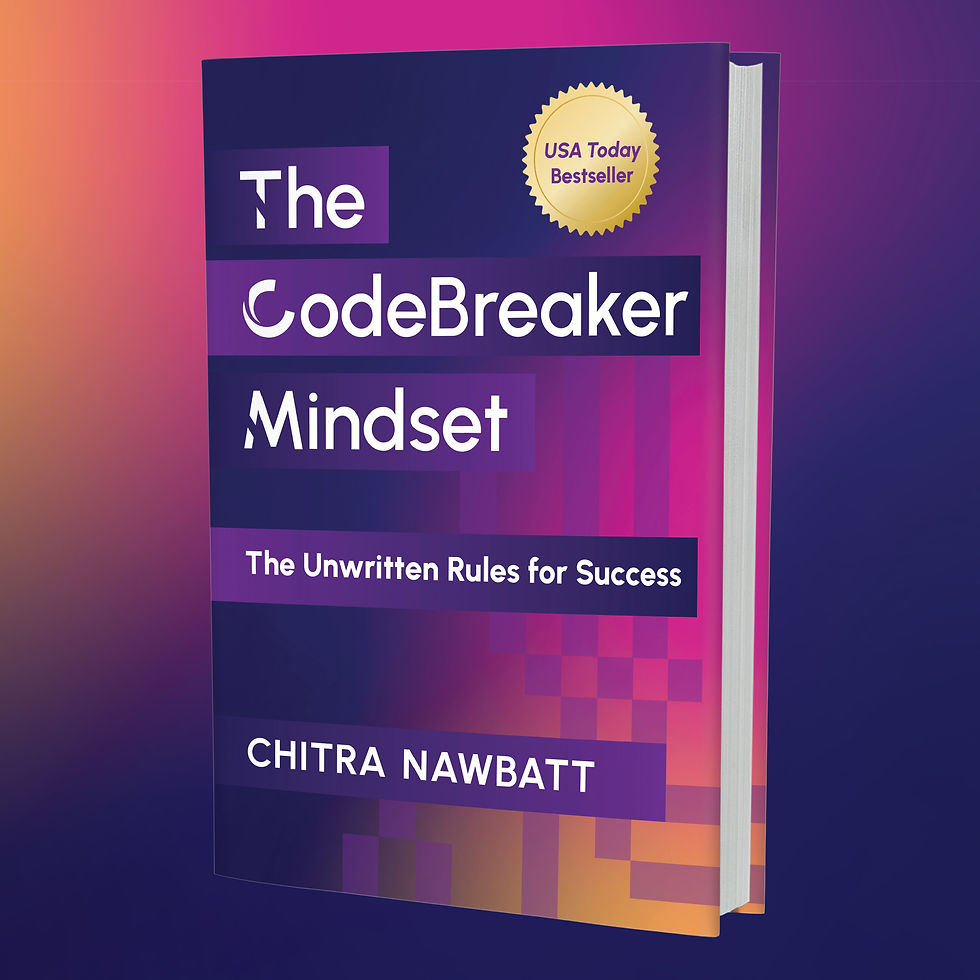
The CodeBreaker Mindset™ Ft. BD Wong, Tony Award winning and Emmy-nominated Actor


BD Wong shares his journey from a childhood filled with performance to becoming a Tony Award-winning actor. He discusses the evolution of his passion for acting, the challenges of breaking into Hollywood, and the importance of mastering the art of auditioning. Wong emphasizes the significance of resilience, mentorship, and building relationships in the industry, while also addressing the unwritten rules of success in acting. BD Wong discusses the multifaceted nature of being an actor, emphasizing the importance of emotional and physical health, navigating the complexities of the industry, and the impact of technology and AI. He shares personal experiences of career pivots, the significance of resilience in the face of rejection, and the role of serendipity in his journey. BD Wong also addresses the challenges of representation for people of color in Hollywood and the evolving landscape of the industry.
Chapters
(00:11) Introduction
(00:54) What does it take to have a sustained career in Hollywood & Broadway
(01:43) Navigating the Unwritten Rules of Acting
(03:02) Building Resilience in the Face of Rejection
(04:46) Career Pivots and Rediscovering Identity
(06:51) Overcoming Industry Challenges and Competition
(10:27) The Impact of Technology and AI on Acting
(12:39) The Role of Serendipity in Career Paths
(15:09) Embracing The CodeBreaker Mindset™
(23:44) Navigating Race and Identity in the Industry
Episode Resources
BD Wong | Bio
Chitra Nawbatt | Bio
The CodeBreaker Mindset™ book order here: Amazon | Barnes & Noble
The CodeBreaker Mindset™ Ft. BD Wong, Tony Award winning and Emmy-nominated Actor
Chitra Nawbatt (00:11)
Welcome to The CodeBreaker Mindset™, where leaders and influencers share the rules, pivots, and serendipity to achieving goals and dreams. I'm your host, Chitra Nawbatt. Joining us today is BD Wong, Tony Award-winning and Emmy-nominated actor. BD, welcome. Thank you for joining us.
BD Wong (00:29)
Thank you, Chitra. Hello. Hi, everybody.
Chitra Nawbatt (00:32)
You've been a Hollywood actor for 40 plus years, acting in more than 30 films, more than 35 TV shows and a handful of plays. You won the Tony Award for M. Butterfly and you were nominated for an Emmy for Mr. Robot. Law and Order Special Victims Unit, the Jurassic Park film series are some of your popular work.(00:49)
The Rules of the Game
Chitra Nawbatt (00:54)
BD, if you can break down for us those key written rules and unwritten rules in terms of what it takes to be great and have a sustained career in Hollywood and Broadway.
BD Wong (01:05)
Well, I think the written rules are likeability, popularity, follows and followers, and playing the game and participating. Actors have to participate, otherwise they get invisible, and doing good work. And I'd say the unwritten rules are, ooh, wow, the unwritten rules. They must be, huh.
What's unwritten? What would unwritten be? This is hard. What's hidden?
Chitra Nawbatt (01:40)
Things that nobody touch.
BD Wong (01:43)
The things that nobody tells you. Well, it's hard. It's like really the rejection and the kind of the stuff that you have to go through and the stuff that you have to be prepared for are really intense. It's a very intense existence to be constantly putting yourself up for approval or to be selected or to be liked or to be judged. Especially now in the social media context. You can't put your photograph on your feed without inviting all of the opinions that come with it. That's a new thing kind of. Well, that's thing of our times. So that comes with it.
And so I think you have to be really strong. I think you have to have a constitution like iron. And I think you have to take care of yourself mentally, physically, emotionally, because all of it is just you. There's nothing you can hide behind except you. You are the thing that is the craft that you're doing, and you are the spokesperson for yourself. You are all of it. It's like a musician. You can't take the violin and put it away in a case. You are it.
Chitra Nawbatt (03:02)
So how do you deal with the NOs? How do you deal with the rejection? And how do you build up the fortitude to deal with all the things you've just described?
BD Wong (03:14)
I love doing it. I really love doing it. I love being a storyteller. I love the opportunity to use your platform to create discussions and conversations about life that's separate from the art. And I love participating in public discussions like that. So that drives me in a certain way. I also love the form, the art form, the creativity, the thing is a foundation for me to get me through it. I'm... I think you just can never, ever, ever, ever, ever take stuff personally. And you want to, all the time. You want to blame or you want to attribute some kind of rejection to some flaw in yourself. When I'd say 12 times out of 10, it is not that. The selection process, the casting process, it's all much more complex than that. And the reasons why you don't get picked, have very little to nothing to do with you and your value and your worth as a human being and your talent. It really isn't. So once you figure that out, kind of lets you let yourself off the hook and you can get through more. be more resilient that way. And you have to have a really great support system. You have to have great partners who understand what you do and appreciate and support what you do. And you have to have a really good, system of friendship and friends and family.
The Pivots
Chitra Nawbatt (04:46)
Let's get into the pivots. What are some of those profound career and life pivots that you've had to make?
BD Wong (04:56)
The first one was that I became a dad in 2000, and then I was miraculously offered a contract on law and Order SVU really soon after that happened. And that caused me to take a job that I stayed with for 11 years. When I was more of a creative person, you know, I was a character actor, I played all kinds of different wacky roles and things up until that time.
And when I left the show, I had to get that back. I had to get my identity as a creative actor who immersed himself in characters back. It took like two years for people to remember that I did all those other roles before Law & Order. And then I felt like I was myself again when I got Gotham and I could transform myself and I got Mr. Robot. Those two jobs. really played a huge role in me feeling like I was myself again. And that was one big pivot.
The other pivot is that my way back from when I was a high school student, my teacher reminded me and was very strong with me about the fact that I did many things. And she made me design the posters for the plays and the sets and the costumes and did the choreography and then I've become a writer and she actually had me direct a lot of the productions and stuff. And she kind of instilled in me this idea that I did different things. And so really recently I have returned to, because it took so much energy to become an actor and to stay being an actor, that I let these other things like directing and writing fall by the wayside. And I have reconnected with them in the last, I guess, 10 or so years. And that has made, also made me feel like I am myself more. So those are two major pivots.
Chitra Nawbatt (06:51)
And you know, as part of that, many perceive the industry, Hollywood, Broadway, very competitive, could be cutthroat, nepotism, it's about who you know. And as you said earlier, sometimes you don't get the part, it has nothing to do with your ability and skill. Has there been scenarios where you felt someone in the industry hijacked you, sabotaged you? Was there such a situation? And if there was, did you deal with it? How do you recover from that?
BD Wong (07:23)
I don't feel like I have anecdotal evidence of that. I feel like there have been a lot of rocky road kind of situations. So it's not like all like, know, sunshine and roses at all. But as far as any particular person actively, know, sabotaging, think there are people you're in competition with and they're people that you kind of observe and you and you know, I'm in therapy and the one thing you mustn't ever do is compare yourself to other people What they have what they don't have what you have what they don't you you mustn't do that And so I make it a real point to not compare myself with other people to compare myself with myself And the goals that I have and that's really helpful, but I don't have I don't think I have a juicy story about that
Chitra Nawbatt (08:17)
Well, when you talk about those rocky roads, what's an example of one of those big rocky road scenarios? How you dealt with it, how you recovered, how you pivoted, how you built yourself back up.
BD Wong (08:28)
Hmm. I don't know. I mean, I don't know if there's any particular, let's see, what story, you know, when I left Law and like I said, mentioned just a little bit back, when I left Law and Order, I was a little bit at sea. You know, I made the choice to leave a show that's still on now. It's 26 years old, that show. And I left like 11 seasons into it. So I could have stayed, I could still, I could be much wealthier than I am now, to be quite honest, if I had stayed on it. I didn't want to, and I didn't, and I felt a strong need to kind of get back to the work that I wanted to do and myself, a sense of myself. And when I left the show and I made that commitment to myself to do that, my son was older and I felt like I was safe to do that, I had to endure, know, kind of ride through a long period of time where I didn't work or where I got work that didn't satisfy me or wasn't interesting or didn't feel like it was the right kind of work for me. And I think I kind of had to trust that eventually things would kind of turn around and steer themselves back to the right way. And they did.
And here we are today, this moment that I'm talking to you, we are in a real interesting place in the industry, which is where they've slashed a lot of production. They're not doing as much work as they used to. And I can feel it. I can feel the slowness of it. And I just have to trust that we all have to trust that it kind of finds its way back. This is the cadence of what it means to be an actor. Sometimes you have these great financial and successful moments and then other times you have to be really careful about how you're spending your money and stuff like that yeah, I don't know.
Chitra Nawbatt (10:27)
Yeah. And on that point, when you talk about the cadence and you feeling sort less production right now, a lot of impact with technology and artificial intelligence. Going into the future, how does the environment, how does the way that you play the game and that you operate, how does that change with all this technology, all this artificial intelligence that's impacting the industry?
BD Wong (10:52)
I think that it's really right of us to be really concerned and wary of all of the artificial intelligence and what that can mean for actors and for performers and what it means for the industry and for writers and all of that stuff. And yet I think that human beings are looking after it in a way that I don't see the kind of dystopic ending to the story that is, I think it can be our friend to have AI in the mix. And this last big sag strike that we had put on the table, the conversation about how you just can't do anything with someone's image that you want. And that, you know, if you sign a contract, and that actors should not have to sign a contract, it signs away their right to their own likeness so that AI can be used to make an entire performance that they never gave and then not pay them for it. So we are having the conversation that supposedly is gonna protect actors and writers from these things as a kind of cautionary tale. And I'm hopeful that human beings prevail and that people get it. And I do sense that that conversation was heard. And your question was, does that answer your question? I feel pretty confident about that. How do we circumvent it? We have to kind of stick our ground, hold our ground about what our work means and what our work is. I also don't see it being done very well in a way that we can be replaced. think that it's just, if that might happen later on, right now, I don't see you taking someone's likeness and giving them a whole performance that anyone really buys.
The Magic
Chitra Nawbatt (12:39)
In Hollywood and Broadway, there's a lot of magic. So let's get into the magic. How do you define serendipity? And where did serendipity play a critical role in your journey?
BD Wong (12:45)
Sure.
BD Wong (12:54)
I have to say that I've, serendipity, never use the word, but serendipity is constant in my life. And I feel like I'm noticing it all the time. it has to do with the people that you encounter and when you re-encounter them and what they're doing later and how you're doing something later and wow. And then you reconnect and I thought, let me see if I can try to be, if I can try to be specific about it you know i just i don't know if i can be specific about it.
Chitra Nawbatt (13:32)
That’s Okay.
BD Wong (13:33)
Chitra it's like it's it's a thing that it's ongoing i do feel it like like it's ongoing and i feel like i for me the serendipity is not maybe maybe it's not really even actual serendipity. But it is the the the the humanity of our lives as people, we interwoven with one another, we grow apart and we come back together. And in the theater and in show business, as a nomadic kind of life that we have, we go from one job to another job, we have these really intense relationships and family feeling kind of working environments, and then it's over and we move on to something else.
And the way that we kind of, it ebbs and flows and people come back into your life that you might have even forgotten about or haven't seen in decades and decades, that's beautiful and incredible. it always, it never stops surprising you. It's wonderful. And to me, maybe it's not serendipity, but it is this kind of trust that nothing is lost when you say goodbye to someone and that every relationship means something. And even though something is very quick and then ends, you know, a job ends or a show ends, the things that happen there are real and make you who you are and build, allow you to build on your life and your relationships in a way that's really meaningful and really wonderful.
Chitra Nawbatt (15:09)
What's your take on The CodeBreaker Mindset™?
BD Wong (15:14)
You mean the show?
Chitra Nawbatt (15:16)
And the concept of being The CodeBreaker Mindset™ about written and unwritten rules, pivots, serendipity. What's your take on The CodeBreaker Mindset™?
BD Wong (15:28)
Well, I think you're an ass to resist it or to discount it or to not allow it to inform your life and your choices and, you know, it's everywhere. I guess that's what I mean by serendipity and I didn't really think about this before. I wish I had thought about it more in preparation for this, what it really means to me. I am a person who believes in consequence, I believe in hard work leading to something, but often not leading to the thing you think it leads to, but it leading to something. And I have grown trust over the years in understanding that that is so. In other words, this, I did this, but it didn't lead to that, that thing that I wanted it to be too. And that was my younger self. And the older self is like, it's okay, right? Everything, everything is for a real good reason and allows. And so what is The CodeBreaker part? Break this down for me. What is The CodeBreaker part of it?
Chitra Nawbatt (16:43)
Yeah. So The CodeBreaker Mindset™ is this notion of most things are not as they appear to be. There's always going to be written and unwritten rules to pursuing any goal. There's always going to be pivots, whether it's voluntary or involuntary.
BD Wong (16:53)
Yeah. Yeah.
I see.
Chitra Nawbatt (16:57)
And there's always going to be serendipity. And for you, perhaps it was Tom Fontana watching your work and then writing that opportunity for you or the fact that your high school teacher or that acting coach in LA that helped you so much.
BD Wong (17:12)
Yeah. Yeah. Yeah.
Chitra Nawbatt (17:14)
So, and serendipity could also be a headwind. It could be something not working out. So you're not in that location. You have to then go someplace else. So The CodeBreaker Mindset™ is around written and unwritten rules, pivots, serendipity. but it's really your definition. know, how do you think about these things? What's your take on The CodeBreaker Mindset™? And how would, does one cultivate The CodeBreaker Mindset™?
BD Wong (17:30)
Yeah. Yeah.
Yeah.
BD Wong (17:40)
Great. I feel like without even knowing it, I live by The CodeBreaker Mindset™. I see things not at face value for what they are necessarily. I see often a relationship or an introduction, the way I met you, as a kind of an introduction to something that I don't know quite what it is, but it feels positive and it feels like it shouldn't be shut down. I think you know from my energy meeting you that I shut very few things down. I'm like, wait, what is this? What is the possibility of this?
Chitra Nawbatt (18:20)
Yeah, thank you.
BD Wong (18:21)
You know, hello, it's an introduction. you know, someone like me meets people all the time and I've learned and grown to love being open to anything and then going, well, what is the thing?
That is in there that is useful to me or enlightening to me or something that I can learn from or something that I can, that is positive. And what I have found, and I really strongly believe this, is that these things are everywhere. They're just in everything. You can't go through the day without encountering something that can open a door for you. Or that, and I don't mean open a door of opportunity necessarily. I mean open a door to knowledge or insight or a relationship that you didn't expect. It happens all the time. And so yes, I think part of your being here in the first place is to encourage people to be open to that and to look forward at every opportunity and to embrace it and to get used to it.
And I'm super used to it. I might be a really good candidate for this discussion because I try to live by it. I try to see things, you know, and I'm being invited and asked for any number of reasons to do any number of things. And a lot of the times, or most of the time, I will leave something after and I well, gosh, I didn't really want to do that, but that turned out really good. I met some really great people. I knew I would and I just had to kind be open to it. You know, my husband and I have this really funny and mean response to people sending us wedding invitations because we think we hate going to weddings. Because they're a pain in the ass and you're getting dressed up and where are we going again and what is this and where are we buying them a present and then you go to the wedding and the wedding is rarely not beautiful on some level of emotion or your relationship to the people or their relationship to each other or the new people you meet there. And so that's a perfect example to me of how I'm resistant in some ways to something that actually turns out to be really great. Really, really, really great.
Chitra Nawbatt (20:51)
And just a couple more things, because one thing you said important earlier, and you talked a little bit about this, in Hollywood and Broadway, being a person of color, being Asian-American, the pros of that experience, the barriers and the cons of that. And how did you overcome that?
BD Wong (21:12)
Well, you know, of course, this is a whole hour in itself, right? Talking about race and talking about the way that I interface with my own race and all of that. But what I will say really briefly is it was a thing that was a challenge for me when I was a young boy. I didn't want to be Asian. I didn't want to be queer. I pushed these things aside. And then magically over time, I realized these are the salient, wonderful, incredible, powerful things about me that give me a platform and a voice that give me an understanding about humanity that some other people don't have that I can use in my work and I can use in my craft and in my storytelling and in my day-to-day interactions with other people, it's a point of view. I, so I went 360 from being really down on it to being like, I get it now, I get the thing.
So In the industry, there is lot of stuff to weed through and hack through and to better challenging and challenges. And we see over time a budging of the visibility and representation that we covet and that we were kind of cheerleading on the sidelines for the industry and our industries to continue with the energy of that. We find it becoming a political issue with the shutting down of DEI conversations in colleges and universities across the country because of the administration, the presidential administration within a presidential year. And so what will happen? You and I are talking about this right now on the brink of the actual election and what will happen? This race is just a thing that, boy, it's just a huge part of any discussion about the industry. You just can't.
You know, misogyny, race, homophobia, these are all built into the content that is most powerfully created for people to consume and yet a lot of people are scared of it, they don't want to deal with it and there's an age-old kind of resistance to keep, you know, keeping things vanilla. Now, not a resistance to all of that which makes them keep things vanilla. And we're pushing against that. We're not interested anymore, either as audience members or as members of a community in keeping things vanilla.
Chitra Nawbatt (23:44)
And last question, whether it's in front of the camera, behind the camera, on the stage, behind the scenes, what do think it's going to take to really break through to the next horizon of people of color, Asian Americans, being out there at scale, in front of the camera, on the stage, behind the scenes, just as much as anyone else?
BD Wong (23:46)
Uh-huh.
BD Wong (24:12)
I think that the key to our representation and exposure and power in this industry and in the medium of as entertainers is starting to happen. And what I would have said five years ago is, well, we need leading Asian American actors. Let's talk about Asian American for a second, specifically to star in a Hollywood movie and win Oscars. And then we want the movie to win an Oscar, and recently we were given the gift of that. What the ramifications of that are is not known to us and whether we can use that momentum artistically and financially commercially to take advantage of it and take us to the next level is to be seen.
And it is the opportunity that lays before us right now. That is the moment we're in. That's why I'm a little frustrated that content is down, like production is down now because this is the time for Asian American writers and people, even more than it was five years ago when Nor from Queens, the show that I was on with Awkwafina was written and developed and created. That was a very fresh example of Asian American content.
And so that was then, and now here we are on the threshold of, think, a new wave of people expressing themselves being hired behind the scenes or on camera, and people appreciating the stories of people universally rather than only the stories of the people that look like them. You know, I think there's a lot to be said for people that cross over and stories that cross over. And there was a time when people thought, well, Black people go to Black movies.
And we don't have any Asian movies, so Asian people have to just deal with whatever there is and then white people go to white movies. But we don't really think that way anymore and I think that we, Asian artists, need to take advantage of that.
Chitra Nawbatt (26:15)
So you're not saying that it's a no, it's not a magic bullet where whether it's Netflix or the studio executives or the Broadway financiers, they've got to just say, yes, that they're, you know, that either they're holding up progress or, you know, if you know, if you had a magic wand to get folks, Asian Americans at scale into these places, out on the stage in front of the screen, is there, is there a magic wand moment or thing or?
BD Wong (26:43)
I think the magic wand moment was everything, everywhere, all at once. It felt like an amazing confluence of incredible artists coming together and the audience being there for them. And I'm not saying that that ended or began anything, but that was as magic wand-y as it gets for me. And it was serendipitous. In other words, nobody did it to do it. You can't predict that it's going to be lauded, you can't predict that it's going to be given awards, you can't predict all of those things. They came together, they did the work, they got the community, you it's all thumbs up for that. I don't know what else to expect or to demand of the people in power, but there are more of us in power now than there were before, and so that's another thing to aspire to. I don't know if there's a magic wand hypothetical, actually.
Chitra Nawbatt (27:46)
BD, this was amazing. This was awesome. Thank you so much for your time. Thank you for being with us.
BD Wong (27:51)
gosh, thanks. Of course, thank you.
Chitra Nawbatt (27:56)
Thank you so much for joining us.
BD Wong (28:00)
Thanks. Thanks for having me.
Chitra Nawbatt (00:28:02)
Thank you for supporting The CodeBreaker Mindset™. For more episodes, go to
www.ChitraNawbatt.com to like and subscribe. Connect with me on social media
@ChitraNawbatt.
The CodeBreaker Mindset™ Ft. BD Wong, Tony Award winning and Emmy-nominated Actor
Chitra Nawbatt (00:11)
Welcome to The CodeBreaker Mindset™, where leaders and influencers share the rules, pivots, and serendipity to achieving goals and dreams. I'm your host, Chitra Nawbatt. Joining us today is BD Wong, Tony Award-winning and Emmy-nominated actor. BD, welcome. Thank you for joining us.
BD Wong (00:29)
Thank you, Chitra. Hello. Hi, everybody.
Chitra Nawbatt (00:32)
You've been a Hollywood actor for 40 plus years, acting in more than 30 films, more than 35 TV shows and a handful of plays. You won the Tony Award for M. Butterfly and you were nominated for an Emmy for Mr. Robot. Law and Order Special Victims Unit, the Jurassic Park film series are some of your popular work.(00:49)
The Rules of the Game
Chitra Nawbatt (00:54)
BD, if you can break down for us those key written rules and unwritten rules in terms of what it takes to be great and have a sustained career in Hollywood and Broadway.
BD Wong (01:05)
Well, I think the written rules are likeability, popularity, follows and followers, and playing the game and participating. Actors have to participate, otherwise they get invisible, and doing good work. And I'd say the unwritten rules are, ooh, wow, the unwritten rules. They must be, huh.
What's unwritten? What would unwritten be? This is hard. What's hidden?
Chitra Nawbatt (01:40)
Things that nobody touch.
BD Wong (01:43)
The things that nobody tells you. Well, it's hard. It's like really the rejection and the kind of the stuff that you have to go through and the stuff that you have to be prepared for are really intense. It's a very intense existence to be constantly putting yourself up for approval or to be selected or to be liked or to be judged. Especially now in the social media context. You can't put your photograph on your feed without inviting all of the opinions that come with it. That's a new thing kind of. Well, that's thing of our times. So that comes with it.
And so I think you have to be really strong. I think you have to have a constitution like iron. And I think you have to take care of yourself mentally, physically, emotionally, because all of it is just you. There's nothing you can hide behind except you. You are the thing that is the craft that you're doing, and you are the spokesperson for yourself. You are all of it. It's like a musician. You can't take the violin and put it away in a case. You are it.
Chitra Nawbatt (03:02)
So how do you deal with the NOs? How do you deal with the rejection? And how do you build up the fortitude to deal with all the things you've just described?
BD Wong (03:14)
I love doing it. I really love doing it. I love being a storyteller. I love the opportunity to use your platform to create discussions and conversations about life that's separate from the art. And I love participating in public discussions like that. So that drives me in a certain way. I also love the form, the art form, the creativity, the thing is a foundation for me to get me through it. I'm... I think you just can never, ever, ever, ever, ever take stuff personally. And you want to, all the time. You want to blame or you want to attribute some kind of rejection to some flaw in yourself. When I'd say 12 times out of 10, it is not that. The selection process, the casting process, it's all much more complex than that. And the reasons why you don't get picked, have very little to nothing to do with you and your value and your worth as a human being and your talent. It really isn't. So once you figure that out, kind of lets you let yourself off the hook and you can get through more. be more resilient that way. And you have to have a really great support system. You have to have great partners who understand what you do and appreciate and support what you do. And you have to have a really good, system of friendship and friends and family.
The Pivots
Chitra Nawbatt (04:46)
Let's get into the pivots. What are some of those profound career and life pivots that you've had to make?
BD Wong (04:56)
The first one was that I became a dad in 2000, and then I was miraculously offered a contract on law and Order SVU really soon after that happened. And that caused me to take a job that I stayed with for 11 years. When I was more of a creative person, you know, I was a character actor, I played all kinds of different wacky roles and things up until that time.
And when I left the show, I had to get that back. I had to get my identity as a creative actor who immersed himself in characters back. It took like two years for people to remember that I did all those other roles before Law & Order. And then I felt like I was myself again when I got Gotham and I could transform myself and I got Mr. Robot. Those two jobs. really played a huge role in me feeling like I was myself again. And that was one big pivot.
The other pivot is that my way back from when I was a high school student, my teacher reminded me and was very strong with me about the fact that I did many things. And she made me design the posters for the plays and the sets and the costumes and did the choreography and then I've become a writer and she actually had me direct a lot of the productions and stuff. And she kind of instilled in me this idea that I did different things. And so really recently I have returned to, because it took so much energy to become an actor and to stay being an actor, that I let these other things like directing and writing fall by the wayside. And I have reconnected with them in the last, I guess, 10 or so years. And that has made, also made me feel like I am myself more. So those are two major pivots.
Chitra Nawbatt (06:51)
And you know, as part of that, many perceive the industry, Hollywood, Broadway, very competitive, could be cutthroat, nepotism, it's about who you know. And as you said earlier, sometimes you don't get the part, it has nothing to do with your ability and skill. Has there been scenarios where you felt someone in the industry hijacked you, sabotaged you? Was there such a situation? And if there was, did you deal with it? How do you recover from that?
BD Wong (07:23)
I don't feel like I have anecdotal evidence of that. I feel like there have been a lot of rocky road kind of situations. So it's not like all like, know, sunshine and roses at all. But as far as any particular person actively, know, sabotaging, think there are people you're in competition with and they're people that you kind of observe and you and you know, I'm in therapy and the one thing you mustn't ever do is compare yourself to other people What they have what they don't have what you have what they don't you you mustn't do that And so I make it a real point to not compare myself with other people to compare myself with myself And the goals that I have and that's really helpful, but I don't have I don't think I have a juicy story about that
Chitra Nawbatt (08:17)
Well, when you talk about those rocky roads, what's an example of one of those big rocky road scenarios? How you dealt with it, how you recovered, how you pivoted, how you built yourself back up.
BD Wong (08:28)
Hmm. I don't know. I mean, I don't know if there's any particular, let's see, what story, you know, when I left Law and like I said, mentioned just a little bit back, when I left Law and Order, I was a little bit at sea. You know, I made the choice to leave a show that's still on now. It's 26 years old, that show. And I left like 11 seasons into it. So I could have stayed, I could still, I could be much wealthier than I am now, to be quite honest, if I had stayed on it. I didn't want to, and I didn't, and I felt a strong need to kind of get back to the work that I wanted to do and myself, a sense of myself. And when I left the show and I made that commitment to myself to do that, my son was older and I felt like I was safe to do that, I had to endure, know, kind of ride through a long period of time where I didn't work or where I got work that didn't satisfy me or wasn't interesting or didn't feel like it was the right kind of work for me. And I think I kind of had to trust that eventually things would kind of turn around and steer themselves back to the right way. And they did.
And here we are today, this moment that I'm talking to you, we are in a real interesting place in the industry, which is where they've slashed a lot of production. They're not doing as much work as they used to. And I can feel it. I can feel the slowness of it. And I just have to trust that we all have to trust that it kind of finds its way back. This is the cadence of what it means to be an actor. Sometimes you have these great financial and successful moments and then other times you have to be really careful about how you're spending your money and stuff like that yeah, I don't know.
Chitra Nawbatt (10:27)
Yeah. And on that point, when you talk about the cadence and you feeling sort less production right now, a lot of impact with technology and artificial intelligence. Going into the future, how does the environment, how does the way that you play the game and that you operate, how does that change with all this technology, all this artificial intelligence that's impacting the industry?
BD Wong (10:52)
I think that it's really right of us to be really concerned and wary of all of the artificial intelligence and what that can mean for actors and for performers and what it means for the industry and for writers and all of that stuff. And yet I think that human beings are looking after it in a way that I don't see the kind of dystopic ending to the story that is, I think it can be our friend to have AI in the mix. And this last big sag strike that we had put on the table, the conversation about how you just can't do anything with someone's image that you want. And that, you know, if you sign a contract, and that actors should not have to sign a contract, it signs away their right to their own likeness so that AI can be used to make an entire performance that they never gave and then not pay them for it. So we are having the conversation that supposedly is gonna protect actors and writers from these things as a kind of cautionary tale. And I'm hopeful that human beings prevail and that people get it. And I do sense that that conversation was heard. And your question was, does that answer your question? I feel pretty confident about that. How do we circumvent it? We have to kind of stick our ground, hold our ground about what our work means and what our work is. I also don't see it being done very well in a way that we can be replaced. think that it's just, if that might happen later on, right now, I don't see you taking someone's likeness and giving them a whole performance that anyone really buys.
The Magic
Chitra Nawbatt (12:39)
In Hollywood and Broadway, there's a lot of magic. So let's get into the magic. How do you define serendipity? And where did serendipity play a critical role in your journey?
BD Wong (12:45)
Sure.
BD Wong (12:54)
I have to say that I've, serendipity, never use the word, but serendipity is constant in my life. And I feel like I'm noticing it all the time. it has to do with the people that you encounter and when you re-encounter them and what they're doing later and how you're doing something later and wow. And then you reconnect and I thought, let me see if I can try to be, if I can try to be specific about it you know i just i don't know if i can be specific about it.
Chitra Nawbatt (13:32)
That’s Okay.
BD Wong (13:33)
Chitra it's like it's it's a thing that it's ongoing i do feel it like like it's ongoing and i feel like i for me the serendipity is not maybe maybe it's not really even actual serendipity. But it is the the the the humanity of our lives as people, we interwoven with one another, we grow apart and we come back together. And in the theater and in show business, as a nomadic kind of life that we have, we go from one job to another job, we have these really intense relationships and family feeling kind of working environments, and then it's over and we move on to something else.
And the way that we kind of, it ebbs and flows and people come back into your life that you might have even forgotten about or haven't seen in decades and decades, that's beautiful and incredible. it always, it never stops surprising you. It's wonderful. And to me, maybe it's not serendipity, but it is this kind of trust that nothing is lost when you say goodbye to someone and that every relationship means something. And even though something is very quick and then ends, you know, a job ends or a show ends, the things that happen there are real and make you who you are and build, allow you to build on your life and your relationships in a way that's really meaningful and really wonderful.
Chitra Nawbatt (15:09)
What's your take on The CodeBreaker Mindset™?
BD Wong (15:14)
You mean the show?
Chitra Nawbatt (15:16)
And the concept of being The CodeBreaker Mindset™ about written and unwritten rules, pivots, serendipity. What's your take on The CodeBreaker Mindset™?
BD Wong (15:28)
Well, I think you're an ass to resist it or to discount it or to not allow it to inform your life and your choices and, you know, it's everywhere. I guess that's what I mean by serendipity and I didn't really think about this before. I wish I had thought about it more in preparation for this, what it really means to me. I am a person who believes in consequence, I believe in hard work leading to something, but often not leading to the thing you think it leads to, but it leading to something. And I have grown trust over the years in understanding that that is so. In other words, this, I did this, but it didn't lead to that, that thing that I wanted it to be too. And that was my younger self. And the older self is like, it's okay, right? Everything, everything is for a real good reason and allows. And so what is The CodeBreaker part? Break this down for me. What is The CodeBreaker part of it?
Chitra Nawbatt (16:43)
Yeah. So The CodeBreaker Mindset™ is this notion of most things are not as they appear to be. There's always going to be written and unwritten rules to pursuing any goal. There's always going to be pivots, whether it's voluntary or involuntary.
BD Wong (16:53)
Yeah. Yeah.
I see.
Chitra Nawbatt (16:57)
And there's always going to be serendipity. And for you, perhaps it was Tom Fontana watching your work and then writing that opportunity for you or the fact that your high school teacher or that acting coach in LA that helped you so much.
BD Wong (17:12)
Yeah. Yeah. Yeah.
Chitra Nawbatt (17:14)
So, and serendipity could also be a headwind. It could be something not working out. So you're not in that location. You have to then go someplace else. So The CodeBreaker Mindset™ is around written and unwritten rules, pivots, serendipity. but it's really your definition. know, how do you think about these things? What's your take on The CodeBreaker Mindset™? And how would, does one cultivate The CodeBreaker Mindset™?
BD Wong (17:30)
Yeah. Yeah.
Yeah.
BD Wong (17:40)
Great. I feel like without even knowing it, I live by The CodeBreaker Mindset™. I see things not at face value for what they are necessarily. I see often a relationship or an introduction, the way I met you, as a kind of an introduction to something that I don't know quite what it is, but it feels positive and it feels like it shouldn't be shut down. I think you know from my energy meeting you that I shut very few things down. I'm like, wait, what is this? What is the possibility of this?
Chitra Nawbatt (18:20)
Yeah, thank you.
BD Wong (18:21)
You know, hello, it's an introduction. you know, someone like me meets people all the time and I've learned and grown to love being open to anything and then going, well, what is the thing?
That is in there that is useful to me or enlightening to me or something that I can learn from or something that I can, that is positive. And what I have found, and I really strongly believe this, is that these things are everywhere. They're just in everything. You can't go through the day without encountering something that can open a door for you. Or that, and I don't mean open a door of opportunity necessarily. I mean open a door to knowledge or insight or a relationship that you didn't expect. It happens all the time. And so yes, I think part of your being here in the first place is to encourage people to be open to that and to look forward at every opportunity and to embrace it and to get used to it.
And I'm super used to it. I might be a really good candidate for this discussion because I try to live by it. I try to see things, you know, and I'm being invited and asked for any number of reasons to do any number of things. And a lot of the times, or most of the time, I will leave something after and I well, gosh, I didn't really want to do that, but that turned out really good. I met some really great people. I knew I would and I just had to kind be open to it. You know, my husband and I have this really funny and mean response to people sending us wedding invitations because we think we hate going to weddings. Because they're a pain in the ass and you're getting dressed up and where are we going again and what is this and where are we buying them a present and then you go to the wedding and the wedding is rarely not beautiful on some level of emotion or your relationship to the people or their relationship to each other or the new people you meet there. And so that's a perfect example to me of how I'm resistant in some ways to something that actually turns out to be really great. Really, really, really great.
Chitra Nawbatt (20:51)
And just a couple more things, because one thing you said important earlier, and you talked a little bit about this, in Hollywood and Broadway, being a person of color, being Asian-American, the pros of that experience, the barriers and the cons of that. And how did you overcome that?
BD Wong (21:12)
Well, you know, of course, this is a whole hour in itself, right? Talking about race and talking about the way that I interface with my own race and all of that. But what I will say really briefly is it was a thing that was a challenge for me when I was a young boy. I didn't want to be Asian. I didn't want to be queer. I pushed these things aside. And then magically over time, I realized these are the salient, wonderful, incredible, powerful things about me that give me a platform and a voice that give me an understanding about humanity that some other people don't have that I can use in my work and I can use in my craft and in my storytelling and in my day-to-day interactions with other people, it's a point of view. I, so I went 360 from being really down on it to being like, I get it now, I get the thing.
So In the industry, there is lot of stuff to weed through and hack through and to better challenging and challenges. And we see over time a budging of the visibility and representation that we covet and that we were kind of cheerleading on the sidelines for the industry and our industries to continue with the energy of that. We find it becoming a political issue with the shutting down of DEI conversations in colleges and universities across the country because of the administration, the presidential administration within a presidential year. And so what will happen? You and I are talking about this right now on the brink of the actual election and what will happen? This race is just a thing that, boy, it's just a huge part of any discussion about the industry. You just can't.
You know, misogyny, race, homophobia, these are all built into the content that is most powerfully created for people to consume and yet a lot of people are scared of it, they don't want to deal with it and there's an age-old kind of resistance to keep, you know, keeping things vanilla. Now, not a resistance to all of that which makes them keep things vanilla. And we're pushing against that. We're not interested anymore, either as audience members or as members of a community in keeping things vanilla.
Chitra Nawbatt (23:44)
And last question, whether it's in front of the camera, behind the camera, on the stage, behind the scenes, what do think it's going to take to really break through to the next horizon of people of color, Asian Americans, being out there at scale, in front of the camera, on the stage, behind the scenes, just as much as anyone else?
BD Wong (23:46)
Uh-huh.
BD Wong (24:12)
I think that the key to our representation and exposure and power in this industry and in the medium of as entertainers is starting to happen. And what I would have said five years ago is, well, we need leading Asian American actors. Let's talk about Asian American for a second, specifically to star in a Hollywood movie and win Oscars. And then we want the movie to win an Oscar, and recently we were given the gift of that. What the ramifications of that are is not known to us and whether we can use that momentum artistically and financially commercially to take advantage of it and take us to the next level is to be seen.
And it is the opportunity that lays before us right now. That is the moment we're in. That's why I'm a little frustrated that content is down, like production is down now because this is the time for Asian American writers and people, even more than it was five years ago when Nor from Queens, the show that I was on with Awkwafina was written and developed and created. That was a very fresh example of Asian American content.
And so that was then, and now here we are on the threshold of, think, a new wave of people expressing themselves being hired behind the scenes or on camera, and people appreciating the stories of people universally rather than only the stories of the people that look like them. You know, I think there's a lot to be said for people that cross over and stories that cross over. And there was a time when people thought, well, Black people go to Black movies.
And we don't have any Asian movies, so Asian people have to just deal with whatever there is and then white people go to white movies. But we don't really think that way anymore and I think that we, Asian artists, need to take advantage of that.
Chitra Nawbatt (26:15)
So you're not saying that it's a no, it's not a magic bullet where whether it's Netflix or the studio executives or the Broadway financiers, they've got to just say, yes, that they're, you know, that either they're holding up progress or, you know, if you know, if you had a magic wand to get folks, Asian Americans at scale into these places, out on the stage in front of the screen, is there, is there a magic wand moment or thing or?
BD Wong (26:43)
I think the magic wand moment was everything, everywhere, all at once. It felt like an amazing confluence of incredible artists coming together and the audience being there for them. And I'm not saying that that ended or began anything, but that was as magic wand-y as it gets for me. And it was serendipitous. In other words, nobody did it to do it. You can't predict that it's going to be lauded, you can't predict that it's going to be given awards, you can't predict all of those things. They came together, they did the work, they got the community, you it's all thumbs up for that. I don't know what else to expect or to demand of the people in power, but there are more of us in power now than there were before, and so that's another thing to aspire to. I don't know if there's a magic wand hypothetical, actually.
Chitra Nawbatt (27:46)
BD, this was amazing. This was awesome. Thank you so much for your time. Thank you for being with us.
BD Wong (27:51)
gosh, thanks. Of course, thank you.
Chitra Nawbatt (27:56)
Thank you so much for joining us.
BD Wong (28:00)
Thanks. Thanks for having me.
Chitra Nawbatt (00:28:02)
Thank you for supporting The CodeBreaker Mindset™. For more episodes, go to
www.ChitraNawbatt.com to like and subscribe. Connect with me on social media
@ChitraNawbatt.
Disclaimer: the show notes and transcript are powered by artificial intelligence (AI).
Featured Episodes and Insights