The CodeBreaker Mindset™ Ft. Forest Harper, INROADS, President and CEO


In this episode of The CodeBreaker Mindset™, host Chitra Nawbatt speaks with Forest Harper, President and CEO of Inroads, about the organization's mission to empower talented students from diverse backgrounds. They discuss the unique approach of Inroads, Forest's personal journey from the military to corporate leadership, and the challenges faced by nonprofits in diversifying revenue streams. The conversation also touches on the importance of storytelling, the impact of artificial intelligence in education, and the role of serendipity in networking. Forest shares insights on cultivating a creative mindset and the significance of leadership principles learned throughout his career.
Chapters
(00:00) Introduction to Inroads and Its Impact
(02:57) Forest Harper's Journey and Leadership Philosophy
(06:08) Challenges and Opportunities in Nonprofit Sector
(08:59) The Importance of Storytelling and Alumni Engagement
(11:59) Pivots in Leadership and Organizational Strategy
(15:09) Embracing Artificial Intelligence in Education
(17:51) The Role of Serendipity in Networking
(21:02) Cultivating The CodeBreaker Mindset™
Episode Resources
Forest Harper | Bio
Chitra Nawbatt | Bio
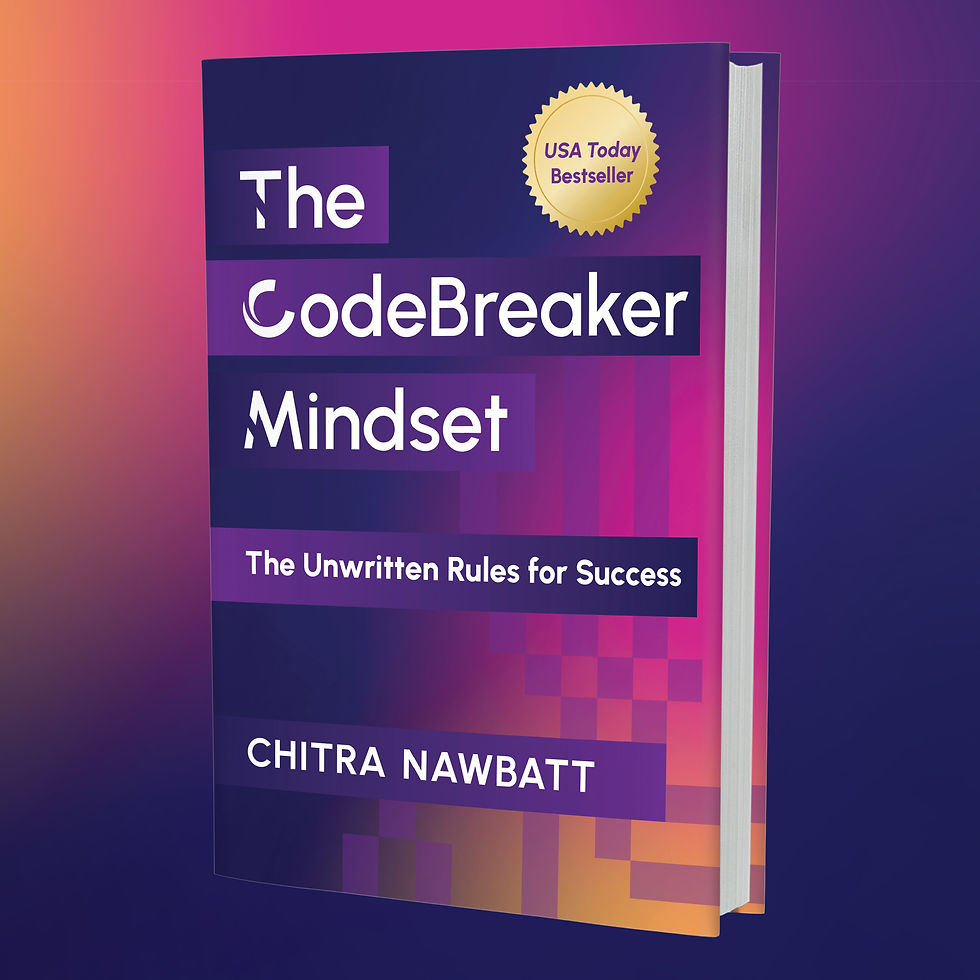
The CodeBreaker Mindset™ book order here: Amazon | Barnes & Noble
The CodeBreaker Mindset™ Ft. Forest Harper, INROADS, President and CEO
Chitra Nawbatt (00:10)
Welcome to The CodeBreaker Mindset™, where leaders share the unwritten rules for success. I'm your host, Chitra Nawbatt. Joining us today is Forest Harper, president and CEO of inroads. Forest, welcome. Thank you for joining us.
Forest Harper (00:24)
Thank you Chitra. It's a pleasure to be here to have this start exchange with someone who has just a mind breaking opportunity to talk through two things that people probably don't normally see. So. Thank you.
Chitra Nawbatt (00:34)
You're super kind. Tell us about inroads. What it's about its impact.
Forest Harper (00:40)
Or inroads as a nation's leading organization that focuses on developing, identifying talented students from early on, from high school to college to live out their dreams in their careers, entrepreneurship, and also leading their communities.
Chitra Nawbatt (00:55)
There's a lot of organizations who say they do similar things. How are you different? Bring it to life for us.
Forest Harper (01:01)
Well, it's different because of the campus of Princeton University came a student who wanted to see something different about giving all students an inclusive opportunity to be able to live out their dreams. So when he arrived in those communities that didn't have those opportunities. What makes those different is that he got a vision. His vision came from Martin Luther King in 1963 on the speech on Washington in a mall in Washington.
When he heard that speech, he came back and envision an opportunity of a pathway to get students on to professional development. From that point, we start with ninth graders and go all the way through college. That's unique for most organizations. Not only do we do that, we matched them up with corporations and government opportunities and nonprofits to seek careers in over 37 different majors.
That really is distinctive. Only at inroads.
Chitra Nawbatt (01:55)
Give us a sense of the numbers in terms of number of students. Number of companies participating. Quantify the impact.
Forest Harper (02:02)
Sure. So first of all, inroads has been around now for 55 years. And in 55 years, we've touched an impact over 164,000 students. Of those hundred and 64,000 students, we track about 40,000. Most of those, most of those, 40,000 are in level three to level one of corporate America. Not only that, we also track their economic mobility. And these students are now mature.
They're in corporate America, or they're leading governmental agencies or they're entrepreneurs. Matter of fact, 23.5% of our students coming through in-roads are successful entrepreneurs that own their own companies. And those kind of impact numbers drive success for years to come. Today we now take in over 7000 students a year. We have internships between 500 and 1000 internships in the college level and to high school level.
We serve over 1200 students in 18 cities across the US.
Chitra Nawbatt (03:02)
What are companies telling you that they're looking for in terms of skills, attributes from this, early journey? Talent?
Forest Harper (03:13)
Absolutely. Companies and employers are saying we need students early in the pipeline who have focus on skills that drive job description specifically. It used to be the time where we just, you know, give me a student will help them develop, and then we'll figure a place to put them. Now it's a bit more laser focused on that job description that is focused on skills, not necessarily the general students.
And so when we get that, we also ask about the culture. What is their employment culture. What kind of student are you looking for? I look for the student who's hungry or the student who's curious. And so when we figure that out, we map those students with the employers, that they're looking for.
Chitra Nawbatt (03:55)
Now, you before were an employee yourself because you spent many years in corporate America. Tell us about your journey to inroads, because I'm about 30 plus 30 years at Pfizer. Before that, you started in the Army? In the 82nd Airborne Division. So your your journey.
Forest Harper (04:10)
Well, it all started with a single parent and my mom, we grew up in the projects of South Florida, and I got a chance to go to college. That was a gift to be able to. She couldn't afford it. So I had to go on a football scholarship. And when I got to Morgan State University, which I think is one of the best universities in the world, frankly, in Baltimore, Maryland, I got an opportunity to to be able to leave college with two degrees, one as a lieutenant in the United States Army and two to graduate with a degree in social work.
So I was guaranteed to have some type of employment at the college and I did. I went to the military and served in the top unit in the military, the 82nd airborne, where I spent, about eight years as a military officer, achieving the rank of captain left there. And then I got to explore what it meant to be an for an industry, an organization that was involved with innovation, research and development and providing health care that kept people alive for longer.
And that was Pfizer. I spent 28 years in Pfizer through the sales ranks from a salesperson all the way to, the head of one of the major divisions in Pfizer. I was the first African-American to lead, as a vice president in Pfizer. But I left there in that role, not wanting to be the only. And so I set out my course saying, what can I do to be able to ensure that there's a pipeline of inclusiveness so that others can achieve what I achieve throughout Pfizer.
And it rewarded me. I was the first, vice president of the African-American employee resource group before they became an employee resource group. That's not to brag, it's just saying it was a phenomenal opportunity for me to give back. And in doing so, I left Pfizer, after 28 years. And then, someone knocked at my door and said, hey, we have a role for you.
Inroads and inroads gave me an opportunity to be their sixth president and CEO. So for the last 15 years, I've been the president humbly. So the last as president of inroads.
Chitra Nawbatt (06:13)
So with that rich experience and pattern recognition across multiple industries, military health care now, nonprofit inroads, let's get into the rules of the game and talk about the top tailwind and the top headwind impacting your industry and specifically your organization.
The Rules of the Game
Forest Harper (06:34)
Well, I would say for the past ten years, nonprofits have evolved. Their revenue streams were narrow, very big in all, particularly programmatic. But their fundraising revenue streams were not as strong, particularly if you're a mid-level nonprofit to hire. So leaders in nonprofits had to really explore and get creative on diversifying their revenue streams. That was the headwind because people traditionally would say, are you really a nonprofit?
Really? Do you have a gala? Do you have a donors? Do you have DAF funds? Donor advised funds? Do you have an endowment? 80% of the nonprofits don't have endowments to be big and unique, to be able to thrive off of, one day to another. So that really headwind was diversifying your revenue portfolio. And we did that at inroads.
It took about 10 to 12 years to do it. But we did it. So now we have a focus around multiple revenue streams. The tailwind is that if you are fulfilling a need, that is just a disparity that still needs help. Your tailwind is your cause. Your tailwind is what your impact is. So if your students are graduating on time or you're doing what you said you would do in your mission, it's easier to get people to donate or it's easier to get grants.
But if you're not, then that's a tough one for you. So it's a really, really important part. That they have that tailwind. And the gap for most nonprofits is marketing and promotions about letting people know what you do.
Chitra Nawbatt (08:14)
So what has been an unwritten rule that you have learned and deployed in this sandbox, to address either those tailwinds or, you know, to address the headwind or to seize the opportunity of a challenge headwind first.
Forest Harper (08:30)
Yeah. Okay. That diversifying that portfolio. Well, according to USA Giving Today, which is the Bible of tracking nonprofit revenue, in 2023, there were $354 billion in the philanthropic space. Of that 354 billion, 82% comes from individual donors. So one of the tailwind, one of the headwinds you had to find out, do you have a good donor giving program?
And we didn't. So and we have alumni. So we have to figure out how do we get to our alumni who dedicated to the program to become donors. And we've been working at that with the alumni donor base, strategies and a new CRM system, that we're now using called virtuous that we're ready to go with in the next month.
So our goal is to tap into those individual donors, and we believe the headwinds won't be as strong. Coming from there. The tailwind is really the impact, the stories and the storytelling. That is the headwind when you can look in your 55 years of folks some impact you make, you start to see the evidence and you start to see those students now reaching the C-suite like Thasunda Duckett, who is a CEO of TIAA. She came through in-roads. And part of her her story is that when she came through, she would not have been there without at least inroads being there at the beginning. That's what we want to be when we start telling those stories. People understand what we do and the impact we make.
But there are hundreds of Thasunda Ducketts. She's one that has achieved and successfully to be the CEO of TIAA.
Chitra Nawbatt (10:15)
When you think about the military, you're almost 30 years at Pfizer and now inroads. Is there a consistent written rule or unwritten rule that has contributed to your leadership success?
Forest Harper (10:31)
Absolutely. I give, first of all, my mentors credit before I even got to the military for my family, they were discipline. About respect for people. How in order to be a leader, you got to be a follower first. Those are the principles that came from my family. From the military. I not only read and believe in, the leadership traits.
He wrote a book on it. General Colin Powell, and I follow those. He has a book called the 14 traits of a leader. And when you read them, that so common sense that I brought that for the military over into my, commercial or my professional career and private sector advisor. And then the last one.
I'm a servant leader. My role is to be a servant leader because I think servant leaders are resilient. They're sustainable, and they respect people. And we respect people. People follow you. And so in that, I remember a story one day where I was in my office and someone, made a complaint that I had a Bible on my desk, which I had my devotion in the morning, and I put the Bible there and left it.
No offense to anyone at all, but, someone says you need to do something about that Bible. So the next day, I was over at Barnes and Noble. I bought my first book that combined what a servant leader is is called Jesus the CEO. Then I put that one on the desk there and took my Bible away. No one had any complaints, but the principles of it was about servant leadership.
And servant leadership to me is to treat others as you would want them to be treated. Be a follower before you can be a leader and that will help you throughout your life.
Chitra Nawbatt (12:11)
Let's get into the pivots. What's a significant organization business pivot that you've led?
The Pivots
Forest Harper (12:22)
Oh, boy. There's so many. And they are. Some are forced and some were initiated. So I would just say that probably the two that stand out the most. I'll start with, Pfizer. And one most important was about we must respect inclusion and diversity as it pertains to who we treat because everybody's human. So when the Aids and HIV Aids epidemic was here, we had a product advisor that basically took care of the infection rates for, for, for a lot of the HIV.
Individual. And unfortunately, we weren't getting to certain communities. We knew it. We started to see it was particularly only in, Caucasians who came forward to say that they had HIV Aids that we could treat, but we weren't getting to the minority communities that we knew. We saw some things happen. The pivot was to get out to the HBCU medical schools.
Like Meharry and Howard University to figure out what we needed to do. That pivot was strong. And, once we did that, we were able to find solutions to do that with and then it inroads. Our number one pivot was the fact that we had to go earlier in the pipeline. Our model was traditional around college students.
Well, about two years before Covid. Three years before Covid. We were getting to students too late once they got to college. So we needed to build the program out to get the high school students first. That pivot led us to starting our program with ninth graders. Instead of waiting till they got to college. So we now have a program that's robust.
We're in 18 cities across the country where we start the Inroads program at the ninth grade to the 12th grade. That was a huge pivot for inroads.
Chitra Nawbatt (14:19)
In either of those scenarios. How did you talk about your pattern recognition? Because how did you keep your antenna alert to spot the signals in what are like, what are those signals that's informing you, the leader, to then say, hey, you know what, we need to get ahead of this situation and pivot this way. Pivot that way.
Forest Harper (14:41)
You got to keep open ears. Are your staff eyes open to your staff because they're on the front lines? I couldn't see everything myself. So you have to, as a leader, have good ears and good eyes to pay attention to what the staff in the front lines are telling you and your community what's happening. And so once we saw what the community was saying, that we need to get to our ninth graders sooner, it was right and they were correct.
So it's about leaders paying attention to, their staff and those who report them.
Chitra Nawbatt (15:13)
Artificial intelligence. It's it's the new norm. It's it's impacting every facet of life. Talk about a top use case at scale, where your organization is investing in artificial intelligence and the outcomes.
Forest Harper (15:29)
Well, first of all, we're relatively new at the game as a nonprofit. Let me speak about that first. In our systems, but in our learning management systems, students can be able to go to a platform and be able to design what they their needs are and use artificial intelligence to help them set their course. So if I want to become a psychologist, what do I need to do?
Use those tools that AI provides. In order to do that. But on the student side of it, they're already coming to us from colleges and higher ed already. I prep the I ready? So what? We're doing is sitting down with employers and saying what skills would the students be able to have before they get to your company?
Do they have a AI center? Skill sets. And we're adjusting ours now, so we're early into the game. But if there was anything at all, I that we do use, but I think resume building just period sounds small, but, our nation for decades. But so much on how good does that resume look? Does it have the right font?
Does it have the right information? Should these parts go first to your job history? Should you include the Wendy's or the dairy Queen on your job description? I'm not kidding. It's just one of those things where we teach. But now, today, in AI environment, these students are able to not only align, the system that can automate, and integrate, to I just, you know, resumes.
So we've had to move with the innovation fast, to keep up with the students and what the employers are asking for. So that's our bridge satisfying those two students first and then the employer.
Chitra Nawbatt (17:18)
And how has that impacted stakeholder experience?
Forest Harper (17:21)
Oh, it has a lot. Our stakeholders, our students, there are number one, that's our boss. Because we make them productive. We get them success when they go from there. And the students really appreciate it. I'll give you an example. We have a lot of student athletes that participate in our program. They're the furthest away from being professionally ready for the most part, because they're concentrating on the sports with the swimmers, football players or basketball player, or by the time that they go to their career center, they're almost out of college.
And so we've had to be able to get them up to speed and be there, be their career center. So that's what enrolls does, and that has enabled us to help take it from 4000 students a year to almost 7000 students a year, that we help out, get what we call career ready and, employer ready.
Chitra Nawbatt (18:12)
For us. Let's get into the magic. How do you define serendipity, and where has serendipity played a significant role in a business or organization outcome?
The Magic
Forest Harper (18:26)
You know, I, I don't have a strong philosophy for serendipitously. That's okay. I think it's intentional or it's an intentional accident that two forces were going to happen at some point in some time to equal a larger and amazing output. And I'll share with you what my biggest part about serendipitous has to do with networking. Okay. We all grew up high school, elementary school.
We go to college, we have a network. And each one of those groups. Right. You got friends. You're really close friends. School graduated with. We also get to work. We have a network. But who would have thought that the network that you created in college, that person became a lawyer. You own a business and you need a lawyer.
And you just so happened to be in the same Starbucks as that person that day. That set down, it was only two two seats and the two of you sat down together. Oh, right. I remember you from high school. I'm looking for a lawyer. That's the serendipitous part that I say. I was always there, and it's the most unique one that we all forget about is the network.
It is so clean, so quiet. And it happens, independently. And I'll give you an example. One that I just went through recently. So I'm looking, to build a house and so looking for, an architect and a design person to help out with it. I had no clue in this area. And just so happens I'm in a Starbucks.
I am having a cup of coffee, and I'm on call, and there's, a seat, and basically had something spilled in the seat. So I cleaned it out because this person needed to sit down. That person sat down a designer that was not going to be my designer for my house. That's the serendipitous. I think that happens every single day.
But it's based off of this whole area about networks. And so when I say to people, build your network because you never know when that's going to come all true, that serendipitously, somebody in that network is going to have some influence, some value, some funding, particularly in nonprofits that you never thought you might have. And so to that end, that's what I think the serendipitous parts about what happens for us.
Chitra Nawbatt (20:55)
What's your advice on how to cultivate The CodeBreaker Mindset™?
Forest Harper (21:02)
I'm a big, big believer that, you should take some time each day to think about, don't allow yourself, to wrestle with whether or not your creative, creative thinking breaks the code. Because codes. Because the code is that if you know how to decode something or you know how to code something for a breakthrough, that's one thing.
That's engineering, that's part. But creativity is the part has no boundaries. So if you're suggesting that, I want to become a doctor, but my my math is not very good, but but being a doctor requires math. What can creativity happen with that? You have to that your mindset around creativity. And that is the science that that sort of, takes and decode, what's possible.
And, I say that because there's a friend of mine who's scheduled to go up, and Blue Origin as one of the four female astronauts before going to for female passengers. That's going up this month. Her name is Aisha Bo, young girl from, from a young girl from the Bahamas. Went to Michigan and became an aeronautical engineer.
Who would have thought she was going to be one of the people to go up, as an astronaut here very soon? It's all because of her creativity. But guess what she did? She created a actually coding system called lingo that my students trained from just ten years ago. She was doing that. Now she's getting ready to go up.
And so decoding has to be able to be take that creativity. Don't let any limits get to you. But being able to think beyond the normal and that's what I call decoding would do for us.
Chitra Nawbatt (22:55)
Thank you so much for joining us.
Forest Harper (22:58)
You're welcome. I enjoyed the conversation.
Chitra Nawbatt (23:01)
Thank you for supporting The CodeBreaker Mindset™. For more episodes, go to www.ChitraNawbatt.com to like and subscribe. Connect with me on social media, @ChitraNawbatt.
The CodeBreaker Mindset™ Ft. Forest Harper, INROADS, President and CEO
Chitra Nawbatt (00:10)
Welcome to The CodeBreaker Mindset™, where leaders share the unwritten rules for success. I'm your host, Chitra Nawbatt. Joining us today is Forest Harper, president and CEO of inroads. Forest, welcome. Thank you for joining us.
Forest Harper (00:24)
Thank you Chitra. It's a pleasure to be here to have this start exchange with someone who has just a mind breaking opportunity to talk through two things that people probably don't normally see. So. Thank you.
Chitra Nawbatt (00:34)
You're super kind. Tell us about inroads. What it's about its impact.
Forest Harper (00:40)
Or inroads as a nation's leading organization that focuses on developing, identifying talented students from early on, from high school to college to live out their dreams in their careers, entrepreneurship, and also leading their communities.
Chitra Nawbatt (00:55)
There's a lot of organizations who say they do similar things. How are you different? Bring it to life for us.
Forest Harper (01:01)
Well, it's different because of the campus of Princeton University came a student who wanted to see something different about giving all students an inclusive opportunity to be able to live out their dreams. So when he arrived in those communities that didn't have those opportunities. What makes those different is that he got a vision. His vision came from Martin Luther King in 1963 on the speech on Washington in a mall in Washington.
When he heard that speech, he came back and envision an opportunity of a pathway to get students on to professional development. From that point, we start with ninth graders and go all the way through college. That's unique for most organizations. Not only do we do that, we matched them up with corporations and government opportunities and nonprofits to seek careers in over 37 different majors.
That really is distinctive. Only at inroads.
Chitra Nawbatt (01:55)
Give us a sense of the numbers in terms of number of students. Number of companies participating. Quantify the impact.
Forest Harper (02:02)
Sure. So first of all, inroads has been around now for 55 years. And in 55 years, we've touched an impact over 164,000 students. Of those hundred and 64,000 students, we track about 40,000. Most of those, most of those, 40,000 are in level three to level one of corporate America. Not only that, we also track their economic mobility. And these students are now mature.
They're in corporate America, or they're leading governmental agencies or they're entrepreneurs. Matter of fact, 23.5% of our students coming through in-roads are successful entrepreneurs that own their own companies. And those kind of impact numbers drive success for years to come. Today we now take in over 7000 students a year. We have internships between 500 and 1000 internships in the college level and to high school level.
We serve over 1200 students in 18 cities across the US.
Chitra Nawbatt (03:02)
What are companies telling you that they're looking for in terms of skills, attributes from this, early journey? Talent?
Forest Harper (03:13)
Absolutely. Companies and employers are saying we need students early in the pipeline who have focus on skills that drive job description specifically. It used to be the time where we just, you know, give me a student will help them develop, and then we'll figure a place to put them. Now it's a bit more laser focused on that job description that is focused on skills, not necessarily the general students.
And so when we get that, we also ask about the culture. What is their employment culture. What kind of student are you looking for? I look for the student who's hungry or the student who's curious. And so when we figure that out, we map those students with the employers, that they're looking for.
Chitra Nawbatt (03:55)
Now, you before were an employee yourself because you spent many years in corporate America. Tell us about your journey to inroads, because I'm about 30 plus 30 years at Pfizer. Before that, you started in the Army? In the 82nd Airborne Division. So your your journey.
Forest Harper (04:10)
Well, it all started with a single parent and my mom, we grew up in the projects of South Florida, and I got a chance to go to college. That was a gift to be able to. She couldn't afford it. So I had to go on a football scholarship. And when I got to Morgan State University, which I think is one of the best universities in the world, frankly, in Baltimore, Maryland, I got an opportunity to to be able to leave college with two degrees, one as a lieutenant in the United States Army and two to graduate with a degree in social work.
So I was guaranteed to have some type of employment at the college and I did. I went to the military and served in the top unit in the military, the 82nd airborne, where I spent, about eight years as a military officer, achieving the rank of captain left there. And then I got to explore what it meant to be an for an industry, an organization that was involved with innovation, research and development and providing health care that kept people alive for longer.
And that was Pfizer. I spent 28 years in Pfizer through the sales ranks from a salesperson all the way to, the head of one of the major divisions in Pfizer. I was the first African-American to lead, as a vice president in Pfizer. But I left there in that role, not wanting to be the only. And so I set out my course saying, what can I do to be able to ensure that there's a pipeline of inclusiveness so that others can achieve what I achieve throughout Pfizer.
And it rewarded me. I was the first, vice president of the African-American employee resource group before they became an employee resource group. That's not to brag, it's just saying it was a phenomenal opportunity for me to give back. And in doing so, I left Pfizer, after 28 years. And then, someone knocked at my door and said, hey, we have a role for you.
Inroads and inroads gave me an opportunity to be their sixth president and CEO. So for the last 15 years, I've been the president humbly. So the last as president of inroads.
Chitra Nawbatt (06:13)
So with that rich experience and pattern recognition across multiple industries, military health care now, nonprofit inroads, let's get into the rules of the game and talk about the top tailwind and the top headwind impacting your industry and specifically your organization.
The Rules of the Game
Forest Harper (06:34)
Well, I would say for the past ten years, nonprofits have evolved. Their revenue streams were narrow, very big in all, particularly programmatic. But their fundraising revenue streams were not as strong, particularly if you're a mid-level nonprofit to hire. So leaders in nonprofits had to really explore and get creative on diversifying their revenue streams. That was the headwind because people traditionally would say, are you really a nonprofit?
Really? Do you have a gala? Do you have a donors? Do you have DAF funds? Donor advised funds? Do you have an endowment? 80% of the nonprofits don't have endowments to be big and unique, to be able to thrive off of, one day to another. So that really headwind was diversifying your revenue portfolio. And we did that at inroads.
It took about 10 to 12 years to do it. But we did it. So now we have a focus around multiple revenue streams. The tailwind is that if you are fulfilling a need, that is just a disparity that still needs help. Your tailwind is your cause. Your tailwind is what your impact is. So if your students are graduating on time or you're doing what you said you would do in your mission, it's easier to get people to donate or it's easier to get grants.
But if you're not, then that's a tough one for you. So it's a really, really important part. That they have that tailwind. And the gap for most nonprofits is marketing and promotions about letting people know what you do.
Chitra Nawbatt (08:14)
So what has been an unwritten rule that you have learned and deployed in this sandbox, to address either those tailwinds or, you know, to address the headwind or to seize the opportunity of a challenge headwind first.
Forest Harper (08:30)
Yeah. Okay. That diversifying that portfolio. Well, according to USA Giving Today, which is the Bible of tracking nonprofit revenue, in 2023, there were $354 billion in the philanthropic space. Of that 354 billion, 82% comes from individual donors. So one of the tailwind, one of the headwinds you had to find out, do you have a good donor giving program?
And we didn't. So and we have alumni. So we have to figure out how do we get to our alumni who dedicated to the program to become donors. And we've been working at that with the alumni donor base, strategies and a new CRM system, that we're now using called virtuous that we're ready to go with in the next month.
So our goal is to tap into those individual donors, and we believe the headwinds won't be as strong. Coming from there. The tailwind is really the impact, the stories and the storytelling. That is the headwind when you can look in your 55 years of folks some impact you make, you start to see the evidence and you start to see those students now reaching the C-suite like Thasunda Duckett, who is a CEO of TIAA. She came through in-roads. And part of her her story is that when she came through, she would not have been there without at least inroads being there at the beginning. That's what we want to be when we start telling those stories. People understand what we do and the impact we make.
But there are hundreds of Thasunda Ducketts. She's one that has achieved and successfully to be the CEO of TIAA.
Chitra Nawbatt (10:15)
When you think about the military, you're almost 30 years at Pfizer and now inroads. Is there a consistent written rule or unwritten rule that has contributed to your leadership success?
Forest Harper (10:31)
Absolutely. I give, first of all, my mentors credit before I even got to the military for my family, they were discipline. About respect for people. How in order to be a leader, you got to be a follower first. Those are the principles that came from my family. From the military. I not only read and believe in, the leadership traits.
He wrote a book on it. General Colin Powell, and I follow those. He has a book called the 14 traits of a leader. And when you read them, that so common sense that I brought that for the military over into my, commercial or my professional career and private sector advisor. And then the last one.
I'm a servant leader. My role is to be a servant leader because I think servant leaders are resilient. They're sustainable, and they respect people. And we respect people. People follow you. And so in that, I remember a story one day where I was in my office and someone, made a complaint that I had a Bible on my desk, which I had my devotion in the morning, and I put the Bible there and left it.
No offense to anyone at all, but, someone says you need to do something about that Bible. So the next day, I was over at Barnes and Noble. I bought my first book that combined what a servant leader is is called Jesus the CEO. Then I put that one on the desk there and took my Bible away. No one had any complaints, but the principles of it was about servant leadership.
And servant leadership to me is to treat others as you would want them to be treated. Be a follower before you can be a leader and that will help you throughout your life.
Chitra Nawbatt (12:11)
Let's get into the pivots. What's a significant organization business pivot that you've led?
The Pivots
Forest Harper (12:22)
Oh, boy. There's so many. And they are. Some are forced and some were initiated. So I would just say that probably the two that stand out the most. I'll start with, Pfizer. And one most important was about we must respect inclusion and diversity as it pertains to who we treat because everybody's human. So when the Aids and HIV Aids epidemic was here, we had a product advisor that basically took care of the infection rates for, for, for a lot of the HIV.
Individual. And unfortunately, we weren't getting to certain communities. We knew it. We started to see it was particularly only in, Caucasians who came forward to say that they had HIV Aids that we could treat, but we weren't getting to the minority communities that we knew. We saw some things happen. The pivot was to get out to the HBCU medical schools.
Like Meharry and Howard University to figure out what we needed to do. That pivot was strong. And, once we did that, we were able to find solutions to do that with and then it inroads. Our number one pivot was the fact that we had to go earlier in the pipeline. Our model was traditional around college students.
Well, about two years before Covid. Three years before Covid. We were getting to students too late once they got to college. So we needed to build the program out to get the high school students first. That pivot led us to starting our program with ninth graders. Instead of waiting till they got to college. So we now have a program that's robust.
We're in 18 cities across the country where we start the Inroads program at the ninth grade to the 12th grade. That was a huge pivot for inroads.
Chitra Nawbatt (14:19)
In either of those scenarios. How did you talk about your pattern recognition? Because how did you keep your antenna alert to spot the signals in what are like, what are those signals that's informing you, the leader, to then say, hey, you know what, we need to get ahead of this situation and pivot this way. Pivot that way.
Forest Harper (14:41)
You got to keep open ears. Are your staff eyes open to your staff because they're on the front lines? I couldn't see everything myself. So you have to, as a leader, have good ears and good eyes to pay attention to what the staff in the front lines are telling you and your community what's happening. And so once we saw what the community was saying, that we need to get to our ninth graders sooner, it was right and they were correct.
So it's about leaders paying attention to, their staff and those who report them.
Chitra Nawbatt (15:13)
Artificial intelligence. It's it's the new norm. It's it's impacting every facet of life. Talk about a top use case at scale, where your organization is investing in artificial intelligence and the outcomes.
Forest Harper (15:29)
Well, first of all, we're relatively new at the game as a nonprofit. Let me speak about that first. In our systems, but in our learning management systems, students can be able to go to a platform and be able to design what they their needs are and use artificial intelligence to help them set their course. So if I want to become a psychologist, what do I need to do?
Use those tools that AI provides. In order to do that. But on the student side of it, they're already coming to us from colleges and higher ed already. I prep the I ready? So what? We're doing is sitting down with employers and saying what skills would the students be able to have before they get to your company?
Do they have a AI center? Skill sets. And we're adjusting ours now, so we're early into the game. But if there was anything at all, I that we do use, but I think resume building just period sounds small, but, our nation for decades. But so much on how good does that resume look? Does it have the right font?
Does it have the right information? Should these parts go first to your job history? Should you include the Wendy's or the dairy Queen on your job description? I'm not kidding. It's just one of those things where we teach. But now, today, in AI environment, these students are able to not only align, the system that can automate, and integrate, to I just, you know, resumes.
So we've had to move with the innovation fast, to keep up with the students and what the employers are asking for. So that's our bridge satisfying those two students first and then the employer.
Chitra Nawbatt (17:18)
And how has that impacted stakeholder experience?
Forest Harper (17:21)
Oh, it has a lot. Our stakeholders, our students, there are number one, that's our boss. Because we make them productive. We get them success when they go from there. And the students really appreciate it. I'll give you an example. We have a lot of student athletes that participate in our program. They're the furthest away from being professionally ready for the most part, because they're concentrating on the sports with the swimmers, football players or basketball player, or by the time that they go to their career center, they're almost out of college.
And so we've had to be able to get them up to speed and be there, be their career center. So that's what enrolls does, and that has enabled us to help take it from 4000 students a year to almost 7000 students a year, that we help out, get what we call career ready and, employer ready.
Chitra Nawbatt (18:12)
For us. Let's get into the magic. How do you define serendipity, and where has serendipity played a significant role in a business or organization outcome?
The Magic
Forest Harper (18:26)
You know, I, I don't have a strong philosophy for serendipitously. That's okay. I think it's intentional or it's an intentional accident that two forces were going to happen at some point in some time to equal a larger and amazing output. And I'll share with you what my biggest part about serendipitous has to do with networking. Okay. We all grew up high school, elementary school.
We go to college, we have a network. And each one of those groups. Right. You got friends. You're really close friends. School graduated with. We also get to work. We have a network. But who would have thought that the network that you created in college, that person became a lawyer. You own a business and you need a lawyer.
And you just so happened to be in the same Starbucks as that person that day. That set down, it was only two two seats and the two of you sat down together. Oh, right. I remember you from high school. I'm looking for a lawyer. That's the serendipitous part that I say. I was always there, and it's the most unique one that we all forget about is the network.
It is so clean, so quiet. And it happens, independently. And I'll give you an example. One that I just went through recently. So I'm looking, to build a house and so looking for, an architect and a design person to help out with it. I had no clue in this area. And just so happens I'm in a Starbucks.
I am having a cup of coffee, and I'm on call, and there's, a seat, and basically had something spilled in the seat. So I cleaned it out because this person needed to sit down. That person sat down a designer that was not going to be my designer for my house. That's the serendipitous. I think that happens every single day.
But it's based off of this whole area about networks. And so when I say to people, build your network because you never know when that's going to come all true, that serendipitously, somebody in that network is going to have some influence, some value, some funding, particularly in nonprofits that you never thought you might have. And so to that end, that's what I think the serendipitous parts about what happens for us.
Chitra Nawbatt (20:55)
What's your advice on how to cultivate The CodeBreaker Mindset™?
Forest Harper (21:02)
I'm a big, big believer that, you should take some time each day to think about, don't allow yourself, to wrestle with whether or not your creative, creative thinking breaks the code. Because codes. Because the code is that if you know how to decode something or you know how to code something for a breakthrough, that's one thing.
That's engineering, that's part. But creativity is the part has no boundaries. So if you're suggesting that, I want to become a doctor, but my my math is not very good, but but being a doctor requires math. What can creativity happen with that? You have to that your mindset around creativity. And that is the science that that sort of, takes and decode, what's possible.
And, I say that because there's a friend of mine who's scheduled to go up, and Blue Origin as one of the four female astronauts before going to for female passengers. That's going up this month. Her name is Aisha Bo, young girl from, from a young girl from the Bahamas. Went to Michigan and became an aeronautical engineer.
Who would have thought she was going to be one of the people to go up, as an astronaut here very soon? It's all because of her creativity. But guess what she did? She created a actually coding system called lingo that my students trained from just ten years ago. She was doing that. Now she's getting ready to go up.
And so decoding has to be able to be take that creativity. Don't let any limits get to you. But being able to think beyond the normal and that's what I call decoding would do for us.
Chitra Nawbatt (22:55)
Thank you so much for joining us.
Forest Harper (22:58)
You're welcome. I enjoyed the conversation.
Chitra Nawbatt (23:01)
Thank you for supporting The CodeBreaker Mindset™. For more episodes, go to www.ChitraNawbatt.com to like and subscribe. Connect with me on social media, @ChitraNawbatt.
Disclaimer: the show notes and transcript are powered by artificial intelligence (AI).
Featured Episodes and Insights