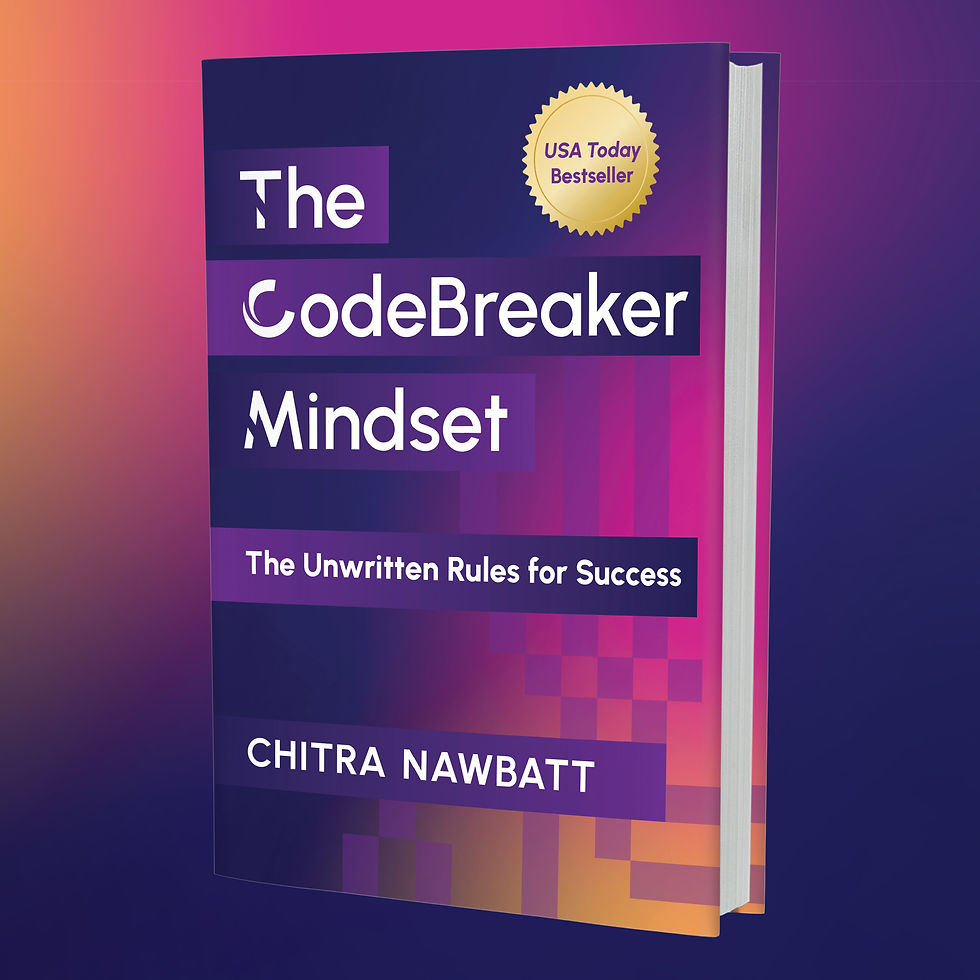
The CodeBreaker Mindset™ Ft. Jill Pemberton, LVMH, CFO North America


In this episode of The CodeBreaker Mindset™, host Chitra Nawbatt speaks with Jill Pemberton, CFO of LVMH North America. They discuss the unique position of LVMH in the luxury market, the challenges and opportunities faced by the industry, and the importance of balancing growth with cost management. Jill shares her insights on leadership, the role of data and AI in decision-making, and the significance of resilience and networking in career development. The conversation highlights the importance of innovation in the luxury retail space and the impact of serendipity on career success.
Chapters
00:00 Introduction to LVMH and Its Unique Position
03:07 Navigating the Luxury Market: Headwinds and Tailwinds
05:52 CFO Insights: Balancing Growth and Cost
08:45 Leadership Lessons and Unwritten Rules
11:50 Data-Driven Decisions and AI in Luxury
14:39 The Role of Serendipity in Career Success
17:55 Building Resilience and The CodeBreaker Mindset™
Episode Resources
Jill Pemberton | Bio
Chitra Nawbatt | Bio
The CodeBreaker Mindset™ book order here: Amazon | Barnes & Noble
The CodeBreaker Mindset™ Ft. Jill Pemberton, LVMH, CFO North America
Chitra Nawbatt (00:10)
Welcome to The CodeBreaker Mindset™, where leaders share the unwritten rules for success. I'm your host Chitra Nawbatt. Joining us today is Jill Pemberton LVMH North America CFO. Jill, welcome. Thank you for joining us.
Jill Pemberton (00:24)
Thank you for having me.
Chitra Nawbatt (00:26)
LVMH, French headquartered conglomerate specializing in luxury. It's home to brands such as Louis Vuitton, Dior, Tiffany Hennessy, Rihanna's Fenty with revenue close to $90 billion. The Arnault family owns about 49% of the company. Tell us about LVMH and how it's different compared to competitors like Caring, who owns Gucci, Saint Laurent?
Jill Pemberton (00:49)
Yes. So LVMH, as you mentioned, is a French owned company that has over 75 different brands or what we call Maison. So as you mentioned, everything from Louis Vuitton, Tiffany, Moet Hennessy. A lot of our wine and spirits products were in six different categories. So wine and spirits, fashion and leather goods, perfumes and cosmetics. Watch and jewelry, selective retailing, as well as many other categories.
So I think what really makes LVMH different is the breadth of the luxury landscape in which we cover, which is a bit more than some of our other peer companies.
Chitra Nawbatt (01:29)
And take us a little bit more into that size, scale, diversity, geographic presence.
Jill Pemberton (01:36)
Yes, a little bit. So obviously global company, we here in North America make up about 25% of the the global business. And again, most of those all of those maisons are represented here in the US. I've seen China is another big area of focus for the company. And again, six different, six different categories that we're in.
Chitra Nawbatt (01:59)
And in that high end luxury. Where exactly in the market do you play? Because there's high end luxury. There's ultra luxury. You're around your stakeholders and the value that you offer.
Jill Pemberton (02:08)
Sure. We kind of cover the gamut and actually depends on our brand. So we have some brands that are very, cater mostly to the ultra high net worth individual consumer. We have other brands that, have a much wider range and may also bring in what we call our aspirational, luxury consumer, which is a bit on the lower end.
So it just we have perfumes and cosmetics, which is luxury. But, at a lower general price point, so you can have a many more, consumers be able to experience our brand. So we really do run the gamut of the luxury, landscape.
Chitra Nawbatt (02:47)
Getting into a little bit of your journey, since LVMH owns fancy brands, it gets a CFO on you in 25 plus years of experience, and you come from some fancy brands yourself. Yes. Johnson and Johnson. Viacom, how do you go from health care, to consumer goods and specifically luxury as a CFO?
Jill Pemberton (03:07)
Interesting. So, yes, I've always loved working, for companies that make things, products I can see, feel, touch or things I can get on. So early in my career, I worked for Delta Airlines for ten years. Obviously, very large product experience that I can see. I work for H.J. Heinz Food Company. Again, wonderful products. As you mentioned, I work for Johnson and Johnson, mostly in the consumer side of the business or that's consumer health care products.
And now, at LVMH, which is what's better than luxury products. So really, I enjoy being close to the consumer, close to the product, being able to see, feel, touch what I'm actually responsible for.
Chitra Nawbatt (03:50)
Well, with that rich experience, you, then are very versed in spotting tailwinds and headwinds in the market. So let's get into the rules of the game. Because every industry company, they've got to navigate headwinds, tailwinds in the market. So in the industry that you're in, what's the top headwind and what's the top tailwind that you're seeing.
And what's your unwritten rule your hack on how to navigate that?
The Rules of the Game
Jill Pemberton (04:18)
Yeah, I think, we're I'm very interesting times right now, but lots of lots of ups and downs in the industry. So if you take luxury over the last couple of years coming out of Covid, a lot of the our consumer base was at home. And so they were drinking a lot at home and they were buying a lot of handbags and shopping online.
If you look at things now, like several other businesses with, the economy where it is with inflation and interest rates, it is also impacting to somewhat the high end consumer as well, maybe is not as much as, kind of the middle lower consumer, but we're still seeing, challenges in that.
Right. Another big piece of our business is, the wine and spirits part of the business. There's definitely changing trends in that business that we need to watch out for. Health and wellness as a trend. You know how much people, are again, trading down, within a category given the current macroeconomic environment. So I would say the, headwinds right now are is just like what everyone else is feeling, Tariffs, What's happening with the economy? How people are choosing to spend their money? But at the same time, we still have some positives in the environment. People are still wanting to, you know, buy high quality goods, want to have wonderful experiences. So it's a bit of a mix, environment right now.
Chitra Nawbatt (05:52)
So on that, on that profitable growth piece, there's there's pressure. I would view that there's pressure on that CFO function because, it's where the you've got to make you've got to make magic out of the numbers. Right. When the, you know, ultimately, even in a consumer goods, especially luxury business, at the end of the day, it's all about volume.
You need the volume. Volume will be what it's going to be. And there's only so much you can sort of push that year to year. Where then do you play around? I don't want to say play around with the numbers, but where then do you optimize on that cost side? Optimize in terms of levers that you can pull to contribute to that profitable growth?
Sure.
Jill Pemberton (06:30)
Just like, in any business, you have to balance, growth versus, you know, the cost side of the equation. And so in an area in a time like this where you might have a bit lower growth, what is it that you want need to do? From the cost side of the equation to make sure you continue to have profitable growth, but also to make sure you're continuing to invest in the long term.
So obviously, in our view, we want to make sure that we have, the right innovation in the right store environment for us to continue to, attract, and get our consumers. So it's a balance. And so that's the decisions that we make every day is how do we invest, to make sure that we can continue to grow long term, but at the same time, make sure that we're balancing, the short term, financial needs as well.
Chitra Nawbatt (07:22)
So you've been a CFO in some very tough industries, health care, media. Now, luxury consumer goods. Is there a consistent written rule, unwritten rule that has guided you, in being a CFO at the highest levels in your leadership journey? From a business.
Jill Pemberton (07:42)
Perspective, as you said, it's really all about how do you make sure that you're balancing that, the growth versus the cost side of the equation and how you're making sure that you invest for the long term? Whatever the industry in the market is, whether it's, you know, food or consumer health care that has much lower margins than, say, luxury consumer, you still have to make sure that you are balancing that equation.
And that's a decision that you make almost every day when you're when you're determining how to invest.
Chitra Nawbatt (08:17)
And leadership principle side.
Jill Pemberton (08:20)
Yeah. You know, on the leadership side, I think it's it's really trying to make sure that you have very good, sponsors and mentors along the way to help you understand what those unwritten rules might be so that that can help kind of guide you in your career.
Chitra Nawbatt (08:41)
And what was that unwritten rule for you? What is it that you learned the hard way?
Jill Pemberton (08:46)
I think it's really people tell you early in your career you need to network, you need to really build strong relationships. And I don't think until you're further in your career, you really understand how important that is, one for your own growth and development, but also to make sure that you are also there to sponsor mentor others as well so that they can achieve, their, their career objectives as well.
Chitra Nawbatt (09:14)
Yeah. Let's get into the pivots. Sure. What's a significant business pivot that you've led?
The Pivots
Jill Pemberton (09:20)
Sure. And one company, we were working, we looking at our financials and we were significantly below operating margin. Then, some of our peer set and so I worked with, one of our core business leaders to really bring in, focus on, obviously, the cost side of the equation and where we needed to reduce cost.
So did, a huge, study, and then turned into a transformation as to how could we actually reduce our, really our G&A cost to be able to be able to invest back in the business? So that was a big transformation. Another company was all about our end to end forecasting process. So we were realizing that we were not meeting our plan consistently.
So we went back and looked at all aspects of, the planning cycle from demand plan, supply plan, our category plans and ultimately our financial, budget and forecast and kind of re-engineered that whole process so that we could make sure that we were consistently meeting our forecast.
Chitra Nawbatt (10:31)
So on that, this word, signals and an antenna. Right. Because as a CFO and part of businesses, you know, the reactive, proactive, everyone wants to be proactive. So as a CFO, how do you how do you get ahead? What are the the signals that you're looking for? Tell us about you know, your pattern recognition.
Jill Pemberton (10:52)
Well, I've asked do you think you look at what's going on in the market, right. So you try to understand either what's happening with the broader macroeconomic environment, like we're doing with right now. What your consumer, you actually do your, your research and you look at what your consumer, is, how they're performing, what their expectations are.
And then you need to pivot based on both of those, what your peers, might be up to as well. And so you continue to educate yourself both internally and externally. Data, data obviously huge with a I and that is a really big area. So we have tons of data coming into the company now. How do you analyze that data to be able to make the best decisions and provide the business with information so that they can make the best decisions possible?
So we spend a lot of time focused on data and making sure we can understand it well.
Chitra Nawbatt (11:50)
Going further on data and you talked about AI. So artificial intelligence it's the new norm. Yes. Talk about top use cases at scale when you guys are investing and the outcomes.
Jill Pemberton (12:02)
Sure. So in general, I think our overall, I Jen, I focus is on, our client base and our consumers, whether that's things like client selling or product development. How can we use technology to help make those, processes more efficient and innovative? Also, on the back end as well. Yeah. ChatGPT. We have an internal ChatGPT system that we encourage our, employees and team members to use and get comfortable with so that we can also be more efficient.
And I'd say, you know, finance or our other areas of the business, at the same time.
Chitra Nawbatt (12:41)
And on the consumer side, because going on the word consumer, what's, you know, your thoughts on next horizons of innovation? Because ultimately in consumer goods retail especially luxury. Yeah. You got to keep it shiny. You got to keep it sexy. You got to, you know, keep upping the experience component to her. What do you see as the next horizon of innovation?
Jill Pemberton (13:02)
That's a great question. And we we talk a lot about, especially over the last couple of years with the growth of e-commerce and online versus the in-store experience. And we've talked about that, like, what is the role of the store? How is it that we can bring our clients into the store versus just buying something online? So I think an an increased area of innovation is what you can do in the store environment.
So we have several, you know, stores that we renovate every year. And so how do you bring something new and fresh? I'm sure everyone has seen our, Louis Vuitton store on Fifth Avenue will be under renovation. We have a big, huge kind of trunk, display right now. And so continuing to, reinvent our flagships and bring something new to our consumers is what we want to do.
Chitra Nawbatt (13:52)
And and bringing that together, you know, is there an example where you talk about the impact to the customer experience with the AI, the data, the insights, connecting to that customer experience? Is there an example in terms of what that looks like?
Jill Pemberton (14:07)
Yeah, I mean, I think that the teams are currently kind of looking through that now with all the information to see, what we can gather from the data to see if that helps inform, us of where we might be able to, you know, use better innovation or we use different services in our, store experience.
Those are things that we're looking at. Every day.
Chitra Nawbatt (14:30)
Let's get into the magic. How do you define serendipity, and where has serendipity played a significant role in a business outcome?
The Magic
Jill Pemberton (14:40)
In a business outcome? I can answer from a personal outcome.
Chitra Nawbatt (14:46)
By all means.
Jill Pemberton (14:47)
I think, you know, being think at the right place at the right time. Early in my career, I was at a company, and I had mentioned that it's a global company. I mentioned that I wanted to, work externally or internationally at some point in my career, and I'd been working there for about a year.
And then all of a sudden I get a call from my boss saying, hey, I'm going back to, work in Europe. And I want you to come with me. I think this will be a great experience. And that was kind of a moment of kind of serendipity being at the right place at the right time, and ended up having a fabulous couple of years working, working in Europe.
And so I think the combination of things working at, at the right time, with, as I mentioned earlier, kind of sponsors and mentors can help, add that, to your career.
Chitra Nawbatt (15:38)
And what's your, what's your process when things don't go the way that you like? You know, if you can tell us about maybe a situation where, quote unquote, there was failure or, or something that didn't work out how you dealt with that, how you recover.
Jill Pemberton (15:53)
Yeah. That's a great question. Yes. As you know, things don't always work out the way we think they are, especially in your career. It's never a straight line. And I think really just having, the resilience to, you know, to continue moving forward. And I think you need to learn from whatever it is, the mistake of the failure you may have, whether it's from a business context, you made a decision that didn't necessarily work out the way you wanted to, whether it's a business decision or a hiring decision or, your career isn't necessarily working out the way you want it to.
And you have that failure. I think you learn from it and you move on.
Chitra Nawbatt (16:32)
But how do you build that resilience? Because it's hard. Yeah, it's hard, especially for a career lifespan. A long time ago someone gave me this analogy. You know, this. You squeeze the toothpaste, do you think there's nothing there? And you squeeze and you get something a little out? Yeah. And that was his advice around? Yes. You know, digging deep within a person.
What's your process? How do you actually build that resilience?
Jill Pemberton (16:53)
I think a one resilience comes from having to experience that a couple of times. I think each time you experience that, you understand that, okay, things are going to be okay. So the next time you might have a failure, you say, okay, I'm going to learn from it, but I know things will be okay, things will work out.
And so each time you kind of build that resilience, but you continue to kind of take a step back for a couple of minutes, ground yourself, and then you move forward.
Chitra Nawbatt (17:21)
Jill, what's your advice on how to cultivate The CodeBreaker Mindset™?
Jill Pemberton (17:27)
I think yeah, it's all about, you know, setting a goal, having an objective and then being able to kind of envision the steps that you need to get to that goal or objective. And I think just having that process in mind, whether it's a career objective, a business objective is, you know, to be able to have that goal and but set kind of the small path that you need to take to get there.
Sometimes you need to course correct around along the way. But getting you to have the goal in mind and continue to have persistence and resilience to get there.
Chitra Nawbatt (17:59)
Jill, thank you so much for joining us.
Jill Pemberton (18:02)
You're welcome. Thank you for having me.
Chitra Nawbatt (18:04)
Thank you for supporting The CodeBreaker Mindset™. For more episodes, go to www.ChitraNawbatt.com to like and subscribe. Connect with me on social media @ChitraNawbatt.
The CodeBreaker Mindset™ Ft. Jill Pemberton, LVMH, CFO North America
Chitra Nawbatt (00:10)
Welcome to The CodeBreaker Mindset™, where leaders share the unwritten rules for success. I'm your host Chitra Nawbatt. Joining us today is Jill Pemberton LVMH North America CFO. Jill, welcome. Thank you for joining us.
Jill Pemberton (00:24)
Thank you for having me.
Chitra Nawbatt (00:26)
LVMH, French headquartered conglomerate specializing in luxury. It's home to brands such as Louis Vuitton, Dior, Tiffany Hennessy, Rihanna's Fenty with revenue close to $90 billion. The Arnault family owns about 49% of the company. Tell us about LVMH and how it's different compared to competitors like Caring, who owns Gucci, Saint Laurent?
Jill Pemberton (00:49)
Yes. So LVMH, as you mentioned, is a French owned company that has over 75 different brands or what we call Maison. So as you mentioned, everything from Louis Vuitton, Tiffany, Moet Hennessy. A lot of our wine and spirits products were in six different categories. So wine and spirits, fashion and leather goods, perfumes and cosmetics. Watch and jewelry, selective retailing, as well as many other categories.
So I think what really makes LVMH different is the breadth of the luxury landscape in which we cover, which is a bit more than some of our other peer companies.
Chitra Nawbatt (01:29)
And take us a little bit more into that size, scale, diversity, geographic presence.
Jill Pemberton (01:36)
Yes, a little bit. So obviously global company, we here in North America make up about 25% of the the global business. And again, most of those all of those maisons are represented here in the US. I've seen China is another big area of focus for the company. And again, six different, six different categories that we're in.
Chitra Nawbatt (01:59)
And in that high end luxury. Where exactly in the market do you play? Because there's high end luxury. There's ultra luxury. You're around your stakeholders and the value that you offer.
Jill Pemberton (02:08)
Sure. We kind of cover the gamut and actually depends on our brand. So we have some brands that are very, cater mostly to the ultra high net worth individual consumer. We have other brands that, have a much wider range and may also bring in what we call our aspirational, luxury consumer, which is a bit on the lower end.
So it just we have perfumes and cosmetics, which is luxury. But, at a lower general price point, so you can have a many more, consumers be able to experience our brand. So we really do run the gamut of the luxury, landscape.
Chitra Nawbatt (02:47)
Getting into a little bit of your journey, since LVMH owns fancy brands, it gets a CFO on you in 25 plus years of experience, and you come from some fancy brands yourself. Yes. Johnson and Johnson. Viacom, how do you go from health care, to consumer goods and specifically luxury as a CFO?
Jill Pemberton (03:07)
Interesting. So, yes, I've always loved working, for companies that make things, products I can see, feel, touch or things I can get on. So early in my career, I worked for Delta Airlines for ten years. Obviously, very large product experience that I can see. I work for H.J. Heinz Food Company. Again, wonderful products. As you mentioned, I work for Johnson and Johnson, mostly in the consumer side of the business or that's consumer health care products.
And now, at LVMH, which is what's better than luxury products. So really, I enjoy being close to the consumer, close to the product, being able to see, feel, touch what I'm actually responsible for.
Chitra Nawbatt (03:50)
Well, with that rich experience, you, then are very versed in spotting tailwinds and headwinds in the market. So let's get into the rules of the game. Because every industry company, they've got to navigate headwinds, tailwinds in the market. So in the industry that you're in, what's the top headwind and what's the top tailwind that you're seeing.
And what's your unwritten rule your hack on how to navigate that?
The Rules of the Game
Jill Pemberton (04:18)
Yeah, I think, we're I'm very interesting times right now, but lots of lots of ups and downs in the industry. So if you take luxury over the last couple of years coming out of Covid, a lot of the our consumer base was at home. And so they were drinking a lot at home and they were buying a lot of handbags and shopping online.
If you look at things now, like several other businesses with, the economy where it is with inflation and interest rates, it is also impacting to somewhat the high end consumer as well, maybe is not as much as, kind of the middle lower consumer, but we're still seeing, challenges in that.
Right. Another big piece of our business is, the wine and spirits part of the business. There's definitely changing trends in that business that we need to watch out for. Health and wellness as a trend. You know how much people, are again, trading down, within a category given the current macroeconomic environment. So I would say the, headwinds right now are is just like what everyone else is feeling, Tariffs, What's happening with the economy? How people are choosing to spend their money? But at the same time, we still have some positives in the environment. People are still wanting to, you know, buy high quality goods, want to have wonderful experiences. So it's a bit of a mix, environment right now.
Chitra Nawbatt (05:52)
So on that, on that profitable growth piece, there's there's pressure. I would view that there's pressure on that CFO function because, it's where the you've got to make you've got to make magic out of the numbers. Right. When the, you know, ultimately, even in a consumer goods, especially luxury business, at the end of the day, it's all about volume.
You need the volume. Volume will be what it's going to be. And there's only so much you can sort of push that year to year. Where then do you play around? I don't want to say play around with the numbers, but where then do you optimize on that cost side? Optimize in terms of levers that you can pull to contribute to that profitable growth?
Sure.
Jill Pemberton (06:30)
Just like, in any business, you have to balance, growth versus, you know, the cost side of the equation. And so in an area in a time like this where you might have a bit lower growth, what is it that you want need to do? From the cost side of the equation to make sure you continue to have profitable growth, but also to make sure you're continuing to invest in the long term.
So obviously, in our view, we want to make sure that we have, the right innovation in the right store environment for us to continue to, attract, and get our consumers. So it's a balance. And so that's the decisions that we make every day is how do we invest, to make sure that we can continue to grow long term, but at the same time, make sure that we're balancing, the short term, financial needs as well.
Chitra Nawbatt (07:22)
So you've been a CFO in some very tough industries, health care, media. Now, luxury consumer goods. Is there a consistent written rule, unwritten rule that has guided you, in being a CFO at the highest levels in your leadership journey? From a business.
Jill Pemberton (07:42)
Perspective, as you said, it's really all about how do you make sure that you're balancing that, the growth versus the cost side of the equation and how you're making sure that you invest for the long term? Whatever the industry in the market is, whether it's, you know, food or consumer health care that has much lower margins than, say, luxury consumer, you still have to make sure that you are balancing that equation.
And that's a decision that you make almost every day when you're when you're determining how to invest.
Chitra Nawbatt (08:17)
And leadership principle side.
Jill Pemberton (08:20)
Yeah. You know, on the leadership side, I think it's it's really trying to make sure that you have very good, sponsors and mentors along the way to help you understand what those unwritten rules might be so that that can help kind of guide you in your career.
Chitra Nawbatt (08:41)
And what was that unwritten rule for you? What is it that you learned the hard way?
Jill Pemberton (08:46)
I think it's really people tell you early in your career you need to network, you need to really build strong relationships. And I don't think until you're further in your career, you really understand how important that is, one for your own growth and development, but also to make sure that you are also there to sponsor mentor others as well so that they can achieve, their, their career objectives as well.
Chitra Nawbatt (09:14)
Yeah. Let's get into the pivots. Sure. What's a significant business pivot that you've led?
The Pivots
Jill Pemberton (09:20)
Sure. And one company, we were working, we looking at our financials and we were significantly below operating margin. Then, some of our peer set and so I worked with, one of our core business leaders to really bring in, focus on, obviously, the cost side of the equation and where we needed to reduce cost.
So did, a huge, study, and then turned into a transformation as to how could we actually reduce our, really our G&A cost to be able to be able to invest back in the business? So that was a big transformation. Another company was all about our end to end forecasting process. So we were realizing that we were not meeting our plan consistently.
So we went back and looked at all aspects of, the planning cycle from demand plan, supply plan, our category plans and ultimately our financial, budget and forecast and kind of re-engineered that whole process so that we could make sure that we were consistently meeting our forecast.
Chitra Nawbatt (10:31)
So on that, this word, signals and an antenna. Right. Because as a CFO and part of businesses, you know, the reactive, proactive, everyone wants to be proactive. So as a CFO, how do you how do you get ahead? What are the the signals that you're looking for? Tell us about you know, your pattern recognition.
Jill Pemberton (10:52)
Well, I've asked do you think you look at what's going on in the market, right. So you try to understand either what's happening with the broader macroeconomic environment, like we're doing with right now. What your consumer, you actually do your, your research and you look at what your consumer, is, how they're performing, what their expectations are.
And then you need to pivot based on both of those, what your peers, might be up to as well. And so you continue to educate yourself both internally and externally. Data, data obviously huge with a I and that is a really big area. So we have tons of data coming into the company now. How do you analyze that data to be able to make the best decisions and provide the business with information so that they can make the best decisions possible?
So we spend a lot of time focused on data and making sure we can understand it well.
Chitra Nawbatt (11:50)
Going further on data and you talked about AI. So artificial intelligence it's the new norm. Yes. Talk about top use cases at scale when you guys are investing and the outcomes.
Jill Pemberton (12:02)
Sure. So in general, I think our overall, I Jen, I focus is on, our client base and our consumers, whether that's things like client selling or product development. How can we use technology to help make those, processes more efficient and innovative? Also, on the back end as well. Yeah. ChatGPT. We have an internal ChatGPT system that we encourage our, employees and team members to use and get comfortable with so that we can also be more efficient.
And I'd say, you know, finance or our other areas of the business, at the same time.
Chitra Nawbatt (12:41)
And on the consumer side, because going on the word consumer, what's, you know, your thoughts on next horizons of innovation? Because ultimately in consumer goods retail especially luxury. Yeah. You got to keep it shiny. You got to keep it sexy. You got to, you know, keep upping the experience component to her. What do you see as the next horizon of innovation?
Jill Pemberton (13:02)
That's a great question. And we we talk a lot about, especially over the last couple of years with the growth of e-commerce and online versus the in-store experience. And we've talked about that, like, what is the role of the store? How is it that we can bring our clients into the store versus just buying something online? So I think an an increased area of innovation is what you can do in the store environment.
So we have several, you know, stores that we renovate every year. And so how do you bring something new and fresh? I'm sure everyone has seen our, Louis Vuitton store on Fifth Avenue will be under renovation. We have a big, huge kind of trunk, display right now. And so continuing to, reinvent our flagships and bring something new to our consumers is what we want to do.
Chitra Nawbatt (13:52)
And and bringing that together, you know, is there an example where you talk about the impact to the customer experience with the AI, the data, the insights, connecting to that customer experience? Is there an example in terms of what that looks like?
Jill Pemberton (14:07)
Yeah, I mean, I think that the teams are currently kind of looking through that now with all the information to see, what we can gather from the data to see if that helps inform, us of where we might be able to, you know, use better innovation or we use different services in our, store experience.
Those are things that we're looking at. Every day.
Chitra Nawbatt (14:30)
Let's get into the magic. How do you define serendipity, and where has serendipity played a significant role in a business outcome?
The Magic
Jill Pemberton (14:40)
In a business outcome? I can answer from a personal outcome.
Chitra Nawbatt (14:46)
By all means.
Jill Pemberton (14:47)
I think, you know, being think at the right place at the right time. Early in my career, I was at a company, and I had mentioned that it's a global company. I mentioned that I wanted to, work externally or internationally at some point in my career, and I'd been working there for about a year.
And then all of a sudden I get a call from my boss saying, hey, I'm going back to, work in Europe. And I want you to come with me. I think this will be a great experience. And that was kind of a moment of kind of serendipity being at the right place at the right time, and ended up having a fabulous couple of years working, working in Europe.
And so I think the combination of things working at, at the right time, with, as I mentioned earlier, kind of sponsors and mentors can help, add that, to your career.
Chitra Nawbatt (15:38)
And what's your, what's your process when things don't go the way that you like? You know, if you can tell us about maybe a situation where, quote unquote, there was failure or, or something that didn't work out how you dealt with that, how you recover.
Jill Pemberton (15:53)
Yeah. That's a great question. Yes. As you know, things don't always work out the way we think they are, especially in your career. It's never a straight line. And I think really just having, the resilience to, you know, to continue moving forward. And I think you need to learn from whatever it is, the mistake of the failure you may have, whether it's from a business context, you made a decision that didn't necessarily work out the way you wanted to, whether it's a business decision or a hiring decision or, your career isn't necessarily working out the way you want it to.
And you have that failure. I think you learn from it and you move on.
Chitra Nawbatt (16:32)
But how do you build that resilience? Because it's hard. Yeah, it's hard, especially for a career lifespan. A long time ago someone gave me this analogy. You know, this. You squeeze the toothpaste, do you think there's nothing there? And you squeeze and you get something a little out? Yeah. And that was his advice around? Yes. You know, digging deep within a person.
What's your process? How do you actually build that resilience?
Jill Pemberton (16:53)
I think a one resilience comes from having to experience that a couple of times. I think each time you experience that, you understand that, okay, things are going to be okay. So the next time you might have a failure, you say, okay, I'm going to learn from it, but I know things will be okay, things will work out.
And so each time you kind of build that resilience, but you continue to kind of take a step back for a couple of minutes, ground yourself, and then you move forward.
Chitra Nawbatt (17:21)
Jill, what's your advice on how to cultivate The CodeBreaker Mindset™?
Jill Pemberton (17:27)
I think yeah, it's all about, you know, setting a goal, having an objective and then being able to kind of envision the steps that you need to get to that goal or objective. And I think just having that process in mind, whether it's a career objective, a business objective is, you know, to be able to have that goal and but set kind of the small path that you need to take to get there.
Sometimes you need to course correct around along the way. But getting you to have the goal in mind and continue to have persistence and resilience to get there.
Chitra Nawbatt (17:59)
Jill, thank you so much for joining us.
Jill Pemberton (18:02)
You're welcome. Thank you for having me.
Chitra Nawbatt (18:04)
Thank you for supporting The CodeBreaker Mindset™. For more episodes, go to www.ChitraNawbatt.com to like and subscribe. Connect with me on social media @ChitraNawbatt.
Disclaimer: the show notes and transcript are powered by artificial intelligence (AI).
Featured Episodes and Insights