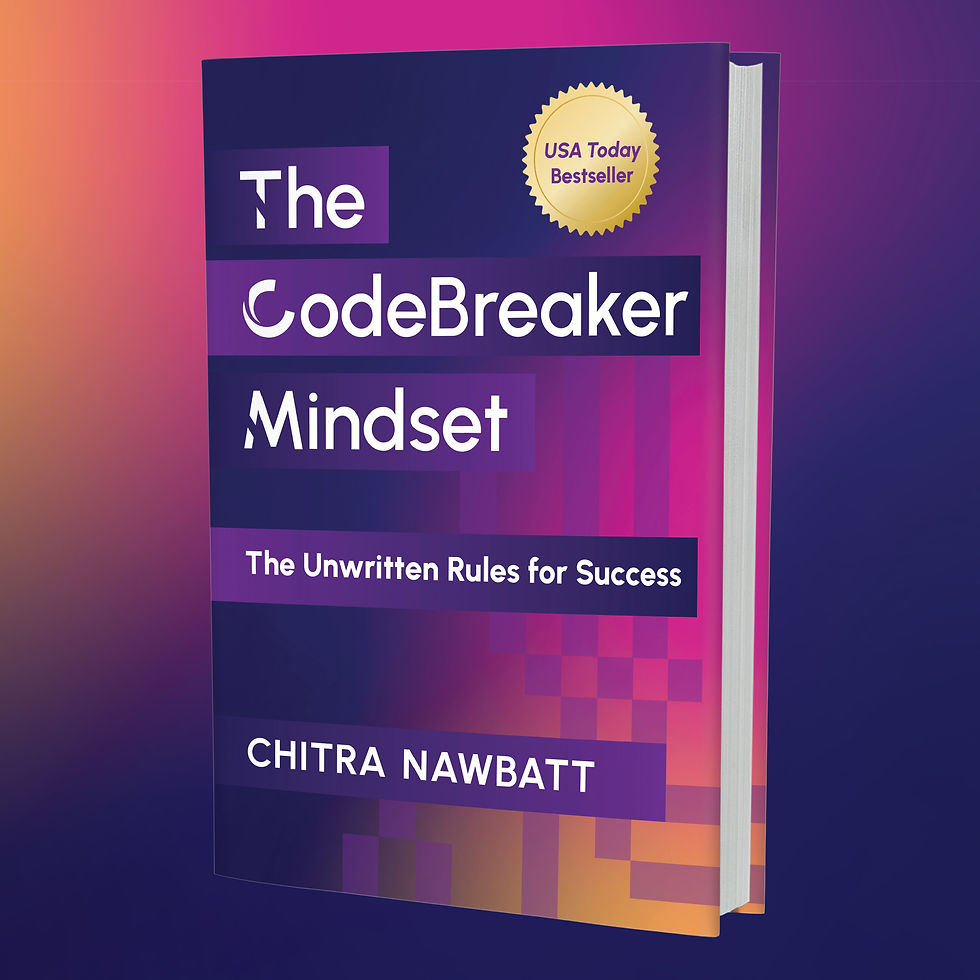
The CodeBreaker Mindset™ Ft. Jon Korngold, Blackstone, Global Head of Blackstone Growth


In this conversation, Jon Korngold, Blackstone's Global Head of Blackstone Growth, shares insights from his extensive career in investment, discussing his journey from Goldman Sachs to Blackstone, the nuances of growth equity versus private equity, and the importance of leadership, pattern recognition, and navigating complex stakeholder dynamics. He emphasizes the role of serendipity and intuition in investment decisions and outlines the principles of ‘The CodeBreaker Mindset™’—a philosophy that encourages agility, authenticity, and continuous learning in the face of change.
Chapters
(00:11) Introduction to Jon Korngold and Blackstone
(00:33) Jon's Career Journey and Growth Equity
(10:04) Understanding Blackstone's Investment Strategy
(13:47) The Dynamics of Growth Equity vs. Private Equity
(16:23) Unwritten Rules of Investing
(20:44) Leadership and Endurance in Investing
(24:35) Pattern Recognition in Investment Decisions
(36:19) The Pivots
(41:58) Navigating People Dynamics in Business
(52:36) Defining Serendipity and Its Impact
(01:03:11) Cultivating The CodeBreaker Mindset™
Episode Resources
Jon Korngold | Bio
Chitra Nawbatt | Bio
The CodeBreaker Mindset™ book order here: Amazon | Barnes & Noble
The CodeBreaker Mindset™ Ft, Jon Korngold, Blackstone, Global Head of Blackstone Growth
Chitra Nawbatt (00:11)
Welcome to the CodeBreaker Mindset™, where leaders and influencers share their path to achieving goals and dreams. I'm your host, Chitra Nawbatt, joining us today is Jon Korngold, Blackstone's Global Co-Head of Technology Investing and Head of Blackstone Growth. Jon, welcome. Thank you for joining us.
Jon Korngold (00:29)
Thanks so much for having me. I really appreciate it. It's a privilege.
Chitra Nawbatt (00:33)
You've had a career as a distinguished investor for over 25 years at globally top ranked firms, starting at Goldman Sachs, then General Atlantic, a multi-billion dollar asset manager, and now Blackstone, the largest alternative asset manager in the world with a trillion plus dollars of assets under management. Take us through your journey.
Jon Korngold (00:56)
I wish I could say it was more planned than not. I mean, I feel like in some ways that my career is kind of mirrored a little bit like Forest Gump. I had a lot of different leadership roles. None of them ever made sense to me one to the next, but after kind of 25 years, it allowed me to develop a pretty nuanced appreciation for kind of the, how the growth equity business was evolving around me. and I was really privileged to have some phenomenal mentors and institutions to be part of. I learned a ton at Goldman Sachs, many of the relationships I picked up in those early years coming out of college became influential mentors for me for the rest of my life. And in many ways, it even led to my joining General Atlantic after Goldman Sachs. I had a wonderful long tenure at General Atlantic was there for 18 years. It's a phenomenal firm. I am just thankful for the opportunity I had there. And on the back of that work that I'd done there, had the privilege of joining Blackstone about five and a half years ago, charged with an opportunity that if you give a blank sheet of paper to fundamentally re-imagine how do you go about supporting the needs of these later stage growth companies are the things you might be able to do that some of the existing incumbents in the ecosystem either structurally or philosophically were not as well set up to do. And so for me, it's a real privilege to be here in my current role.
Chitra Nawbatt (02:06)
So how did you go from Goldman Sachs to General Atlantic and then Blackstone? Was it a recruiter? Was it through colleagues you had worked with?
Jon Korngold (02:15)
Yeah, it was, more the latter. You know, for me, I've always followed, you know, kind of good mentors, right? I mean, you can get lulled in and kind of find the allure of joining fabulous names on a resume, but then, end of the day, so much of your development and the opportunities, the nurturing and the development that mentors kind of placed into me. And I try in turn to pass it forward to, many on my team. And so I had the privilege of working with a couple of fabulous executives at Goldman Sachs.
A couple of them left to actually become partners at General Atlantic. And when they landed at General Atlantic, they called me and said, would you like to join our team? So I spent my summer during business school at General Atlantic and I was privileged to be given an offer at the end. And then the rest is history from there.
Chitra Nawbatt (02:56)
And how did you choose to get into investing? How did you even know about private equity?
Jon Korngold (03:02)
I didn't know much. i grew up in a family of medicine. My dad was a doctor. My mom was a nurse. My brother's a doctor. My wife's a clinician. I thought for sure I was going to end up kind of following the family business. you know, for me, I just simplistically knew there was a world where you had doctors, lawyers, and then there was business and kind of a catch off everything thereafter. I had no contacts on Wall Street. And when I got to college, you start to get surrounded by people with so many different backgrounds and interests. And it opened up my eyes to a set of opportunities that were beyond kind of the more myopic view of healthcare that I had in the world. And they said, Hey, you, think you'd be pretty good at this corporate finance and banking side of the world. Like at least take a couple of meetings. And I did, and I met the folks at Goldman Sachs. One thing led to another, and I had a chance to join as an analyst. And it was a wonderful opportunity. I started their M&A group in New York for a couple of years.
And then I had the chance to go move out to London to go work on large scale industrial buyouts. And that to me was a fabulous opportunity because I never spent time in Europe before. I spent time previously in China, but never had a chance to spend time in Europe. And so it was just a wonderful confluence of getting exposure to the buy side, as well as getting kind of maybe further refining a cultural sensitivity that maybe I knew I had innately, but I never had a chance to really refine and spending some time in yet another continent proved to be for me a seminal moment.
And so I'm really thankful for having that chance to do that.
Chitra Nawbatt (04:24)
So you talked about when you went to General Atlantic, there were some mentors, some colleagues who you had worked with brought you there. You were there for 18 years. How does Blackstone then say, hey, Jon, come join us and we're going to give you a blank sheet of paper at that time about five years ago, right? And then you raised the largest first time growth equity fund at around $4 billion. How does that happen?
Jon Korngold (04:51)
Yeah, was truly serendipitous in many ways. obviously I've been a massive admirer of Blackstone. And I've always kind of viewed Blackstone as like being, I'm a New Yorker, so bear with me, being asked to go play for the Yankees. You get a chance to go play for Blackstone. Like you have to take that call very, very seriously. And I had a lot of history with the firm. We had sold some things to Blackstone. I'd seen kind of what they were able to do with the assets that we did sell them.
I knew a number of the senior executives here and had tremendous respect for kind of what they had built and the culture of the firm they had established. And so in just comparing notes on kind of how the business of growth equity and private equity more broadly was evolving, I there was a shared view, both by Blackstone and then by me, which is in a world where it was easy enough to get away for so many years of just finding the winner, there was enough capital chasing after opportunities that that was no longer sufficient.
You had to be almost in a position to use the strained analogy to make the winner. And therefore those growth equity firms who can align themselves with the largest base of strategic and operational infrastructure will have a far better chance of creating more consistent value through a cycle through operational acumen than just kind of this beta play or this index fund that so much of the industry had evolved into. And so I think that the thesis that resonated with Blackstone, certainly in my mind, is that if instead of having a venture heritage approach to growth equity investing, if you can take a private equity approach to portfolio construction, so very concentrated portfolio and a private equity approach to operational involvement, they're getting really hands on with the companies with whom you partner and then taking a private equity approach to risk management. Right? How do you cut off a lot of that left tail of risk and volatility often associate with growth and technology investing. If you can do that, you really could become the Sleep Well at Night Growth Equity Fund. And my idea was, this is the last bastion of a cottage industry in the equity space, that is growth and venture. And if you can almost weaponize this cottage industry by gaining access to the resources uniquely available to a firm with trillion dollars in assets, you can bring those end state operating resources to companies in their proverbial adolescence.
You can help many of these companies fight way above their weight class and in doing so, kind of minimize some of the execution risks that go from adolescence to adulthood. And so I was really compelled by that chance to have that blank sheet of paper. And I think Blackstone saw in me someone who speaks Blackstone fluently. I think about free cashflow and I'm equally comfortable talking to someone about a Fulcrum security or a change of control tax asset as I am an entrepreneur in a hoodie in Santa Monica. And so I speak Blackstone fluently. I just happen to be authentic to growth having practiced my craft in this space for 25 years.
Chitra Nawbatt (07:40)
How much of it though was Blackstone already having that point of view, or are you pitching that wonderfully rich thesis and approach that you just did? So that's one aspect. And them tracking you, had they been tracking you in the market? And I say this because oftentimes we're here sort of chipping away, doing our woodworking, right? Wondering, is anybody noticing our good work? How does it get to that altitude of a Blackstone to say, Jon, come, pitch us this idea or here's what we're thinking or a couple of your critical relationships in the market were at Blackstone and so you had been on their radar for some time.
Jon Korngold (08:18)
Yeah, I don't know how long I was on their radar I mean by definition, it had to be a while because I did have longstanding friendships and kind of personal and professional relationships here. And so that goes back to, you know, 2006 or so when I was in London, I met a couple of the senior folks, many of whom now are on the management committee here at Blackstone. And so, yeah, there was a kind of a good two way mutual respect. And I think through that regular dialogue, I maintain more on a personal level. I think they had a pretty good sense of the types of deals I looked at. I think importantly, the mindset that I approached that I wasn't a venture capitalist. I wasn't looking to make 100 investments and have 30 of them go bust and 50 of them go sideways and 20 of them end up making your fund. You know, was much more, maybe it's my days are Goldman Sachs and the industrial buyout space where I really do think about risk and more of a PE lens. just happened to have chosen a different path in terms of growth equity. So I think what I was describing was not in any way different than what Blackstone was already doing at a different scale for later stage companies. And so it just, felt like a very, very natural meeting of the minds when we were just brainstorming about what that blank sheet of paper could look like. And so think a combination of they were aware of some of the deals that I had worked on, cause I sold some companies that was involved with two Blackstone years ago. And so think they got a feel for what I was like on maybe the other side of the table, if you will. And then just more broadly, it was just comparing notes over an extended period of time.
And I think when Blackstone realized it was such a rich vein of opportunity to help these companies with access to a set of resources that historically never been introduced to the growth equity market. It just felt like the right moment for me to maybe try that blank sheet of paper and see what we might be able to do if it's not encumbered by decades of a certain way of approaching the industry.
Chitra Nawbatt (10:04)
Now, not everyone might fully appreciate the complexity and understand what Blackstone is. Tell us about Blackstone, what you invest in, and then talk to us more about what is growth equity.
Jon Korngold (10:17)
Sure. So Blackstone is an incredibly well-diversified alternative asset manager. They're one of the largest owners of real assets in the world. Everything from hotels, like historically the Hilton hotels, or hospitality assets like Merlin Entertainment, that's like Legoland or Madame Tussauds, for example, all the way to companies like Spanx and Supergoop and Bumble and Oatly and a handful of other household names. And it's a wide range of spectrum. There's equity, there's credit, there’s infrastructure, there's energy. So it's a mini economy of sorts. think if last time I checked, I think it was close to $300 billion of revenue or so was kind of accounted for across the broader kind of Blackstone ecosystem. And so that affords you a massive base upon which you can amortize a tremendous set of, of operational infrastructure and assets that standalone firms rarely can can match. And so, you know, we do a lot of that across a range of cap structures. And in doing that, it allows us to better monetize the exhaust of our IP as opposed to just kind of force fitting one solution to the extent that you meet a company and they say, well, how about some growth equity? And then entrepreneur says, I don't need growth equity. Then you pause awkwardly and you're like, how about some growth equity? Cause that's all you got. Whereas like in a firm like Blackstone, you're able to much more, think thoughtfully come up with a bespoke solution for what's right for that company at that moment in time.
And I think that ecosystem becomes highly kind of self-fulfilling and it's a range of investment sizes and structures as a result of that. Where I sit in growth equity is first in the role of kind of tech investing more broadly, think of my role as a cross pollinating bumblebee that connects our sectors and regions and asset classes and helps to answer the question, how powerful could it be if Blackstone only knew what Blackstone knows?
And so by being able to kind of harness the signal from all of our disparate assets, it ensures that we're hopefully staying on the right side of history thematically and finding companies that have an inherent survivor bias. In my day-to-day role leading growth equity, growth equity for us in particular, it's well beyond kind of venture stage. I'd say these are not the binary risks where if you build it, they will come or it's someone in a garage, nor is it the..
Chitra Nawbatt (12:36)
Right.
Jon Korngold (12:37)
…exposed growth, very, very mature company. These are companies I'd say in their proverbial adolescence, but there may be like in adults bodies, right? So they're still trying to kind of get to adulthood and they don't need our capital. And that's the irony of our business in growth equity. These are companies that are generally profitable, very well performing companies like Spanx and others. But the opportunity for them is how can they pursue transformational growth?
Kind of taking regional champions and make them the big global champions without incurring a lot of the mistakes we made. think if you, you know, the hard nose of truth of growth, growth equity and private equity is I think many cases entrepreneurs bring us in for the things we did wrong, not for the things we did right. We're just not dumb enough to make the same mistakes twice. And so to the extent that there's a cumulative repository of mistakes that we've witnessed and made over 40 plus years, it can bring those lessons back down to companies in that growth trajectory, hopefully allows them to get to kind of that end state without incurring a lot of the mistakes that are preventable and the pattern recognition that comes in. That's really the essence of, I think, good investing is that pattern recognition.
Chitra Nawbatt (13:47)
And actually, we're going to get into the pattern recognition in a moment. If you could also just talk a little bit about the size, dollar, give a sense of the dollar range on the private equity side versus the growth equity side.
Jon Korngold (14:01)
Sure, so in private equity, we typically are looking for control transactions. So we have a business called Blackstone Capital Partners, and those are partnering with companies like Merlin Entertainment or the London Stock Exchange or UKG or Ancestry.com. Those typically involve very, very large checks, i.e. billion dollar plus equity type commitments. In our world, in growth equity, our checks are large for growth equity, but small relative to what I just described. So average investments, probably closer to $250 million, two or $250 million company investment. Generally minority investments, about 70 % of the time, you we're alongside and founder who doesn't want to sell full control, but realizes maybe there are some merits about having an alignment with a supertanker like Blackstone to help them take advantage of a set of opportunities in a way that less or well capitalized competitors wouldn't have access to.
And we'll typically on average have maybe 20 % ownership stake alongside these companies. We're not relying on debt or leverage to generate our returns. We're really focused on ensuring that strong organic growth is the primary driver of our returns. And we do that through all these company building resources I alluded to earlier.
Chitra Nawbatt (15:19)
So just like how LeBron James, the global basketball icon, has his scoring card and his all-time greatest scorer, how about you, Jon? Give us a sense of total number of investments, number of companies that either you've taken public, gotten exits, a sense of the dollar value, the value that you've created on planet Earth.
Jon Korngold (15:45)
Yeah.
Yeah, gosh, I mean, it's certainly not LeBron James. I mean at least, change, know, dissuade you of any notion that, that I, I mean, they were close to that, to that ecosystem and in the investing world. you know, that said, look, I've had the fortune of being in this game for quite some time for someone in our industry. I've been, you know, again, a part of a team and General Atlantics amazing firm. And we don't win business as any one individual. Blackstone's an amazing firm. don't win companies cause it's just Jon Korngold.
But to the extent that I've had my fingerprints around some of these investments, I mean, that has translated into billions of dollars of capital deployed. And fortunately, billions of dollars of capital returned on behalf of our clients whose money we manage.
The Rules of the Game
Chitra Nawbatt (16:23)
Let's get into the rules of the game, because you've started to touch on this with risk mitigation, pattern recognition, these elements. Let's get into the rules of the game. How did you figure out the written and unwritten rules of the game in investing? Especially since you said you didn't come from that, right? Mom and dad were in the medical industry, doctors, nurses. How did you figure out the written and unwritten rules of the game? And then what are those rules?
Jon Korngold (16:51)
Yeah, the, the unwritten is so much more important than the written. I think, you know, a lot of people love to draw this mystique of what we do is so difficult and so, you know, arcane. And the reality is it's just, you're trying to be a good sounding board and a good partner to management teams. And, know, a lot of it sounds trite to say, but first it starts with good mentors, right? You learn from people, people around you. I think secondly, you only have one reputation in life, personal and professional. have to be a hundred percent referenceable. You have to be known as someone.
that will do exactly what they say you will do exactly what you say you will do, always, without compromise. I think that's really important. Again, we take that for granted, but in a world where everyone views it as like, you've got these masters of the universe and private equity, that's so far from the truth. Like you have one reputation, there's so many pools of capital that good entrepreneurs can choose from. So if you're not 100 % referenceable, I think that is a death knell as an investor. I also think that bringing a healthy dose of humility.
I think you have to recognize you're not going to create anything in the four walls in my office here at Blackstone. So you've got to get out and learn and surround yourself with people who really do know a lot. And if you're good at your job, you're connecting some of those dots. You might hear someone point to this direction, another one point there. And if you're good at that pattern recognition, you start to interpolate, maybe the world actually is going here. I think that's very, very helpful. 90 plus percent of the meetings I take have nothing to do with the deal, ironically.
information nodes, if you will. There's nodes and spokes. And if you can find people that are really, really knowledgeable and super connected in what they do in their respective craft, by definition, then you benefit from all of that. And you know, one simple exercise, I still do this to this day, I did it as an analyst as well. At the end of each day, I jot it down, what did I learn today? As simple as that, like literally, if I can learn one thing, it could be about surfing, it could be about, you know, private equity deal structure. But if you can learn one thing a day, and hopefully even more than one thing a day, and you do that 365 days a year, and you do it across your whole career, you become pretty wise, right? And I think that wisdom, this insatiable thirst for knowledge and learning, and you bring, again, this dose of humility where you'd say, I am just here to be a sponge, and then really then digest and then figure out where the world might be going. That's very, important.
I think that I read voraciously everything from newspapers to magazines to trade journals to investment memos. And each time I read, each time I speak with someone, hopefully I can get something from that. And ideally I can give something back as well. think that's important is viewing kind of this as a longer term relationship and not a transactional one way. So I go way out of my way to try to be for people who do well by me, I do much better by them ideally. and that's the way I think you keep a good reputation in the market where people want to be your partner, right? And growth equity, especially where these companies are profitable. These are fast growing companies. They don't need your money. They're looking for a partner rather than an owner. So I think EQ is much more important ironically than IQ. A lot of times people overstate the IQ. It's like, can you be this person's trusted sounding board and partner and not just a fair weather fan? I can you really be there in the trenches and help advise and guide with the best ideas you might be able to bring as these companies incur different challenges?
So think some of those are some of the unspoken rules. think don't be afraid to ask questions. Ask too many questions probably. I'm always trying to learn from people around me. over time, you start to get smarter and you develop your own point of view. And eventually you become a node and you become someone hopefully that people in the industry view as having some insights that are additive to their own learning. And so the more you can kind of fulfill that.
I think that the more essentially you become in kind of that ecosystem in which you're playing in.
Chitra Nawbatt (20:44)
Jon, can you go a little bit further and break it down for us in terms of the endurance and the leadership element, right? Because it's one thing to come out of, whether you come out of a top school or a school that's lesser known, you could say some of the written rules is as, hey, you gotta have the strong technical analytics, right? And then as you said, it gets into the unwritten, but you now have been doing this for more than 25 plus years and not just doing it, succeeding and leadership at the highest levels.
Right? And that gets into a highly filtered population globally. There's only so many of you. Right? And so from that perspective, you know, what were those, whether it's a written or an unwritten rule to get to that level of global leadership, top ranked, elite class?
Jon Korngold (21:33)
Yeah, I, I, I, again, I, it's, I don't want to put myself in that category. It's kind of either kind of put, my, myself in that level. I wouldn't, as I view myself at that level, but I do think if I look back at what's kind of worked well for me, I think there is a strong technical base, right? I was well-trained and I had a chance to work in a lot of transactions and that pattern recognition. I think I'm reasonably quick study. Well, I might not know everything. I know how to one, one degree of separation away from someone who does, and therefore I'm humble enough.
to want to learn from them. So I think the core, like foundational skills, I think it was well trained and I think I'm reasonably good at those. Now I think the probably more important one going back to the leadership, there a lot of good people who are good investors who might not be good leaders. And I think, again, going back to my mentors, I think some of the very best people for whom I worked and I try to emulate a lot of those styles, I think the first is as a leader, you have to be very quick to deflect credit and absorb blame for your team. That's very important. A lot of people are just quick to throw other people on the bus. Again, it goes back to you have one reputation. Secondly, I really am trying to get the best out of the people, not the most out of them. And that's not semantics. I mean, if you think about that, I really am trying to surround myself with people where if I can use my perch and my resources, allow them to kind of spread their wings and become the very best versions of themselves and kind of help empower them to achieve what they're capable of doing. And look, the more they can do, then by definition, the more it allows me to do other things. And that's given me kind of upward trajectory in my career is not trying to kind of micromanage and steal credit from those around me. It's instead, how do you empower those people? I think also setting a good healthy balance of work and life. I think it makes you more grounded. I think it makes you more relatable. All you do is work and you have nothing else that's defining you.
I'd argue that in our industry where it's just a collection of relationships, the more, I'd say, interesting backgrounds or experiences you have, it just gives you a better chance to connect with people. So you really are looking for people who, well, they take their work seriously. They don't take themselves too seriously. And in many ways, they're defined as much, not by more than what they're doing outside of work, than they are in work. And I think that becomes a self-fulfilling prophecy of finding relatability, balance, family.
I think that's really important. Like I work all the time, like all of us do in our industry. But it doesn't come at the expense of seeing my family. I'm there for my kids. I get home to see them for dinner. I'm there at every parent teacher conference. I'm there at every game. That to me is a really important grounding element. It just forces me to be that much more efficient and better as both an investor and as a manager for me to kind of find that balance. Now it probably comes at the expense of not seeing my friends or colleagues or whatever as often as I'd like, but outside of work. But I spend that time with them during the day and the rest of my time is with my family.
Chitra Nawbatt (24:35)
You talked about a couple of times, pattern recognition signals. Let's get into the secret sauce of how you invest. What are the data signals, pattern recognition that cause you to invest?
Jon Korngold (24:53)
Well, first of all, I guess you break that down. You gotta look at the market, right? Is this a big enough market? I have a simple rule, and maybe it's overly simple, is if you have to size the market, it's probably too small. I'll just start with that. If it's not too small for you, it's too small for the next buyer. So you're looking for big, open-ended markets where if you can get the right company, they're gonna take advantage of a tremendous set of opportunities. I think that's number one. I think number two, you wanna make sure you're getting behind management team that has the utmost integrity. And two, one of things I look for is in a meeting with the CEO, for example, is how often are the rest of his team members or her team members speaking in a meeting? That's a really important signal. Because if you see this cult of personality of a very charismatic entrepreneur, and that person is dominating the entire conversation and no one on their team is empowered to speak, that shows a real blind spot for that manager. That's another one I am
looking for. Because are they really capable of surrounding themselves with like truly world class talent that gives them a bench to draw from as they continue to scale their business? very good people are not just going to sit there passively and hold the bag for forever. So that's very telling. Oftentimes hiring people from industries that have very high operating margins, masks, it makes up for a lot of operating sins. And so ironically, you know, finding management teams who've maybe come from tougher industries or lower margin industries or ones there might be some binary risks. It might be reimbursement risk and healthcare, for example. Those generally translate to more agile management teams because they're constantly living with the risk of this existential threat to their core business as opposed to investing in a company that's got 95 % gross margins. Like you can get a whole bunch of things wrong and still be okay. So that's another thing I look at. You look at the underlying business model itself, like earnings matter. Like in our industry, it's been very easy to kind of excuse away growth at all costs. And you can have this cash hemorrhaging unicorn because don't worry, you'll raise the next round and you go public. You know, that the end of the day, that's, that's just my mind, the foolish way to invest. You've got to look at, does this thing generate cashflow at some point? It has to, if it doesn't, it's not really a good business and you shouldn't invest in that. And then lastly, and I think this most recent market correction kind of put, pushes the thinking on this. I always used to believe that you only cry once when you buy the best, right? Or you don't want half price sushi is maybe a different analogy. So it's worth kind of paying a full price. But we just realized then what we endured with this 40 % market correction is you can actually even pay too much for a great business. So there's a difference between a very good company and a very good investment. And I'd still rather err on paying a full side of a fair price for a better company than a really good price for a crappy company.
But there is a limit and you've got to think about the risk reward. Are you going to get sufficiently compensated for the risk you're taking in stepping into a company at a moment in time? And I think you do have to be grounded in valuation as well as part of that as well.
Chitra Nawbatt (28:02)
So that risk reward equation, is that the biggest difference then between a good company versus a good investment?
Jon Korngold (28:10)
it definitely definitely plays into it. I mean, you can look at it through deal structure. You can look at, know, kind of where you are in the cap table. but as a general rule, especially in our world where you're investing alongside a management team, we're not buying out the entirety of a company. If we get a good deal at management's expense, they're going to resent us and vice versa. So you both have to find yourself sufficiently uncomfortable with the outcome. And chances are, means it's probably a fair deal. If you can't find that bridge and you have to start relying on all sorts of crazy structures with bells and whistles to bridge that gap, you're probably setting up a misaligned relationship. And that's something generally we've always sought to avoid.
Chitra Nawbatt (28:49)
And as you just took us through your pattern recognition of when you said looking at the market opportunity, you don't want to have to size the market that is too small. The CEO, the team, can you give us an example to bring it to life, whether it's Spanx or another company that you've invested in, just to bring it to life for people, for all of us.
Jon Korngold (29:06)
Yeah, sure. Yeah, you just said Spanx or Supergoop. Those are two great examples. mean, take Supergoop for a moment. Sadly, Supergoop is one in five people will develop skin cancer at some point in their life. skin cancer is not a fad, sadly. And the best way to prevent that is through SPF application on a regular basis. Now, rather than a regular suntan lotion where you go on vacation and you slide yourself up with some sunscreen and you come back.
Supergoop is a much more kind of daily lifestyle product where SPF is incorporated into kind of the your regimen So last I checked I think it was 81 % of people who use super group use it every single day That's a very different type of purchase than a traditional consumer one You're dealing with big open global market, right? Regardless of your skin type or nationality or age, you know skin is sun is the biggest source of damage for Kind of aging. It's the biggest source of
obviously the cause of skin cancer. So preventative measures using daily SPF is the best way to kind of insulate yourself from that. But you're dealing with a business model that has a level of repeatability that's almost software like what I just described, but you're doing it with kind of a phenomenal cult like brand that people kind of naturally gravitate to the product itself. So you've got a great product with a great installed base. It's sold through multiple channels with a deep open-ended global market. So you're not just playing for a single threaded exit. And you've got a business that's got a fabulous brand and reputation that I think it'll be long-term very attractive either as this independent company, maybe public, or maybe one day a large strategic buyer would say, hey, this is a high quality name I should want in my broader portfolio.
Chitra Nawbatt (30:56)
So earlier you talked about information, reading a lot, synthesis. You actually use this word synthesis and the data points. Do you have a differentiated information gathering and synthesis process? What is it?
Jon Korngold (31:13)
Yeah, so I think one of the benefits of being at a firm like Blackstone is, we are almost like a proxy for the real economy. Like we see things at the scale that we're in. We saw inflation rising way earlier than I think you are seeing pundits on TV or even the Fed for that matter. There's a lot of what's out there is lagging indicators. We're seeing real time data. You know, we're one of the largest owners of single family and multifamily homes in the country. We're one of the largest owners of student housing, of ecommerce, logistics warehouses, Hotels. We buy centrally on behalf of nearly 740,000 people across 70 plus spend categories. And so when you're buying at that scale, almost as a global five company, it really does give you insight into where wage inflation might be happening, where are we seeing slowdown in consumer spending? You know we were one the largest owners of ports in the United States. That gives us a phenomenal view into just pallet shipments and activity. And so to the extent that you can harness that information, it becomes unbelievably powerful in terms of really allowing us to see things that standalone businesses couldn't otherwise see. Because you really have this luxury of this massive economy of a trillion dollars of assets that are so diversified by region and sector that it's such a rich tapestry of information we draw from. So that would be number one. And that is a unique advantage, I think, to a firm of Blackstone scale and diversification.
Secondly, I strongly believe you cannot be a generalist and be relevant to this day and age. I think those days are long gone. You really have to be deep specialists. And so we aspire to have our work be led by thematic work, like really figuring out where is the world going. And let's get to know the companies that'll be the beneficiaries of those trends long before it's fashionable to know them. So to the extent that you can really have a well-informed insight that's akin to almost being a manager in this space as opposed to just an investor in the space, that does give you an information edge. As opposed to, you one day we look at a rental car company, then we call McKinsey to get us up to speed on healthcare IT 101. Like that to me is a, that's a dying era. I don't think there's a real role for those types of firms anymore. It's become way too competitive and information is your only end goal right now.
Chitra Nawbatt (33:33)
How do you think about data, information and feedback from the dimension of, I think three sort of broad types, information and feedback that's actually data-driven, that you can substantiate, verify, so independently verifiable data-driven versus perception-driven versus manipulation-driven?
Jon Korngold (33:57)
The latter, hopefully there's not too much. Generally stay away. If you're worried about manipulation, like you're probably in business with the wrong people. There's definitely biases, right? And I think what you really have to do is to offset those inherent procovities. So take growth equity. I'll put myself first and foremost. We are by definition optimists, right? We always look at the glass as being half full because we believe in innovation. We believe in disruption. So the way you offset that is to focus your attention in the investment committee, for example, on all the things that can go wrong. Because I can convince myself a thousand reasons why it's going to go right. So if you were to listen to our investment committee meeting, you'd swear we're a credit fund. We're constantly talking about how do you avoid losing money here? Because if you can convince yourself that you really have minimized that left tail of risk, then there's really good asymmetry to the upside. Because otherwise we wouldn't be talking about this company in the first place.
So it's just the nature of the queries, the nature of the questions, the nature of the analysis was designed to offset our own inherent biases and kind of proclivities. So you start with that in terms of process. The second thing is a feedback loop. So a lot of times I would say where I have been generally pretty good is predicting revenue growth. Where I've been relatively poor is predicting margin expansion. Rarely can companies pull off both where they grow really quickly and expand margins.
And so one way to offset my own underwriting in that regard is to have a feedback loop. So we have a portfolio committee who is, know, we have an investment committee, we have a portfolio committee. That portfolio committee is looking at, hey, once again, we missed earnings, but we made revenue. There's obviously something systematic in our underwriting. We need to adjust upfront to ensure that we're thinking about margin expansion, maybe a little bit more cynically. So when a management team says they're going to increase their operating margin by, you know, thousand basis points, rather than being inclined to accept that at face value or convince yourself, almost saying in the face of cognitive dissonance that you can get there, looking back and say, like, if it's really gonna grow that much, let's really double click and spend time on that. Because historically, the data says we're getting that one wrong too often. So a lot of that is just data driven. So one's process, and two is capturing that data as a way to re-inform how do you underwrite these deals to avoid making the same mistakes twice.
The Pivots
Chitra Nawbatt (36:19)
Now, what you're getting into is about the pivots, risk mitigation, the elements that you just outlined there. Let's talk about the pivots. When you make an investment, you're holding it for five years or more, right? And most of those elements, you talked about it, market forces, people, processes, systems, the economy are dynamic, not static. So what is that process of how you manage, steward your investments? Talk about that pivot process in business and investing.
Jon Korngold (36:55)
Sure. So the first thing just for us structurally, we've really decided to have a much more concentrated portfolio than what typically exists in growth equity. So the average number of board seats per senior professional on my team is about two. That stands in stark contrast to traditional growth firms where it's not at all uncommon to speak to a partner at a growth equity firm and they might be on five boards or 10 boards or I just recently interviewed someone who was on 23 boards.
Legitimate 23 boards is like at that point by bother being on the boards in a bull market and get away with that right when you live through a corrective moment. Unfortunately, you are forced to choose among children because you got a finite number of operating resources. You have a finite amount of bandwidth and your time in your day. To kind of help your portfolio companies and you do end up choosing among children by having a much more concentrated portfolio. Fortunately, we put ourselves in position we don't have to choose among children. That's really helpful
Chitra Nawbatt (37:23)
Yeah. Yeah.
Jon Korngold (37:51)
So just physically being present is just available to help navigate some of these problems. Because 100 % of our companies will hit a pothole. 100%, all of them will, inevitably, for all the reasons you said earlier. And the question is, do you have the bandwidth and the resources to get that company back on the track? And I think that structurally was kind of a core element of how we set up BXG, Blackstone Growth, which was, how do we ensure that we can pay attention to our companies across all elements of a cycle, not just the bull market, when it's convenient to do that. That's number one. Number two, it gets back to agile management. Second one. And three, you hopefully are investing in companies where you do bring some strategic angle, i.e. where you do have a set of resources that on balance can maybe shape the trajectory of these companies to withstand some of the economic headwinds you might be enduring.
Chitra Nawbatt (38:45)
So what's that? Sorry, no.
Jon Korngold (38:49)
I was gonna say, we recently invested in a hotel accounting software business. And we own a whole bunch of hotels. And so we have a very informed view on that. And so as these, company's trying to serve a whole ecosystem of hotel owners, we tend to be one of the larger ones. And so we are able to help them navigate what's the pain point for the hotel owner as we go sell it, because we're one of the largest ones. And so through that lens, we're able to kind of, I think, pass on some of those lessons that allow these companies to maybe navigate choppy storms in a way that on their own in a vacuum, if you don't have the luxury of having one of the largest hotel operators in the world in your cap structure, like you'd kind of be out of it alone. And that's a huge advantage I think we bring across cycles.
Chitra Nawbatt (39:34)
Is that then where the playbook comes in? Cause private equity is known to have value creation playbooks, right? If you could tell us a little bit of, you know, in terms of what that is at Blackstone and what that process is, because it is, you know, for lack of a better word, I want to say experimentation. This is not experimentation by any means, but it's running a playbook. You get feedback, the feedback loop in terms of then how you course correct not only that particular investment, but other similar investments you may have over time and where you see pattern recognition pattern matching.
Jon Korngold (40:08)
Yeah. Yeah.
Yeah. So, we don't have a playbook, right? I think, you know, there might be some firms that show up and say, you're going to, this is the playbook you're going to operate. mean, what we're trying to do is serve as an extension of the bandwidth of management teams to help them take advantage of a great set of opportunities that maybe through our help become viable opportunities as opposed to quixotic ones on their own. but you have to be, first of all, you have to earn your involvement, right?
Just because you own a stake in the business doesn't guarantee you that seat at the table. So, and the way you do that is by being acting like as an invited guest. We're not wallflowers to be clear, but at the end of the day, you're getting behind strong leaders and strong management teams and you're trying to be an objective sounding board to really push their thinking. But fortunately for us, because most of our companies are profitable and they didn't need our money, we're there more on a pull basis than a push. You will follow this playbook.
We're there because they want our input. They want our active involvement. And that ends up becoming this wonderful self-fulfilling prophecy. Because if you've got that dynamic with a management team, it allows you to maybe have an outsized strategic and operational influence, regardless of your level of economic ownership. So that's one way we really are trying to kind of help these companies pivot, when we can have that voice. As opposed to saying, well, we're on the board because we're in the series C, D, E, F, G cohort.
and therefore you have to listen to us. That tends not to work over time in our experience. And it's kind of being that invited guest where you bring a thematic understanding of the markets in which they're participating in. You have a set of resources that you can kind of put your thumb on that proverbial scale to change the trajectory of these businesses. That's where you're gonna add value across the cycle.
Chitra Nawbatt (41:58)
So there's a couple of things there that I want to get into. When you talk about the influence, right? Not being, you know, not pounding the table or being heavy fisted, but using your influence, it's aligning a lot of very complicated stakeholders, management of the company, customers, fellow investors, markets, regulators, etc. So many complex stakeholders. How do you...
How do you deal with the people dynamics? Any bit of sort of secret sauce in terms of how you navigate the people equation? And more importantly, how do you deal with problematic people? People that say no or people that you can't get them to move off their position?
Jon Korngold (42:40)
Sure. Well, that's where pattern recognition comes in upfront. So you really want to pick your partners carefully. And there's a lot of times that you come across a great company with an incredibly strong-willed entrepreneur. I know everything. I got it. This is what I'm going to do. And thanks for your view, but I just want your capital. We self-select out of those every time. And I'd say probably more often than not, companies fall in that category. So it's
It's when you go through diligence, for example, instead of having a manager team that's defensive of everything you're doing, they're like, gosh, I love an outside view of what you think is up with my company, good and bad. Like take inventory of what I've got on all my dimensions, including my management team, by the way. And when you have that type of open invitation to really opine on a management team, that becomes very enlightening because it shows you how open-minded and enlightened is that CEO.
If you say, think your head of sales is A plus, I think your CFO is lower quartile. They're like, no, no, no, he's great. Like, okay, it's your business, it's your product. But you're asking me, I'd say he's lower quartile. And I think the more constructive response you're hoping to see in diligence is I'd love to understand why is that? Maybe he was my best friend in high school, he was an accounting major, he's really a controller, we call him our CFO. Can you introduce me to what you think are upper quartile CFOs across your portfolio?
which we do all the time. You have that type of dialogue, you've got a phenomenal relationship. That means you have a very, very mature, enlightened management team that's in place. So that helps you with the human capital side. And look, unfortunately, you do end up having to make some tough calls and that's always in partnership with the founder. And usually those calls are identified upfront during your diligence. Before we invest, we walk management through our outside inventory of what we think they've got on hand. We think this is great. We think this is less great. And our view and hope would be you'd make the following changes. And what do you think? And hopefully you come up with a shared vision of what the art of the possible is for this company to kind of achieve its long-term potential. And that almost always starts with the management team. And so those are some of the tougher conversations we'll have up front. But our goal is to not replace teams. We generally stick behind the core team and are constantly augmenting them as the business scales to a different level.
Chitra Nawbatt (53:16)
So given that intersection of what you just talked about, the human capital element and being exposed and investing in so many broad dimensions of technology innovation across frankly all industries, what type of mindset and skills will equip people for the future, especially to deal with the high velocity of change coming from technology and artificial intelligence led innovation?
Jon Korngold (45:31)
There's so much there. I think the first is so much of what we see today is not even going to be around in 15 years. Or they say most of the vast majority of careers that our kids will have are not even in existence today. Think 17 years ago, the iPhone wasn't even out. Think about how much our life has changed since then. It's almost unrecognizable that there wasn't eBay, there wasn't Amazon 30 years ago. And it's just like, how is that possible? Our whole life is kind of built around that ecosystem. So I think it's a applying just core frameworks, right? So how do you assess businesses, management teams, business models, kind of growth trajectories and apply that. And maybe I lucked out a little bit in my career. Was in tech, I moved to London, I ran the healthcare group for seven years, I ran financial services for seven years, I was chair of the firm’s portfolio company, was at General Atlantic.
And I didn’t, each time I had to bring a consistent framework and then populate it with a set of information over time and you know, I look back and I think that learning agility serves you well because there’s so much that you can’t anticipate, but can you stay calm? Like I never lose my temper ever, ever. I think that’s important one. I have a simple filter in life. My dad taught it to me. If something’s not going to bother you in six months time, don’t let it bother you today. I think that really starts to help you establish a hierarchy of what really is meaningful. It doesn’t mean don’t care about things, but like pick your battles.
Chitra Nawbatt (46:52)
Yeah.
Jon Korngold (46:57)
Because then when you dig in, allows you to really say, Jon actually does care about this. Let’s hear what he has to say on that. So I think learning agility, I think having a much more global perspective, I think that’s so critical. It sounds trite, you know, to me, that’s why I was so focused on moving to China and moving to London twice. I wanted to become more of a citizen of the world than just a citizen of New York city. And the more you can do that, the more pattern recognition globally you can bring. Cause so many of these, these trajectories and trends are converging on a global basis, not a regional basis. And so you have to be in firms, in my mind, that have much more of global aperture to them. So you can kind of feed off of that kind of mindset and resource. That’s super, super important.
Chitra Nawbatt (47:41)
You talked about, used the word battle and you used the word agility. What’s a critical situation where you were hijacked? If you can talk about hijacked by yourself, self-sabotage, and how you dealt with that and hijacked by somebody else and how you recovered, how you pivoted.
Jon Korngold (48:02)
Yeah, gosh, I probably have so many self sabotage stories. Come in and ask my wife, she’ll probably have a thousand to share in that regard. You know, I think, you know, there’s always this, this balance of, you know, wanting to draw on your pattern recognition, but recognizing sometimes that can be stale. Like there was a period of time where yellow page directories were really, really amazing business models and taxi medallions were amazing business models.
And then Google came along and Uber came along and yeah, it’s those are both crappy business models. And so as much as you want to kind of be fixated on, know this area, and therefore this is my pattern recognition. Think you have to remind yourself that the world is changing so quickly around you that if you allow yourself to be unfairly and unnecessarily rooted to what you know, you’re not going to be in a position to be as, as agile. Are going to get more caught flat foot. And I think there are a lot of times where I went into certain situations in our investment committee, just dogmatic about, know this area well, I’ve invested in five companies in this space and I’m telling you this is where it’s gonna go. Sometimes it really takes a fresh set of eyes to push your thinking, because you realize there might be huge subsectors I summarily dismiss because of some unfounded buyer that bringing an ignorant, I’ll put that in quotations, an ignorant set of new eyes to a problem, realize that gosh, like, you’ve got to get out your own way.
I think some of that, I’ve dozens of examples, if I think about that, where I went into these conversations thinking I probably knew more than I did based on historical success in an area without appreciating that so much of the world had changed. And some of the things that made those areas successful, like Yellow Pages and Taxi Medallions, are no longer founded on the same principles and foundations that they had going forward.
Chitra Nawbatt (49:57)
And what about someone else trying to hijack you or sabotage you? Because let’s face it, Jon, know, corporate America, but frankly, whether you’re in a startup, whether you’re an entrepreneur, corporate America, whether you’re at a big brand firm like yours, any firm, you’re dealing with lots of people, right? And not everybody wants to be a team player. Not everybody is about merit takes the day. So whether it’s a customer, colleague, a situation that, you you remember that was just critical to you where someone was trying to sabotage you.
Jon Korngold (50:02)
cash.
Chitra Nawbatt (50:26)
And how you how you dealt with that and how you how you pivoted how you recovered?
Jon Korngold (50:33)
Yeah, I find kind of that disloyalty or almost like treasonous behavior to me to be so off-putting. And again, you have one reputation in life. And I really do believe that water finds its level. I think you can’t let that consume you. You can only do what’s in your control. Like just you show up each day, you try to be a good partner. You’re always honest. You try to be supportive. You try to define your success by those around you.
Chitra Nawbatt (50:42)
you
Jon Korngold (51:00)
And, you know, in firms that value that mindset, which is a firm like Blackstone, you know, the nail that gets, it sticks up, gets hammered back in, i.e. that treacherous person that you described, they don’t last very long here at a firm like Blackstone. And, and so some of that is the organization almost has like organ rejection for those types of people. And no doubt, you know, I, at first I used to get really bothered if I saw someone being extra political or saying, I want your job, or I’m going to go.
You know, around you, I’m going to talk to the press, I’m do a bunch of others. And it used to hurt me so much because I pride myself on being a manager. In many ways, I’d rather be loved than feared, I suppose, at the core. And, when you realize that the people that are trying to maybe advance their own agenda, you’re like, my God, like I pride myself on being ethical and always doing the right thing. And I just does not compute. Like how could you act in that way? And I think over time, I think that’s just, I’ve learned to let that roll off my back. I’m confident in who I am.
Chitra Nawbatt (51:28)
Yeah.
Jon Korngold (51:56)
confident in the person that I can be and how I treat my partners in that regard. And then just say, look, that person’s obviously having a really bad day. I feel really bad that that person is so insecure that they’re willing to kind of compromise whatever integrity or morals they might have to advance whatever agenda they feel that they need to see advanced at the expense of those around you. It’s antithetical how I was brought up. It’s antithetical to I think how I built a pretty good reputation in the market.
It exists, like you sai’, unfortunately they happen and you jus’ hope that the passage of time kind of water does find its level and you end up surrounding yourself with people who share that same kind of mindset as you.
The Magic
Chitra Nawbatt (52:36)
You used the word serendipity earlier in our conversation. Let's get into the magic. How do you define serendipity?
Jon Korngold (52:38)
Yeah.
I think it was Seneca. Years ago they say luck is when preparedness meets opportunity. And there's so many examples. And I think first goes back to humility. To the extent that you feel that you are in control of your destiny, I think that's such a fool's errand. There's so much more around you that is outside of your control. I'll give you an example. I met my wife on the Crosstown bus on three serendipitous encounters.
Chitra Nawbatt (53:13)
What?
Jon Korngold (53:15)
She was running, I you, I tell my single friends like be on Bumble or take the bus, don't take an Uber, can't meet anyone there. But this week will be our 20th anniversary and I look back to that..
Chitra Nawbatt (53:26)
Hahaha!
Congratulations.
Jon Korngold (53:35)
…yeah thanks. So back to that serendipitous moment. She was running late, which never happens, and I was running early, which doesn't happen. I'm never late, but I always say being right on time, being almost late is right on time. And it just happened to be a day, it my very, very first day at work actually coming out of business school and I met her and my life changed because of that and I wasn't supposed to be back in New York until the following week. I ended up coming earlier. I ended up finding an apartment that was across the street from her. My life has changed on the back of that. I have three kids. I live here in New York. You know, it's as though that's serendipity.
You know, one of my, I got a job as an intern one time when a colleague or partner of mine had a child who was born prematurely right and that child was supposed to be born during the summer Which had that happened then he wouldn't have been around to be my shepherd for my summer internship and You know fortunately the son is now perfectly fine, but back then the son was born several months premature But that moment had he been born on time. I wouldn't have gotten my job I wouldn't have had my career a whole bunch of things would have since I think changed
And so everything in work and life is serendipitous. The question is, you prepared to take advantage of that? And are you prepared to take the calculated risks in life? And you'd see actually in the back of right over there on my wall, I've got a poem that throughout my whole career, I've always, not poem, it's a speech by Teddy Roosevelt, which is an excerpt of the “daring greatly” or the man in the arena.
And it talks about how it's not the critic who counts. It's the man who's in the, in the arena, whose face is marred with blood and sweat, etc who, even if he fails, fails darring greatly. And every single major decision I've ever made in my entire life, post college, I always looked at that little speech just as an inspiration, even like coming to Blackstone, I was scared shitless. And I was, I was, was a well established in my career. I was there for 18 years. The idea of like restarting myself and exposing, putting a light on me and saying, my God, like, what if I fail? I'm to fail spectacularly on this much bigger stage that Blackstone affords me. But I never want to kind of have that itch saying like, how fast could that car race? Like if he actually was on that track with that blank sheet of paper. And if I fail, then look, I failed there daring greatly. And I think part of that is embracing serendipity. There's a lot of things that not in your control, but what you can do is take those calculated risks and kind of see where it takes you from there.
Chitra Nawbatt (56:12)
So at that moment when you felt that doubt, that fear about, I'm going to Blackstone, what if I fail? This is after 20 years and after tremendous success. So even at that point, you felt that moment of fear, that doubt. What was that self-talk process? How did you charge forward?
Jon Korngold (56:32)
It's applied to any major move. I moved to China. I never left the country. I was like, my God. At the time, there was no email. There was no mobile phones, no smartphones. This is 1995 or so. I was out there. I'm like, my God. When I was at General Atlantic and they asked me to go do healthcare, I didn't know anything about healthcare. I didn't know anything about financial services when they asked me to do financial services. I didn't know anything about portfolio operations when I took on some of the responsibilities in that area. As you pointed out, when I made the move to Blackstone,
I'm like, my God, if I fail, I'm gonna fail daring greatly. And I think one is that adrenaline, there's an excitement of pushing yourself to always be uncomfortable, right? And really see what you can learn. I think two, it's drawing a little bit on the confidence of saying, I've done this before. I moved to London, I was successful there. I did healthcare, I was successful there. Went to financial services, I was successful there. I can be successful here.
And if anything, I could probably even more successful here because all these resources and brand and reaching convening power that Blackstone uniquely affords. So like take that chance. And I remember like I sat down with my kids on there, forget like when I told him I was leaving to go to the Blackstone and I had this whole inspirational speech and I'm like, hey, I want to make sure that like you and your respective lives, whatever you decide to do that you look for moments to really
Chitra Nawbatt (57:50)
Hahaha.
Jon Korngold (58:00)
take advantage of, you bet on yourself. And I was like, and this is why I'm doing that. like, I remember this at the dinner table and I had like this whole Jerry Maguire speech. And I was like, it landed so flat. My kids looked at me and was like, did we lose the Knicks tickets that they have? And I was like, what? I was like, that's what we're talking about here. I literally had like this whole prepared speech. And they looked at like, does Blackstone get access to tickets too? And I'm like, my God, yes, we can get tickets. Don't worry about the tickets. I'm talking about a life lesson here and you're talking about tickets.
Chitra Nawbatt (58:08)
Ha!
You
Jon Korngold (58:20)
And that you like the colors of like their jacket, like we have these blue jackets. I'm like, really? That's what we're focused on here. So, it's a little bit, bringing some, some light hardness and say, like, you fail, okay, you fail. But, you know, I was willing to bet that I wasn't going to fail. I'm, know, fortunately six years here later, and I'm really proud of, kind of what we built here. the firm has been phenomenally supportive of the vision that I set out to create. And we've got 50 people on the team and four offices throughout the world and about to launch our second pool of capital now.
Chitra Nawbatt (1:06:46)
Ha ha.
Jon Korngold (58:58)
You know, so just we've had some really good things and I'm proud, but there's not a day that goes by Chitra, I'm not constantly thinking about that, that, speech. So I'm like, every, every major decision in life is comes with consequences and you just have to have confidence in yourself and the people around you that if you fall, they're going to help you get back up.
Chitra Nawbatt (59:16)
And I'm continuing on that serendipity point. Is there an example where serendipity played a critical role in your investment returns?
Jon Korngold (59:25)
sure. yeah. For gosh totally. Yeah, I we picked the right ponds to be in and the right thematic area and get the right company but make no mistake. you know, you see certain companies that at a moment in time might have a uniquely strategic value to an acquirer and then they're paying a very, very big price. mean, gosh, I can think of many examples of companies like that, know, ones that we're you or you caught a tailwind on e-commerce enablement. Like one of my investments I'd worked on when I was at my last firm, this company called Audient, which is an amazing payments business. And it really was the first derivative way to play the growth in e-commerce and omnichannel. So buying online and offline. And this is one of the leading payment processors for that. Now you caught the right second of tailwind and it got rewarded with massive
kind of support in the public markets and that became a very, very successful investment that I was part of. But in part, that was serendipitous. I don't expect that much interest in volume to kind of manifest itself at a moment in time where we happen to have had a fabulous business in front of us. And so every day that's a, you're kidding yourself and way overstating your own alpha generation. If you don't give credit, there's a moment in time where you've got to take advantage of what's in the cosmos around you.
Chitra Nawbatt (1:00:47)
Where does intuition come in for you?
Jon Korngold (1:00:50)
That's huge, huge. It comes out mostly on the people. You just have that gut feeling, you when you meet someone immediately, the first 30 seconds, you're like, I can do business with this person or I can't. You just have that spidey sense. It could be whether you meet someone on a bus and you're like, hey, I could marry this person or you meet a management team saying, this person is gonna be pretty reliable or this person just gives me, I don't know, it feels like the ick and I'm not sure you can ever come back from the ick. And so you do have that.
You and you rely heavily on that intuition. I mean, you use data to hopefully either support or refute that instinct, but more often than not, your instincts are going to be spot on. And I don't know if that can be taught per se. I think it can be honed, but like some people I think are born with just a better sniffer, a better commercial lens to think about, you know, investment opportunities, but also I think just people in general, think being a good read of people is just someone I could build a partnership with.
Chitra Nawbatt (1:01:50)
Huh.
Jon Korngold (1:01:47)
Will that person be treacherous, as you pointed out earlier? I think you really have to rely on your instinct more often than not, because there's no playbook for you to go follow a checklist. Because a lot of everyone you see will check off all the boxes on paper. But if you don't have that special sauce, that sniffer, I think it makes it very, very challenging for you to kind of pick the right horses.
Chitra Nawbatt (1:02:08)
Jon, what's your take on The CodeBreaker Mindset™?
Jon Korngold (1:02:12)
I think it's a lot what we just talked about, which is, you know, there's so much serendipity in life. Some are headwinds for you, some are tailwinds for you. And how can you become agile and take advantage of those opportunities? But importantly, do it in a way that's authentic to yourself. You got just one you, you got one reputation. And I think you always have to use that as your true north, no matter kind of what the world is dealing you, positive headwinds or positive tailwinds or headwinds.
You have to maintain who you are. Never compromise your integrity, never compromise your morals. If you do that right, good things generally happen. So when I think about the CodeBreaker Mindset™, it's recognizing that most of what is around you is not in your control. And so that which you can control are some of your core basic principles. And if you do that right and you surround yourself with enough friends and nodes, they're gonna look out for you and make sure you stay out of trouble. Good things typically come from that.
Chitra Nawbatt (1:03:11)
So following on that, what's your advice on how to cultivate The CodeBreaker Mindset™?
Jon Korngold (1:03:19)
I'd say lunch at your desk is an opportunity wasted. I try to literally meet for lunch every single day, someone different, just to learn. And you've got to get out there. You'll learn a lot. You'll meet a lot of people. And I think each day, you're honest with yourself and you really try to think about what did I learn, that's going to make you better. And I'm always impressed when you hear, if you can get 1 % better every day by the end of the year, it's 37 times better.
Like that applies to our craft as well. So The CodeBreaker Mindset™ to me is how do I draw all that is great around us, recognizing so much and not in your control. But if you harness that right, you can do some amazing things and really ultimately bet on yourself. And hopefully you're in the right environment where people will support kind of you becoming the best version of yourself.
Chitra Nawbatt (1:04:09)
Jon, thank you so much for joining us.
Jon Korngold (1:04:12)
No, it's my pleasure. Thank you again for having me. I really appreciate it.
The CodeBreaker Mindset™ Ft, Jon Korngold, Blackstone, Global Head of Blackstone Growth
Chitra Nawbatt (00:11)
Welcome to the CodeBreaker Mindset™, where leaders and influencers share their path to achieving goals and dreams. I'm your host, Chitra Nawbatt, joining us today is Jon Korngold, Blackstone's Global Co-Head of Technology Investing and Head of Blackstone Growth. Jon, welcome. Thank you for joining us.
Jon Korngold (00:29)
Thanks so much for having me. I really appreciate it. It's a privilege.
Chitra Nawbatt (00:33)
You've had a career as a distinguished investor for over 25 years at globally top ranked firms, starting at Goldman Sachs, then General Atlantic, a multi-billion dollar asset manager, and now Blackstone, the largest alternative asset manager in the world with a trillion plus dollars of assets under management. Take us through your journey.
Jon Korngold (00:56)
I wish I could say it was more planned than not. I mean, I feel like in some ways that my career is kind of mirrored a little bit like Forest Gump. I had a lot of different leadership roles. None of them ever made sense to me one to the next, but after kind of 25 years, it allowed me to develop a pretty nuanced appreciation for kind of the, how the growth equity business was evolving around me. and I was really privileged to have some phenomenal mentors and institutions to be part of. I learned a ton at Goldman Sachs, many of the relationships I picked up in those early years coming out of college became influential mentors for me for the rest of my life. And in many ways, it even led to my joining General Atlantic after Goldman Sachs. I had a wonderful long tenure at General Atlantic was there for 18 years. It's a phenomenal firm. I am just thankful for the opportunity I had there. And on the back of that work that I'd done there, had the privilege of joining Blackstone about five and a half years ago, charged with an opportunity that if you give a blank sheet of paper to fundamentally re-imagine how do you go about supporting the needs of these later stage growth companies are the things you might be able to do that some of the existing incumbents in the ecosystem either structurally or philosophically were not as well set up to do. And so for me, it's a real privilege to be here in my current role.
Chitra Nawbatt (02:06)
So how did you go from Goldman Sachs to General Atlantic and then Blackstone? Was it a recruiter? Was it through colleagues you had worked with?
Jon Korngold (02:15)
Yeah, it was, more the latter. You know, for me, I've always followed, you know, kind of good mentors, right? I mean, you can get lulled in and kind of find the allure of joining fabulous names on a resume, but then, end of the day, so much of your development and the opportunities, the nurturing and the development that mentors kind of placed into me. And I try in turn to pass it forward to, many on my team. And so I had the privilege of working with a couple of fabulous executives at Goldman Sachs.
A couple of them left to actually become partners at General Atlantic. And when they landed at General Atlantic, they called me and said, would you like to join our team? So I spent my summer during business school at General Atlantic and I was privileged to be given an offer at the end. And then the rest is history from there.
Chitra Nawbatt (02:56)
And how did you choose to get into investing? How did you even know about private equity?
Jon Korngold (03:02)
I didn't know much. i grew up in a family of medicine. My dad was a doctor. My mom was a nurse. My brother's a doctor. My wife's a clinician. I thought for sure I was going to end up kind of following the family business. you know, for me, I just simplistically knew there was a world where you had doctors, lawyers, and then there was business and kind of a catch off everything thereafter. I had no contacts on Wall Street. And when I got to college, you start to get surrounded by people with so many different backgrounds and interests. And it opened up my eyes to a set of opportunities that were beyond kind of the more myopic view of healthcare that I had in the world. And they said, Hey, you, think you'd be pretty good at this corporate finance and banking side of the world. Like at least take a couple of meetings. And I did, and I met the folks at Goldman Sachs. One thing led to another, and I had a chance to join as an analyst. And it was a wonderful opportunity. I started their M&A group in New York for a couple of years.
And then I had the chance to go move out to London to go work on large scale industrial buyouts. And that to me was a fabulous opportunity because I never spent time in Europe before. I spent time previously in China, but never had a chance to spend time in Europe. And so it was just a wonderful confluence of getting exposure to the buy side, as well as getting kind of maybe further refining a cultural sensitivity that maybe I knew I had innately, but I never had a chance to really refine and spending some time in yet another continent proved to be for me a seminal moment.
And so I'm really thankful for having that chance to do that.
Chitra Nawbatt (04:24)
So you talked about when you went to General Atlantic, there were some mentors, some colleagues who you had worked with brought you there. You were there for 18 years. How does Blackstone then say, hey, Jon, come join us and we're going to give you a blank sheet of paper at that time about five years ago, right? And then you raised the largest first time growth equity fund at around $4 billion. How does that happen?
Jon Korngold (04:51)
Yeah, was truly serendipitous in many ways. obviously I've been a massive admirer of Blackstone. And I've always kind of viewed Blackstone as like being, I'm a New Yorker, so bear with me, being asked to go play for the Yankees. You get a chance to go play for Blackstone. Like you have to take that call very, very seriously. And I had a lot of history with the firm. We had sold some things to Blackstone. I'd seen kind of what they were able to do with the assets that we did sell them.
I knew a number of the senior executives here and had tremendous respect for kind of what they had built and the culture of the firm they had established. And so in just comparing notes on kind of how the business of growth equity and private equity more broadly was evolving, I there was a shared view, both by Blackstone and then by me, which is in a world where it was easy enough to get away for so many years of just finding the winner, there was enough capital chasing after opportunities that that was no longer sufficient.
You had to be almost in a position to use the strained analogy to make the winner. And therefore those growth equity firms who can align themselves with the largest base of strategic and operational infrastructure will have a far better chance of creating more consistent value through a cycle through operational acumen than just kind of this beta play or this index fund that so much of the industry had evolved into. And so I think that the thesis that resonated with Blackstone, certainly in my mind, is that if instead of having a venture heritage approach to growth equity investing, if you can take a private equity approach to portfolio construction, so very concentrated portfolio and a private equity approach to operational involvement, they're getting really hands on with the companies with whom you partner and then taking a private equity approach to risk management. Right? How do you cut off a lot of that left tail of risk and volatility often associate with growth and technology investing. If you can do that, you really could become the Sleep Well at Night Growth Equity Fund. And my idea was, this is the last bastion of a cottage industry in the equity space, that is growth and venture. And if you can almost weaponize this cottage industry by gaining access to the resources uniquely available to a firm with trillion dollars in assets, you can bring those end state operating resources to companies in their proverbial adolescence.
You can help many of these companies fight way above their weight class and in doing so, kind of minimize some of the execution risks that go from adolescence to adulthood. And so I was really compelled by that chance to have that blank sheet of paper. And I think Blackstone saw in me someone who speaks Blackstone fluently. I think about free cashflow and I'm equally comfortable talking to someone about a Fulcrum security or a change of control tax asset as I am an entrepreneur in a hoodie in Santa Monica. And so I speak Blackstone fluently. I just happen to be authentic to growth having practiced my craft in this space for 25 years.
Chitra Nawbatt (07:40)
How much of it though was Blackstone already having that point of view, or are you pitching that wonderfully rich thesis and approach that you just did? So that's one aspect. And them tracking you, had they been tracking you in the market? And I say this because oftentimes we're here sort of chipping away, doing our woodworking, right? Wondering, is anybody noticing our good work? How does it get to that altitude of a Blackstone to say, Jon, come, pitch us this idea or here's what we're thinking or a couple of your critical relationships in the market were at Blackstone and so you had been on their radar for some time.
Jon Korngold (08:18)
Yeah, I don't know how long I was on their radar I mean by definition, it had to be a while because I did have longstanding friendships and kind of personal and professional relationships here. And so that goes back to, you know, 2006 or so when I was in London, I met a couple of the senior folks, many of whom now are on the management committee here at Blackstone. And so, yeah, there was a kind of a good two way mutual respect. And I think through that regular dialogue, I maintain more on a personal level. I think they had a pretty good sense of the types of deals I looked at. I think importantly, the mindset that I approached that I wasn't a venture capitalist. I wasn't looking to make 100 investments and have 30 of them go bust and 50 of them go sideways and 20 of them end up making your fund. You know, was much more, maybe it's my days are Goldman Sachs and the industrial buyout space where I really do think about risk and more of a PE lens. just happened to have chosen a different path in terms of growth equity. So I think what I was describing was not in any way different than what Blackstone was already doing at a different scale for later stage companies. And so it just, felt like a very, very natural meeting of the minds when we were just brainstorming about what that blank sheet of paper could look like. And so think a combination of they were aware of some of the deals that I had worked on, cause I sold some companies that was involved with two Blackstone years ago. And so think they got a feel for what I was like on maybe the other side of the table, if you will. And then just more broadly, it was just comparing notes over an extended period of time.
And I think when Blackstone realized it was such a rich vein of opportunity to help these companies with access to a set of resources that historically never been introduced to the growth equity market. It just felt like the right moment for me to maybe try that blank sheet of paper and see what we might be able to do if it's not encumbered by decades of a certain way of approaching the industry.
Chitra Nawbatt (10:04)
Now, not everyone might fully appreciate the complexity and understand what Blackstone is. Tell us about Blackstone, what you invest in, and then talk to us more about what is growth equity.
Jon Korngold (10:17)
Sure. So Blackstone is an incredibly well-diversified alternative asset manager. They're one of the largest owners of real assets in the world. Everything from hotels, like historically the Hilton hotels, or hospitality assets like Merlin Entertainment, that's like Legoland or Madame Tussauds, for example, all the way to companies like Spanx and Supergoop and Bumble and Oatly and a handful of other household names. And it's a wide range of spectrum. There's equity, there's credit, there’s infrastructure, there's energy. So it's a mini economy of sorts. think if last time I checked, I think it was close to $300 billion of revenue or so was kind of accounted for across the broader kind of Blackstone ecosystem. And so that affords you a massive base upon which you can amortize a tremendous set of, of operational infrastructure and assets that standalone firms rarely can can match. And so, you know, we do a lot of that across a range of cap structures. And in doing that, it allows us to better monetize the exhaust of our IP as opposed to just kind of force fitting one solution to the extent that you meet a company and they say, well, how about some growth equity? And then entrepreneur says, I don't need growth equity. Then you pause awkwardly and you're like, how about some growth equity? Cause that's all you got. Whereas like in a firm like Blackstone, you're able to much more, think thoughtfully come up with a bespoke solution for what's right for that company at that moment in time.
And I think that ecosystem becomes highly kind of self-fulfilling and it's a range of investment sizes and structures as a result of that. Where I sit in growth equity is first in the role of kind of tech investing more broadly, think of my role as a cross pollinating bumblebee that connects our sectors and regions and asset classes and helps to answer the question, how powerful could it be if Blackstone only knew what Blackstone knows?
And so by being able to kind of harness the signal from all of our disparate assets, it ensures that we're hopefully staying on the right side of history thematically and finding companies that have an inherent survivor bias. In my day-to-day role leading growth equity, growth equity for us in particular, it's well beyond kind of venture stage. I'd say these are not the binary risks where if you build it, they will come or it's someone in a garage, nor is it the..
Chitra Nawbatt (12:36)
Right.
Jon Korngold (12:37)
…exposed growth, very, very mature company. These are companies I'd say in their proverbial adolescence, but there may be like in adults bodies, right? So they're still trying to kind of get to adulthood and they don't need our capital. And that's the irony of our business in growth equity. These are companies that are generally profitable, very well performing companies like Spanx and others. But the opportunity for them is how can they pursue transformational growth?
Kind of taking regional champions and make them the big global champions without incurring a lot of the mistakes we made. think if you, you know, the hard nose of truth of growth, growth equity and private equity is I think many cases entrepreneurs bring us in for the things we did wrong, not for the things we did right. We're just not dumb enough to make the same mistakes twice. And so to the extent that there's a cumulative repository of mistakes that we've witnessed and made over 40 plus years, it can bring those lessons back down to companies in that growth trajectory, hopefully allows them to get to kind of that end state without incurring a lot of the mistakes that are preventable and the pattern recognition that comes in. That's really the essence of, I think, good investing is that pattern recognition.
Chitra Nawbatt (13:47)
And actually, we're going to get into the pattern recognition in a moment. If you could also just talk a little bit about the size, dollar, give a sense of the dollar range on the private equity side versus the growth equity side.
Jon Korngold (14:01)
Sure, so in private equity, we typically are looking for control transactions. So we have a business called Blackstone Capital Partners, and those are partnering with companies like Merlin Entertainment or the London Stock Exchange or UKG or Ancestry.com. Those typically involve very, very large checks, i.e. billion dollar plus equity type commitments. In our world, in growth equity, our checks are large for growth equity, but small relative to what I just described. So average investments, probably closer to $250 million, two or $250 million company investment. Generally minority investments, about 70 % of the time, you we're alongside and founder who doesn't want to sell full control, but realizes maybe there are some merits about having an alignment with a supertanker like Blackstone to help them take advantage of a set of opportunities in a way that less or well capitalized competitors wouldn't have access to.
And we'll typically on average have maybe 20 % ownership stake alongside these companies. We're not relying on debt or leverage to generate our returns. We're really focused on ensuring that strong organic growth is the primary driver of our returns. And we do that through all these company building resources I alluded to earlier.
Chitra Nawbatt (15:19)
So just like how LeBron James, the global basketball icon, has his scoring card and his all-time greatest scorer, how about you, Jon? Give us a sense of total number of investments, number of companies that either you've taken public, gotten exits, a sense of the dollar value, the value that you've created on planet Earth.
Jon Korngold (15:45)
Yeah.
Yeah, gosh, I mean, it's certainly not LeBron James. I mean at least, change, know, dissuade you of any notion that, that I, I mean, they were close to that, to that ecosystem and in the investing world. you know, that said, look, I've had the fortune of being in this game for quite some time for someone in our industry. I've been, you know, again, a part of a team and General Atlantics amazing firm. And we don't win business as any one individual. Blackstone's an amazing firm. don't win companies cause it's just Jon Korngold.
But to the extent that I've had my fingerprints around some of these investments, I mean, that has translated into billions of dollars of capital deployed. And fortunately, billions of dollars of capital returned on behalf of our clients whose money we manage.
The Rules of the Game
Chitra Nawbatt (16:23)
Let's get into the rules of the game, because you've started to touch on this with risk mitigation, pattern recognition, these elements. Let's get into the rules of the game. How did you figure out the written and unwritten rules of the game in investing? Especially since you said you didn't come from that, right? Mom and dad were in the medical industry, doctors, nurses. How did you figure out the written and unwritten rules of the game? And then what are those rules?
Jon Korngold (16:51)
Yeah, the, the unwritten is so much more important than the written. I think, you know, a lot of people love to draw this mystique of what we do is so difficult and so, you know, arcane. And the reality is it's just, you're trying to be a good sounding board and a good partner to management teams. And, know, a lot of it sounds trite to say, but first it starts with good mentors, right? You learn from people, people around you. I think secondly, you only have one reputation in life, personal and professional. have to be a hundred percent referenceable. You have to be known as someone.
that will do exactly what they say you will do exactly what you say you will do, always, without compromise. I think that's really important. Again, we take that for granted, but in a world where everyone views it as like, you've got these masters of the universe and private equity, that's so far from the truth. Like you have one reputation, there's so many pools of capital that good entrepreneurs can choose from. So if you're not 100 % referenceable, I think that is a death knell as an investor. I also think that bringing a healthy dose of humility.
I think you have to recognize you're not going to create anything in the four walls in my office here at Blackstone. So you've got to get out and learn and surround yourself with people who really do know a lot. And if you're good at your job, you're connecting some of those dots. You might hear someone point to this direction, another one point there. And if you're good at that pattern recognition, you start to interpolate, maybe the world actually is going here. I think that's very, very helpful. 90 plus percent of the meetings I take have nothing to do with the deal, ironically.
information nodes, if you will. There's nodes and spokes. And if you can find people that are really, really knowledgeable and super connected in what they do in their respective craft, by definition, then you benefit from all of that. And you know, one simple exercise, I still do this to this day, I did it as an analyst as well. At the end of each day, I jot it down, what did I learn today? As simple as that, like literally, if I can learn one thing, it could be about surfing, it could be about, you know, private equity deal structure. But if you can learn one thing a day, and hopefully even more than one thing a day, and you do that 365 days a year, and you do it across your whole career, you become pretty wise, right? And I think that wisdom, this insatiable thirst for knowledge and learning, and you bring, again, this dose of humility where you'd say, I am just here to be a sponge, and then really then digest and then figure out where the world might be going. That's very, important.
I think that I read voraciously everything from newspapers to magazines to trade journals to investment memos. And each time I read, each time I speak with someone, hopefully I can get something from that. And ideally I can give something back as well. think that's important is viewing kind of this as a longer term relationship and not a transactional one way. So I go way out of my way to try to be for people who do well by me, I do much better by them ideally. and that's the way I think you keep a good reputation in the market where people want to be your partner, right? And growth equity, especially where these companies are profitable. These are fast growing companies. They don't need your money. They're looking for a partner rather than an owner. So I think EQ is much more important ironically than IQ. A lot of times people overstate the IQ. It's like, can you be this person's trusted sounding board and partner and not just a fair weather fan? I can you really be there in the trenches and help advise and guide with the best ideas you might be able to bring as these companies incur different challenges?
So think some of those are some of the unspoken rules. think don't be afraid to ask questions. Ask too many questions probably. I'm always trying to learn from people around me. over time, you start to get smarter and you develop your own point of view. And eventually you become a node and you become someone hopefully that people in the industry view as having some insights that are additive to their own learning. And so the more you can kind of fulfill that.
I think that the more essentially you become in kind of that ecosystem in which you're playing in.
Chitra Nawbatt (20:44)
Jon, can you go a little bit further and break it down for us in terms of the endurance and the leadership element, right? Because it's one thing to come out of, whether you come out of a top school or a school that's lesser known, you could say some of the written rules is as, hey, you gotta have the strong technical analytics, right? And then as you said, it gets into the unwritten, but you now have been doing this for more than 25 plus years and not just doing it, succeeding and leadership at the highest levels.
Right? And that gets into a highly filtered population globally. There's only so many of you. Right? And so from that perspective, you know, what were those, whether it's a written or an unwritten rule to get to that level of global leadership, top ranked, elite class?
Jon Korngold (21:33)
Yeah, I, I, I, again, I, it's, I don't want to put myself in that category. It's kind of either kind of put, my, myself in that level. I wouldn't, as I view myself at that level, but I do think if I look back at what's kind of worked well for me, I think there is a strong technical base, right? I was well-trained and I had a chance to work in a lot of transactions and that pattern recognition. I think I'm reasonably quick study. Well, I might not know everything. I know how to one, one degree of separation away from someone who does, and therefore I'm humble enough.
to want to learn from them. So I think the core, like foundational skills, I think it was well trained and I think I'm reasonably good at those. Now I think the probably more important one going back to the leadership, there a lot of good people who are good investors who might not be good leaders. And I think, again, going back to my mentors, I think some of the very best people for whom I worked and I try to emulate a lot of those styles, I think the first is as a leader, you have to be very quick to deflect credit and absorb blame for your team. That's very important. A lot of people are just quick to throw other people on the bus. Again, it goes back to you have one reputation. Secondly, I really am trying to get the best out of the people, not the most out of them. And that's not semantics. I mean, if you think about that, I really am trying to surround myself with people where if I can use my perch and my resources, allow them to kind of spread their wings and become the very best versions of themselves and kind of help empower them to achieve what they're capable of doing. And look, the more they can do, then by definition, the more it allows me to do other things. And that's given me kind of upward trajectory in my career is not trying to kind of micromanage and steal credit from those around me. It's instead, how do you empower those people? I think also setting a good healthy balance of work and life. I think it makes you more grounded. I think it makes you more relatable. All you do is work and you have nothing else that's defining you.
I'd argue that in our industry where it's just a collection of relationships, the more, I'd say, interesting backgrounds or experiences you have, it just gives you a better chance to connect with people. So you really are looking for people who, well, they take their work seriously. They don't take themselves too seriously. And in many ways, they're defined as much, not by more than what they're doing outside of work, than they are in work. And I think that becomes a self-fulfilling prophecy of finding relatability, balance, family.
I think that's really important. Like I work all the time, like all of us do in our industry. But it doesn't come at the expense of seeing my family. I'm there for my kids. I get home to see them for dinner. I'm there at every parent teacher conference. I'm there at every game. That to me is a really important grounding element. It just forces me to be that much more efficient and better as both an investor and as a manager for me to kind of find that balance. Now it probably comes at the expense of not seeing my friends or colleagues or whatever as often as I'd like, but outside of work. But I spend that time with them during the day and the rest of my time is with my family.
Chitra Nawbatt (24:35)
You talked about a couple of times, pattern recognition signals. Let's get into the secret sauce of how you invest. What are the data signals, pattern recognition that cause you to invest?
Jon Korngold (24:53)
Well, first of all, I guess you break that down. You gotta look at the market, right? Is this a big enough market? I have a simple rule, and maybe it's overly simple, is if you have to size the market, it's probably too small. I'll just start with that. If it's not too small for you, it's too small for the next buyer. So you're looking for big, open-ended markets where if you can get the right company, they're gonna take advantage of a tremendous set of opportunities. I think that's number one. I think number two, you wanna make sure you're getting behind management team that has the utmost integrity. And two, one of things I look for is in a meeting with the CEO, for example, is how often are the rest of his team members or her team members speaking in a meeting? That's a really important signal. Because if you see this cult of personality of a very charismatic entrepreneur, and that person is dominating the entire conversation and no one on their team is empowered to speak, that shows a real blind spot for that manager. That's another one I am
looking for. Because are they really capable of surrounding themselves with like truly world class talent that gives them a bench to draw from as they continue to scale their business? very good people are not just going to sit there passively and hold the bag for forever. So that's very telling. Oftentimes hiring people from industries that have very high operating margins, masks, it makes up for a lot of operating sins. And so ironically, you know, finding management teams who've maybe come from tougher industries or lower margin industries or ones there might be some binary risks. It might be reimbursement risk and healthcare, for example. Those generally translate to more agile management teams because they're constantly living with the risk of this existential threat to their core business as opposed to investing in a company that's got 95 % gross margins. Like you can get a whole bunch of things wrong and still be okay. So that's another thing I look at. You look at the underlying business model itself, like earnings matter. Like in our industry, it's been very easy to kind of excuse away growth at all costs. And you can have this cash hemorrhaging unicorn because don't worry, you'll raise the next round and you go public. You know, that the end of the day, that's, that's just my mind, the foolish way to invest. You've got to look at, does this thing generate cashflow at some point? It has to, if it doesn't, it's not really a good business and you shouldn't invest in that. And then lastly, and I think this most recent market correction kind of put, pushes the thinking on this. I always used to believe that you only cry once when you buy the best, right? Or you don't want half price sushi is maybe a different analogy. So it's worth kind of paying a full price. But we just realized then what we endured with this 40 % market correction is you can actually even pay too much for a great business. So there's a difference between a very good company and a very good investment. And I'd still rather err on paying a full side of a fair price for a better company than a really good price for a crappy company.
But there is a limit and you've got to think about the risk reward. Are you going to get sufficiently compensated for the risk you're taking in stepping into a company at a moment in time? And I think you do have to be grounded in valuation as well as part of that as well.
Chitra Nawbatt (28:02)
So that risk reward equation, is that the biggest difference then between a good company versus a good investment?
Jon Korngold (28:10)
it definitely definitely plays into it. I mean, you can look at it through deal structure. You can look at, know, kind of where you are in the cap table. but as a general rule, especially in our world where you're investing alongside a management team, we're not buying out the entirety of a company. If we get a good deal at management's expense, they're going to resent us and vice versa. So you both have to find yourself sufficiently uncomfortable with the outcome. And chances are, means it's probably a fair deal. If you can't find that bridge and you have to start relying on all sorts of crazy structures with bells and whistles to bridge that gap, you're probably setting up a misaligned relationship. And that's something generally we've always sought to avoid.
Chitra Nawbatt (28:49)
And as you just took us through your pattern recognition of when you said looking at the market opportunity, you don't want to have to size the market that is too small. The CEO, the team, can you give us an example to bring it to life, whether it's Spanx or another company that you've invested in, just to bring it to life for people, for all of us.
Jon Korngold (29:06)
Yeah, sure. Yeah, you just said Spanx or Supergoop. Those are two great examples. mean, take Supergoop for a moment. Sadly, Supergoop is one in five people will develop skin cancer at some point in their life. skin cancer is not a fad, sadly. And the best way to prevent that is through SPF application on a regular basis. Now, rather than a regular suntan lotion where you go on vacation and you slide yourself up with some sunscreen and you come back.
Supergoop is a much more kind of daily lifestyle product where SPF is incorporated into kind of the your regimen So last I checked I think it was 81 % of people who use super group use it every single day That's a very different type of purchase than a traditional consumer one You're dealing with big open global market, right? Regardless of your skin type or nationality or age, you know skin is sun is the biggest source of damage for Kind of aging. It's the biggest source of
obviously the cause of skin cancer. So preventative measures using daily SPF is the best way to kind of insulate yourself from that. But you're dealing with a business model that has a level of repeatability that's almost software like what I just described, but you're doing it with kind of a phenomenal cult like brand that people kind of naturally gravitate to the product itself. So you've got a great product with a great installed base. It's sold through multiple channels with a deep open-ended global market. So you're not just playing for a single threaded exit. And you've got a business that's got a fabulous brand and reputation that I think it'll be long-term very attractive either as this independent company, maybe public, or maybe one day a large strategic buyer would say, hey, this is a high quality name I should want in my broader portfolio.
Chitra Nawbatt (30:56)
So earlier you talked about information, reading a lot, synthesis. You actually use this word synthesis and the data points. Do you have a differentiated information gathering and synthesis process? What is it?
Jon Korngold (31:13)
Yeah, so I think one of the benefits of being at a firm like Blackstone is, we are almost like a proxy for the real economy. Like we see things at the scale that we're in. We saw inflation rising way earlier than I think you are seeing pundits on TV or even the Fed for that matter. There's a lot of what's out there is lagging indicators. We're seeing real time data. You know, we're one of the largest owners of single family and multifamily homes in the country. We're one of the largest owners of student housing, of ecommerce, logistics warehouses, Hotels. We buy centrally on behalf of nearly 740,000 people across 70 plus spend categories. And so when you're buying at that scale, almost as a global five company, it really does give you insight into where wage inflation might be happening, where are we seeing slowdown in consumer spending? You know we were one the largest owners of ports in the United States. That gives us a phenomenal view into just pallet shipments and activity. And so to the extent that you can harness that information, it becomes unbelievably powerful in terms of really allowing us to see things that standalone businesses couldn't otherwise see. Because you really have this luxury of this massive economy of a trillion dollars of assets that are so diversified by region and sector that it's such a rich tapestry of information we draw from. So that would be number one. And that is a unique advantage, I think, to a firm of Blackstone scale and diversification.
Secondly, I strongly believe you cannot be a generalist and be relevant to this day and age. I think those days are long gone. You really have to be deep specialists. And so we aspire to have our work be led by thematic work, like really figuring out where is the world going. And let's get to know the companies that'll be the beneficiaries of those trends long before it's fashionable to know them. So to the extent that you can really have a well-informed insight that's akin to almost being a manager in this space as opposed to just an investor in the space, that does give you an information edge. As opposed to, you one day we look at a rental car company, then we call McKinsey to get us up to speed on healthcare IT 101. Like that to me is a, that's a dying era. I don't think there's a real role for those types of firms anymore. It's become way too competitive and information is your only end goal right now.
Chitra Nawbatt (33:33)
How do you think about data, information and feedback from the dimension of, I think three sort of broad types, information and feedback that's actually data-driven, that you can substantiate, verify, so independently verifiable data-driven versus perception-driven versus manipulation-driven?
Jon Korngold (33:57)
The latter, hopefully there's not too much. Generally stay away. If you're worried about manipulation, like you're probably in business with the wrong people. There's definitely biases, right? And I think what you really have to do is to offset those inherent procovities. So take growth equity. I'll put myself first and foremost. We are by definition optimists, right? We always look at the glass as being half full because we believe in innovation. We believe in disruption. So the way you offset that is to focus your attention in the investment committee, for example, on all the things that can go wrong. Because I can convince myself a thousand reasons why it's going to go right. So if you were to listen to our investment committee meeting, you'd swear we're a credit fund. We're constantly talking about how do you avoid losing money here? Because if you can convince yourself that you really have minimized that left tail of risk, then there's really good asymmetry to the upside. Because otherwise we wouldn't be talking about this company in the first place.
So it's just the nature of the queries, the nature of the questions, the nature of the analysis was designed to offset our own inherent biases and kind of proclivities. So you start with that in terms of process. The second thing is a feedback loop. So a lot of times I would say where I have been generally pretty good is predicting revenue growth. Where I've been relatively poor is predicting margin expansion. Rarely can companies pull off both where they grow really quickly and expand margins.
And so one way to offset my own underwriting in that regard is to have a feedback loop. So we have a portfolio committee who is, know, we have an investment committee, we have a portfolio committee. That portfolio committee is looking at, hey, once again, we missed earnings, but we made revenue. There's obviously something systematic in our underwriting. We need to adjust upfront to ensure that we're thinking about margin expansion, maybe a little bit more cynically. So when a management team says they're going to increase their operating margin by, you know, thousand basis points, rather than being inclined to accept that at face value or convince yourself, almost saying in the face of cognitive dissonance that you can get there, looking back and say, like, if it's really gonna grow that much, let's really double click and spend time on that. Because historically, the data says we're getting that one wrong too often. So a lot of that is just data driven. So one's process, and two is capturing that data as a way to re-inform how do you underwrite these deals to avoid making the same mistakes twice.
The Pivots
Chitra Nawbatt (36:19)
Now, what you're getting into is about the pivots, risk mitigation, the elements that you just outlined there. Let's talk about the pivots. When you make an investment, you're holding it for five years or more, right? And most of those elements, you talked about it, market forces, people, processes, systems, the economy are dynamic, not static. So what is that process of how you manage, steward your investments? Talk about that pivot process in business and investing.
Jon Korngold (36:55)
Sure. So the first thing just for us structurally, we've really decided to have a much more concentrated portfolio than what typically exists in growth equity. So the average number of board seats per senior professional on my team is about two. That stands in stark contrast to traditional growth firms where it's not at all uncommon to speak to a partner at a growth equity firm and they might be on five boards or 10 boards or I just recently interviewed someone who was on 23 boards.
Legitimate 23 boards is like at that point by bother being on the boards in a bull market and get away with that right when you live through a corrective moment. Unfortunately, you are forced to choose among children because you got a finite number of operating resources. You have a finite amount of bandwidth and your time in your day. To kind of help your portfolio companies and you do end up choosing among children by having a much more concentrated portfolio. Fortunately, we put ourselves in position we don't have to choose among children. That's really helpful
Chitra Nawbatt (37:23)
Yeah. Yeah.
Jon Korngold (37:51)
So just physically being present is just available to help navigate some of these problems. Because 100 % of our companies will hit a pothole. 100%, all of them will, inevitably, for all the reasons you said earlier. And the question is, do you have the bandwidth and the resources to get that company back on the track? And I think that structurally was kind of a core element of how we set up BXG, Blackstone Growth, which was, how do we ensure that we can pay attention to our companies across all elements of a cycle, not just the bull market, when it's convenient to do that. That's number one. Number two, it gets back to agile management. Second one. And three, you hopefully are investing in companies where you do bring some strategic angle, i.e. where you do have a set of resources that on balance can maybe shape the trajectory of these companies to withstand some of the economic headwinds you might be enduring.
Chitra Nawbatt (38:45)
So what's that? Sorry, no.
Jon Korngold (38:49)
I was gonna say, we recently invested in a hotel accounting software business. And we own a whole bunch of hotels. And so we have a very informed view on that. And so as these, company's trying to serve a whole ecosystem of hotel owners, we tend to be one of the larger ones. And so we are able to help them navigate what's the pain point for the hotel owner as we go sell it, because we're one of the largest ones. And so through that lens, we're able to kind of, I think, pass on some of those lessons that allow these companies to maybe navigate choppy storms in a way that on their own in a vacuum, if you don't have the luxury of having one of the largest hotel operators in the world in your cap structure, like you'd kind of be out of it alone. And that's a huge advantage I think we bring across cycles.
Chitra Nawbatt (39:34)
Is that then where the playbook comes in? Cause private equity is known to have value creation playbooks, right? If you could tell us a little bit of, you know, in terms of what that is at Blackstone and what that process is, because it is, you know, for lack of a better word, I want to say experimentation. This is not experimentation by any means, but it's running a playbook. You get feedback, the feedback loop in terms of then how you course correct not only that particular investment, but other similar investments you may have over time and where you see pattern recognition pattern matching.
Jon Korngold (40:08)
Yeah. Yeah.
Yeah. So, we don't have a playbook, right? I think, you know, there might be some firms that show up and say, you're going to, this is the playbook you're going to operate. mean, what we're trying to do is serve as an extension of the bandwidth of management teams to help them take advantage of a great set of opportunities that maybe through our help become viable opportunities as opposed to quixotic ones on their own. but you have to be, first of all, you have to earn your involvement, right?
Just because you own a stake in the business doesn't guarantee you that seat at the table. So, and the way you do that is by being acting like as an invited guest. We're not wallflowers to be clear, but at the end of the day, you're getting behind strong leaders and strong management teams and you're trying to be an objective sounding board to really push their thinking. But fortunately for us, because most of our companies are profitable and they didn't need our money, we're there more on a pull basis than a push. You will follow this playbook.
We're there because they want our input. They want our active involvement. And that ends up becoming this wonderful self-fulfilling prophecy. Because if you've got that dynamic with a management team, it allows you to maybe have an outsized strategic and operational influence, regardless of your level of economic ownership. So that's one way we really are trying to kind of help these companies pivot, when we can have that voice. As opposed to saying, well, we're on the board because we're in the series C, D, E, F, G cohort.
and therefore you have to listen to us. That tends not to work over time in our experience. And it's kind of being that invited guest where you bring a thematic understanding of the markets in which they're participating in. You have a set of resources that you can kind of put your thumb on that proverbial scale to change the trajectory of these businesses. That's where you're gonna add value across the cycle.
Chitra Nawbatt (41:58)
So there's a couple of things there that I want to get into. When you talk about the influence, right? Not being, you know, not pounding the table or being heavy fisted, but using your influence, it's aligning a lot of very complicated stakeholders, management of the company, customers, fellow investors, markets, regulators, etc. So many complex stakeholders. How do you...
How do you deal with the people dynamics? Any bit of sort of secret sauce in terms of how you navigate the people equation? And more importantly, how do you deal with problematic people? People that say no or people that you can't get them to move off their position?
Jon Korngold (42:40)
Sure. Well, that's where pattern recognition comes in upfront. So you really want to pick your partners carefully. And there's a lot of times that you come across a great company with an incredibly strong-willed entrepreneur. I know everything. I got it. This is what I'm going to do. And thanks for your view, but I just want your capital. We self-select out of those every time. And I'd say probably more often than not, companies fall in that category. So it's
It's when you go through diligence, for example, instead of having a manager team that's defensive of everything you're doing, they're like, gosh, I love an outside view of what you think is up with my company, good and bad. Like take inventory of what I've got on all my dimensions, including my management team, by the way. And when you have that type of open invitation to really opine on a management team, that becomes very enlightening because it shows you how open-minded and enlightened is that CEO.
If you say, think your head of sales is A plus, I think your CFO is lower quartile. They're like, no, no, no, he's great. Like, okay, it's your business, it's your product. But you're asking me, I'd say he's lower quartile. And I think the more constructive response you're hoping to see in diligence is I'd love to understand why is that? Maybe he was my best friend in high school, he was an accounting major, he's really a controller, we call him our CFO. Can you introduce me to what you think are upper quartile CFOs across your portfolio?
which we do all the time. You have that type of dialogue, you've got a phenomenal relationship. That means you have a very, very mature, enlightened management team that's in place. So that helps you with the human capital side. And look, unfortunately, you do end up having to make some tough calls and that's always in partnership with the founder. And usually those calls are identified upfront during your diligence. Before we invest, we walk management through our outside inventory of what we think they've got on hand. We think this is great. We think this is less great. And our view and hope would be you'd make the following changes. And what do you think? And hopefully you come up with a shared vision of what the art of the possible is for this company to kind of achieve its long-term potential. And that almost always starts with the management team. And so those are some of the tougher conversations we'll have up front. But our goal is to not replace teams. We generally stick behind the core team and are constantly augmenting them as the business scales to a different level.
Chitra Nawbatt (53:16)
So given that intersection of what you just talked about, the human capital element and being exposed and investing in so many broad dimensions of technology innovation across frankly all industries, what type of mindset and skills will equip people for the future, especially to deal with the high velocity of change coming from technology and artificial intelligence led innovation?
Jon Korngold (45:31)
There's so much there. I think the first is so much of what we see today is not even going to be around in 15 years. Or they say most of the vast majority of careers that our kids will have are not even in existence today. Think 17 years ago, the iPhone wasn't even out. Think about how much our life has changed since then. It's almost unrecognizable that there wasn't eBay, there wasn't Amazon 30 years ago. And it's just like, how is that possible? Our whole life is kind of built around that ecosystem. So I think it's a applying just core frameworks, right? So how do you assess businesses, management teams, business models, kind of growth trajectories and apply that. And maybe I lucked out a little bit in my career. Was in tech, I moved to London, I ran the healthcare group for seven years, I ran financial services for seven years, I was chair of the firm’s portfolio company, was at General Atlantic.
And I didn’t, each time I had to bring a consistent framework and then populate it with a set of information over time and you know, I look back and I think that learning agility serves you well because there’s so much that you can’t anticipate, but can you stay calm? Like I never lose my temper ever, ever. I think that’s important one. I have a simple filter in life. My dad taught it to me. If something’s not going to bother you in six months time, don’t let it bother you today. I think that really starts to help you establish a hierarchy of what really is meaningful. It doesn’t mean don’t care about things, but like pick your battles.
Chitra Nawbatt (46:52)
Yeah.
Jon Korngold (46:57)
Because then when you dig in, allows you to really say, Jon actually does care about this. Let’s hear what he has to say on that. So I think learning agility, I think having a much more global perspective, I think that’s so critical. It sounds trite, you know, to me, that’s why I was so focused on moving to China and moving to London twice. I wanted to become more of a citizen of the world than just a citizen of New York city. And the more you can do that, the more pattern recognition globally you can bring. Cause so many of these, these trajectories and trends are converging on a global basis, not a regional basis. And so you have to be in firms, in my mind, that have much more of global aperture to them. So you can kind of feed off of that kind of mindset and resource. That’s super, super important.
Chitra Nawbatt (47:41)
You talked about, used the word battle and you used the word agility. What’s a critical situation where you were hijacked? If you can talk about hijacked by yourself, self-sabotage, and how you dealt with that and hijacked by somebody else and how you recovered, how you pivoted.
Jon Korngold (48:02)
Yeah, gosh, I probably have so many self sabotage stories. Come in and ask my wife, she’ll probably have a thousand to share in that regard. You know, I think, you know, there’s always this, this balance of, you know, wanting to draw on your pattern recognition, but recognizing sometimes that can be stale. Like there was a period of time where yellow page directories were really, really amazing business models and taxi medallions were amazing business models.
And then Google came along and Uber came along and yeah, it’s those are both crappy business models. And so as much as you want to kind of be fixated on, know this area, and therefore this is my pattern recognition. Think you have to remind yourself that the world is changing so quickly around you that if you allow yourself to be unfairly and unnecessarily rooted to what you know, you’re not going to be in a position to be as, as agile. Are going to get more caught flat foot. And I think there are a lot of times where I went into certain situations in our investment committee, just dogmatic about, know this area well, I’ve invested in five companies in this space and I’m telling you this is where it’s gonna go. Sometimes it really takes a fresh set of eyes to push your thinking, because you realize there might be huge subsectors I summarily dismiss because of some unfounded buyer that bringing an ignorant, I’ll put that in quotations, an ignorant set of new eyes to a problem, realize that gosh, like, you’ve got to get out your own way.
I think some of that, I’ve dozens of examples, if I think about that, where I went into these conversations thinking I probably knew more than I did based on historical success in an area without appreciating that so much of the world had changed. And some of the things that made those areas successful, like Yellow Pages and Taxi Medallions, are no longer founded on the same principles and foundations that they had going forward.
Chitra Nawbatt (49:57)
And what about someone else trying to hijack you or sabotage you? Because let’s face it, Jon, know, corporate America, but frankly, whether you’re in a startup, whether you’re an entrepreneur, corporate America, whether you’re at a big brand firm like yours, any firm, you’re dealing with lots of people, right? And not everybody wants to be a team player. Not everybody is about merit takes the day. So whether it’s a customer, colleague, a situation that, you you remember that was just critical to you where someone was trying to sabotage you.
Jon Korngold (50:02)
cash.
Chitra Nawbatt (50:26)
And how you how you dealt with that and how you how you pivoted how you recovered?
Jon Korngold (50:33)
Yeah, I find kind of that disloyalty or almost like treasonous behavior to me to be so off-putting. And again, you have one reputation in life. And I really do believe that water finds its level. I think you can’t let that consume you. You can only do what’s in your control. Like just you show up each day, you try to be a good partner. You’re always honest. You try to be supportive. You try to define your success by those around you.
Chitra Nawbatt (50:42)
you
Jon Korngold (51:00)
And, you know, in firms that value that mindset, which is a firm like Blackstone, you know, the nail that gets, it sticks up, gets hammered back in, i.e. that treacherous person that you described, they don’t last very long here at a firm like Blackstone. And, and so some of that is the organization almost has like organ rejection for those types of people. And no doubt, you know, I, at first I used to get really bothered if I saw someone being extra political or saying, I want your job, or I’m going to go.
You know, around you, I’m going to talk to the press, I’m do a bunch of others. And it used to hurt me so much because I pride myself on being a manager. In many ways, I’d rather be loved than feared, I suppose, at the core. And, when you realize that the people that are trying to maybe advance their own agenda, you’re like, my God, like I pride myself on being ethical and always doing the right thing. And I just does not compute. Like how could you act in that way? And I think over time, I think that’s just, I’ve learned to let that roll off my back. I’m confident in who I am.
Chitra Nawbatt (51:28)
Yeah.
Jon Korngold (51:56)
confident in the person that I can be and how I treat my partners in that regard. And then just say, look, that person’s obviously having a really bad day. I feel really bad that that person is so insecure that they’re willing to kind of compromise whatever integrity or morals they might have to advance whatever agenda they feel that they need to see advanced at the expense of those around you. It’s antithetical how I was brought up. It’s antithetical to I think how I built a pretty good reputation in the market.
It exists, like you sai’, unfortunately they happen and you jus’ hope that the passage of time kind of water does find its level and you end up surrounding yourself with people who share that same kind of mindset as you.
The Magic
Chitra Nawbatt (52:36)
You used the word serendipity earlier in our conversation. Let's get into the magic. How do you define serendipity?
Jon Korngold (52:38)
Yeah.
I think it was Seneca. Years ago they say luck is when preparedness meets opportunity. And there's so many examples. And I think first goes back to humility. To the extent that you feel that you are in control of your destiny, I think that's such a fool's errand. There's so much more around you that is outside of your control. I'll give you an example. I met my wife on the Crosstown bus on three serendipitous encounters.
Chitra Nawbatt (53:13)
What?
Jon Korngold (53:15)
She was running, I you, I tell my single friends like be on Bumble or take the bus, don't take an Uber, can't meet anyone there. But this week will be our 20th anniversary and I look back to that..
Chitra Nawbatt (53:26)
Hahaha!
Congratulations.
Jon Korngold (53:35)
…yeah thanks. So back to that serendipitous moment. She was running late, which never happens, and I was running early, which doesn't happen. I'm never late, but I always say being right on time, being almost late is right on time. And it just happened to be a day, it my very, very first day at work actually coming out of business school and I met her and my life changed because of that and I wasn't supposed to be back in New York until the following week. I ended up coming earlier. I ended up finding an apartment that was across the street from her. My life has changed on the back of that. I have three kids. I live here in New York. You know, it's as though that's serendipity.
You know, one of my, I got a job as an intern one time when a colleague or partner of mine had a child who was born prematurely right and that child was supposed to be born during the summer Which had that happened then he wouldn't have been around to be my shepherd for my summer internship and You know fortunately the son is now perfectly fine, but back then the son was born several months premature But that moment had he been born on time. I wouldn't have gotten my job I wouldn't have had my career a whole bunch of things would have since I think changed
And so everything in work and life is serendipitous. The question is, you prepared to take advantage of that? And are you prepared to take the calculated risks in life? And you'd see actually in the back of right over there on my wall, I've got a poem that throughout my whole career, I've always, not poem, it's a speech by Teddy Roosevelt, which is an excerpt of the “daring greatly” or the man in the arena.
And it talks about how it's not the critic who counts. It's the man who's in the, in the arena, whose face is marred with blood and sweat, etc who, even if he fails, fails darring greatly. And every single major decision I've ever made in my entire life, post college, I always looked at that little speech just as an inspiration, even like coming to Blackstone, I was scared shitless. And I was, I was, was a well established in my career. I was there for 18 years. The idea of like restarting myself and exposing, putting a light on me and saying, my God, like, what if I fail? I'm to fail spectacularly on this much bigger stage that Blackstone affords me. But I never want to kind of have that itch saying like, how fast could that car race? Like if he actually was on that track with that blank sheet of paper. And if I fail, then look, I failed there daring greatly. And I think part of that is embracing serendipity. There's a lot of things that not in your control, but what you can do is take those calculated risks and kind of see where it takes you from there.
Chitra Nawbatt (56:12)
So at that moment when you felt that doubt, that fear about, I'm going to Blackstone, what if I fail? This is after 20 years and after tremendous success. So even at that point, you felt that moment of fear, that doubt. What was that self-talk process? How did you charge forward?
Jon Korngold (56:32)
It's applied to any major move. I moved to China. I never left the country. I was like, my God. At the time, there was no email. There was no mobile phones, no smartphones. This is 1995 or so. I was out there. I'm like, my God. When I was at General Atlantic and they asked me to go do healthcare, I didn't know anything about healthcare. I didn't know anything about financial services when they asked me to do financial services. I didn't know anything about portfolio operations when I took on some of the responsibilities in that area. As you pointed out, when I made the move to Blackstone,
I'm like, my God, if I fail, I'm gonna fail daring greatly. And I think one is that adrenaline, there's an excitement of pushing yourself to always be uncomfortable, right? And really see what you can learn. I think two, it's drawing a little bit on the confidence of saying, I've done this before. I moved to London, I was successful there. I did healthcare, I was successful there. Went to financial services, I was successful there. I can be successful here.
And if anything, I could probably even more successful here because all these resources and brand and reaching convening power that Blackstone uniquely affords. So like take that chance. And I remember like I sat down with my kids on there, forget like when I told him I was leaving to go to the Blackstone and I had this whole inspirational speech and I'm like, hey, I want to make sure that like you and your respective lives, whatever you decide to do that you look for moments to really
Chitra Nawbatt (57:50)
Hahaha.
Jon Korngold (58:00)
take advantage of, you bet on yourself. And I was like, and this is why I'm doing that. like, I remember this at the dinner table and I had like this whole Jerry Maguire speech. And I was like, it landed so flat. My kids looked at me and was like, did we lose the Knicks tickets that they have? And I was like, what? I was like, that's what we're talking about here. I literally had like this whole prepared speech. And they looked at like, does Blackstone get access to tickets too? And I'm like, my God, yes, we can get tickets. Don't worry about the tickets. I'm talking about a life lesson here and you're talking about tickets.
Chitra Nawbatt (58:08)
Ha!
You
Jon Korngold (58:20)
And that you like the colors of like their jacket, like we have these blue jackets. I'm like, really? That's what we're focused on here. So, it's a little bit, bringing some, some light hardness and say, like, you fail, okay, you fail. But, you know, I was willing to bet that I wasn't going to fail. I'm, know, fortunately six years here later, and I'm really proud of, kind of what we built here. the firm has been phenomenally supportive of the vision that I set out to create. And we've got 50 people on the team and four offices throughout the world and about to launch our second pool of capital now.
Chitra Nawbatt (1:06:46)
Ha ha.
Jon Korngold (58:58)
You know, so just we've had some really good things and I'm proud, but there's not a day that goes by Chitra, I'm not constantly thinking about that, that, speech. So I'm like, every, every major decision in life is comes with consequences and you just have to have confidence in yourself and the people around you that if you fall, they're going to help you get back up.
Chitra Nawbatt (59:16)
And I'm continuing on that serendipity point. Is there an example where serendipity played a critical role in your investment returns?
Jon Korngold (59:25)
sure. yeah. For gosh totally. Yeah, I we picked the right ponds to be in and the right thematic area and get the right company but make no mistake. you know, you see certain companies that at a moment in time might have a uniquely strategic value to an acquirer and then they're paying a very, very big price. mean, gosh, I can think of many examples of companies like that, know, ones that we're you or you caught a tailwind on e-commerce enablement. Like one of my investments I'd worked on when I was at my last firm, this company called Audient, which is an amazing payments business. And it really was the first derivative way to play the growth in e-commerce and omnichannel. So buying online and offline. And this is one of the leading payment processors for that. Now you caught the right second of tailwind and it got rewarded with massive
kind of support in the public markets and that became a very, very successful investment that I was part of. But in part, that was serendipitous. I don't expect that much interest in volume to kind of manifest itself at a moment in time where we happen to have had a fabulous business in front of us. And so every day that's a, you're kidding yourself and way overstating your own alpha generation. If you don't give credit, there's a moment in time where you've got to take advantage of what's in the cosmos around you.
Chitra Nawbatt (1:00:47)
Where does intuition come in for you?
Jon Korngold (1:00:50)
That's huge, huge. It comes out mostly on the people. You just have that gut feeling, you when you meet someone immediately, the first 30 seconds, you're like, I can do business with this person or I can't. You just have that spidey sense. It could be whether you meet someone on a bus and you're like, hey, I could marry this person or you meet a management team saying, this person is gonna be pretty reliable or this person just gives me, I don't know, it feels like the ick and I'm not sure you can ever come back from the ick. And so you do have that.
You and you rely heavily on that intuition. I mean, you use data to hopefully either support or refute that instinct, but more often than not, your instincts are going to be spot on. And I don't know if that can be taught per se. I think it can be honed, but like some people I think are born with just a better sniffer, a better commercial lens to think about, you know, investment opportunities, but also I think just people in general, think being a good read of people is just someone I could build a partnership with.
Chitra Nawbatt (1:01:50)
Huh.
Jon Korngold (1:01:47)
Will that person be treacherous, as you pointed out earlier? I think you really have to rely on your instinct more often than not, because there's no playbook for you to go follow a checklist. Because a lot of everyone you see will check off all the boxes on paper. But if you don't have that special sauce, that sniffer, I think it makes it very, very challenging for you to kind of pick the right horses.
Chitra Nawbatt (1:02:08)
Jon, what's your take on The CodeBreaker Mindset™?
Jon Korngold (1:02:12)
I think it's a lot what we just talked about, which is, you know, there's so much serendipity in life. Some are headwinds for you, some are tailwinds for you. And how can you become agile and take advantage of those opportunities? But importantly, do it in a way that's authentic to yourself. You got just one you, you got one reputation. And I think you always have to use that as your true north, no matter kind of what the world is dealing you, positive headwinds or positive tailwinds or headwinds.
You have to maintain who you are. Never compromise your integrity, never compromise your morals. If you do that right, good things generally happen. So when I think about the CodeBreaker Mindset™, it's recognizing that most of what is around you is not in your control. And so that which you can control are some of your core basic principles. And if you do that right and you surround yourself with enough friends and nodes, they're gonna look out for you and make sure you stay out of trouble. Good things typically come from that.
Chitra Nawbatt (1:03:11)
So following on that, what's your advice on how to cultivate The CodeBreaker Mindset™?
Jon Korngold (1:03:19)
I'd say lunch at your desk is an opportunity wasted. I try to literally meet for lunch every single day, someone different, just to learn. And you've got to get out there. You'll learn a lot. You'll meet a lot of people. And I think each day, you're honest with yourself and you really try to think about what did I learn, that's going to make you better. And I'm always impressed when you hear, if you can get 1 % better every day by the end of the year, it's 37 times better.
Like that applies to our craft as well. So The CodeBreaker Mindset™ to me is how do I draw all that is great around us, recognizing so much and not in your control. But if you harness that right, you can do some amazing things and really ultimately bet on yourself. And hopefully you're in the right environment where people will support kind of you becoming the best version of yourself.
Chitra Nawbatt (1:04:09)
Jon, thank you so much for joining us.
Jon Korngold (1:04:12)
No, it's my pleasure. Thank you again for having me. I really appreciate it.
Disclaimer: the show notes and transcript are powered by artificial intelligence (AI).
Featured Episodes and Insights