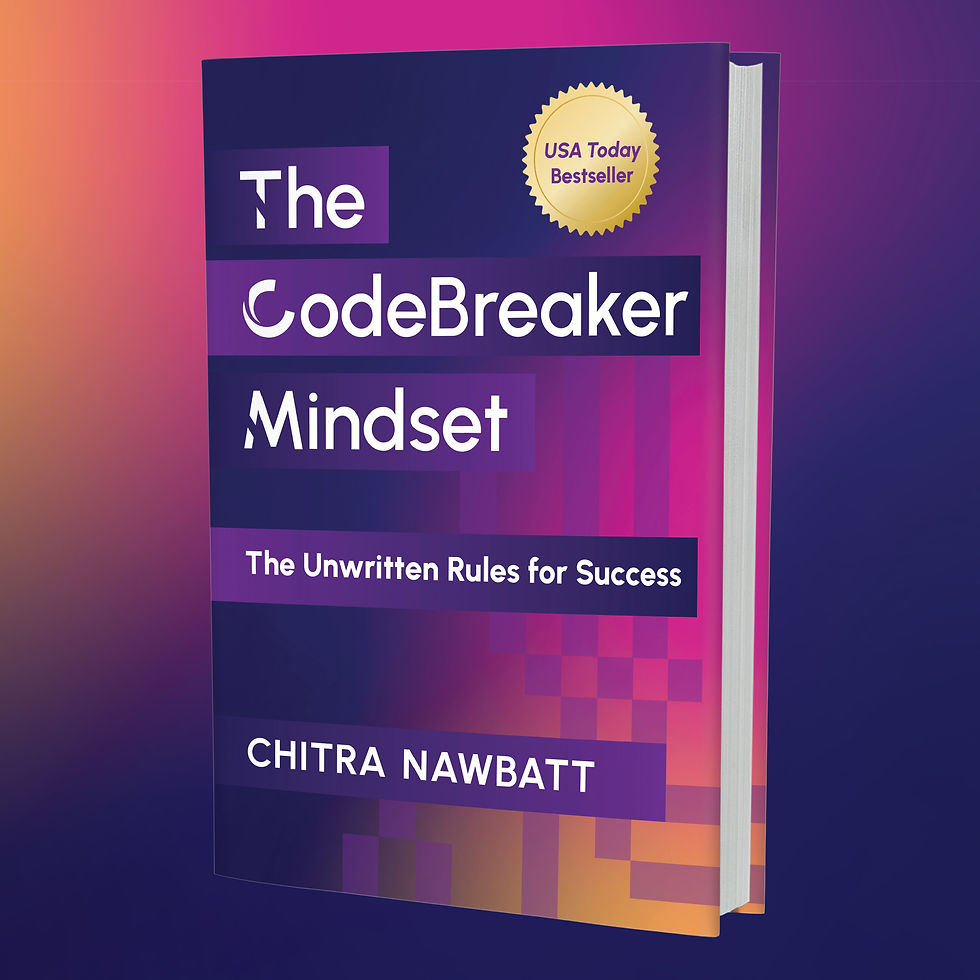
The CodeBreaker Mindset™ Ft. Ndidi Okonkwo Nwuneli, ONE Campaign, President and CEO


Ndidi Nwuneli shares her inspiring journey from Nigeria to the United States and back, highlighting her extensive experience in social entrepreneurship and international development. She discusses her philosophy of 'dying empty,' the importance of mentorship, and the rules of social innovation. Ndidi emphasizes the need for mission-driven leaders, the significance of building relationships, and the challenges of navigating cultural differences across Africa. Her insights provide valuable lessons for aspiring change-makers and leaders in the social sector. In this conversation, Ndidi Okonkwo Nwuneli discusses her experiences with ageism, the burden of proof faced by black women, and the importance of setting boundaries. She emphasizes the need for a supportive community and the role of faith in overcoming challenges. Ndidi shares insights on creating tangible impact in social enterprises, shifting mindsets, and the importance of resilience in leadership. She outlines key ingredients for successful social enterprises and explores the concepts of intuition and serendipity in decision-making. Finally, she offers advice on cultivating The CodeBreaker Mindset™, highlighting the importance of humility, hunger, and emotional intelligence.
Chapters
(00:11) Introduction
(00:32) Introduction to Ndidi Nwuneli's Journey
(07:54) Navigating Education and Early Career Choices of Ndidi
(11:34) The Role of the ONE Campaign
(16:55) Learning the Unwritten Rules of success from Ndidi Nwuneli
(24:47) Expanding Impact Across Africa
(31:02) Navigating Ageism and Setting Boundaries
(42:32) Creating Tangible Impact in Social Enterprises
(47:19) Shifting Mindsets and Changing the Status Quo
(58:34) Pivots and Resilience in Leadership
(01:03:25) Key Ingredients for Successful Social Enterprises
(01:12:43) Cultivating The CodeBreaker Mindset™
Episode Resources
Ndidi Nwuneli | Bio
Chitra Nawbatt | Bio
The CodeBreaker Mindset™ book order here: Amazon | Barnes & Noble
The CodeBreaker Mindset™ Ft. Ndidi Okonkwo Nwuneli, ONE Campaign, President and CEO
Chitra Nawbatt (00:11)
Welcome to The CodeBreaker Mindset™, where leaders and influencers share the rules, pivots, and serendipity to achieving goals and dreams. I'm your host, Chitra Nawbatt. Joining us today is Ndidi Nwuneli, President and CEO of the ONE Campaign. Ndidi, welcome. Thank you for joining us.
Ndidi Okonkwo Nwuneli (00:29)
It's a pleasure to be with you, Chitra.
Chitra Nawbatt (00:32)
You've been a leader in social entrepreneurship and international development for over 25 years with a focus on Africa. McKinsey Consulting is where you launched your career. Then you had a calling to return to Nigeria to serve as the executive director of the FATE Foundation, which helps entrepreneurs launch, build, and scale their businesses. You then founded LEAP Africa, a non-profit that develops African leaders and food change makers. AACE Foods was the next business you launched to democratize the supply of food from 10,000 farmers as well as access to food for Africans. You continued this work through the next venture you founded, Sahel Consulting. Now you lead the ONE Campaign, which was co-founded by Bono.
Take us through this amazing journey from Nigeria to the United States, back to Nigeria, and now global.
Ndidi Okonkwo Nwuneli (01:29)
Thank you so much. So I've always been motivated by a passion to change minds and lives. And that has kind of fostered some of my work as a social innovator. I'm really a passion to die empty, envisaged by God's purposes and plans for my life, but really been very, very proudly African and recognize the potential, the impact and the magnitude of influence that the African continent can have. A continent currently of 1.2 billion people projected to be 2.4 billion by 2050. A continent that is leading in terms of innovation, technology, the creative industries with over 70% of its population under 35. That's vibrant with energy, skills and ideas. And the recognition that, you know, many people across the world do not fully understand what Africa
has to offer, do not respect the continent as an equal player on the global economic landscape, and really have a negative narrative associated with the continent. So my passion, my desire, my force of compelling force has been to change this narrative and to galvanize the next generation of change agents, business leaders, and influencers. And so that has propelled my work first in social innovation, in entrepreneurship, in job creation, wealth creation, but now also in global advocacy to build bridges and to change narratives and to galvanize the investments and policies required to ensure economic opportunity and healthy lives in Africa. So that's why I've done what I've done. And that's why I'm sitting here now as the CEO of the ONE Campaign.
Chitra Nawbatt (03:19)
So let's double click. Walk us through the steps to that journey. Because while that was your passion and the phrase you said, Die Empty, I've never heard that phrase before. And before we actually even go further, Die Empty, bring that to life. What does that mean for you? Die Empty.
Ndidi Okonkwo Nwuneli (03:29)
Yes.
Well, I wouldn't take all the credit for the phrase Die Empty. It's actually a phrase that's used a lot in the Christian faith. And the philosophy is that you as an individual have been born with gifts, talents, purpose, and a mission, and that you have to fulfill it while you're still on this side of eternity. And that you are going to end up going to your grave having completed your purpose. And that's what dying empty means.
And so I think for me, it's been quite a joy to have a purpose from a very young age. And my mom always says relative to a lot of people she's met that actually from a very young age had this desire to create jobs, to create change, and to make a difference in the lives of others. And to have that realization from maybe when I was 21 is for me quite profound. But from when I was like 18, I was already like, you know, President of the African Students Association at Penn, and then at Harvard started the Africa Business Conference with some friends, the first of its kind across business schools, you know, really motivated by that desire to change narratives. And so that kind of conviction from a young age that has stayed with me for the last, you know, more than 25 years is a gift, but it's also a burden, because I feel a sense of urgency and sometimes a sense of despondency that things are not moving fast enough, I'm not doing all that I'm supposed to do, but the recognition that we all have a limited amount of time on Earth and we have to fulfill the purpose that we've been sent here to fulfill and that's what dying empty means.
Chitra Nawbatt (05:27)
So given that conviction that you've had from since a young girl, how then, you're sitting in Nigeria, how then do you say, okay, I'm gonna come to the United States, go to Wharton, go to Penn, go to Harvard Business School, work at McKinsey, where does that come from? Did mom and dad do that? And so you followed mom and dad? Walk us through those steps.
Ndidi Okonkwo Nwuneli (05:49)
Well, I would say that I was very fortunate to be born into an academic family. Both of my parents are professors, Cornell educated, very high ambitions for their children, and really helped us navigate finding passions and interests from a young age. And so initially we were not meant to come to the university in the US. My mom is American, my dad is Nigerian, but we went through a period of military rule in Nigeria, the university system was shut down for months on end. And so coming to the US became the natural step. I came with only $250 in my pockets. My parents had not been paid for months as university professors because there was a crackdown on the educational system because that's where most of the protests against the military came from. And so that was the only...
Chitra Nawbatt (06:38)
And what year was that? What year was that?
Ndidi Okonkwo Nwuneli (06:39)
I came in 1991. And I came with $250 and that's the money, the only money my parents ever gave me for the whole time I lived in America. And I stretched it. Had to take jobs as a waitress and work, study and thank God for financial aid. I could go to Wharton and finished Wharton in three years because I realized the pressure on me and the expectations I could start sending money home. So I think the recognition that we have a burden and many, I guess, immigrants and in my case I was an immigrant with a U.S. citizenship so it made my life a little easier. Had to you know have that burden of responsibility from a young age, maturity, a sense of purpose and direction, a conviction, discipline.
I think was instilled in me from the very beginning and this concept of service. Your life is not just for yourself, you're here to make a difference in the lives of others. So I think I was very fortunate to have those values from a young age and all my siblings have done exceptionally well. So I have to say that it's a combination of God's blessings, nurture and nature, but also a community of support.
Chitra Nawbatt (07:54)
So why go to McKinsey? Take us then through those career choices of going to McKinsey and then when you decided to go back to Nigeria.
Ndidi Okonkwo Nwuneli (08:02)
Okay. All right. Okay. So I think from when I was at Wharton, you know, there are many, many options that you have, but I applied for SEO, Sponsors of Educational Opportunity. It's a New York based program. And when I was, I was assigned to McKinsey. So I was a summer intern at McKinsey in 94. I got an offer to come back to McKinsey and I chose the Chicago office because my siblings were there. Was very interested in consumer goods because that was an industry I understood. So I did both nonprofit work and consumer goods at McKinsey and then got an offer to come back to McKinsey. If you're outstanding, they give you an offer and they offer business school. They cover your business school costs. But I actually applied to Harvard when I was a senior at Wharton, because Harvard had a program reaching out to some students to say, why don't you apply early? So you kind of get a deferred admit. So I applied to Harvard Business School when I was still a senior in college, got in, and had a deferred admit while I worked at McKinsey. Now, it's interesting. While I was at McKinsey, we as Africans at McKinsey, the few of us who were there, put pressure on McKinsey to start an office in Africa.
So actually we opened an office in Johannesburg and I had the unique opportunity to go and work there, which was just an amazing experience. And so that kind of cemented this passion I had to transform the continent and you know, propelled me to, while I was at HBS, actually actively seek summer internships back at home. And while I went back to McKinsey, because they paid for my business school, I got a call from a very successful Nigerian entrepreneur who I had met at Harvard Business School. He said, I heard you want to come home and I want to offer you some jobs. And he listed all the jobs. And one of them was to help start the FATE Foundation and come in as the Pioneer Executive Director. So I was only 25. I resigned from McKinsey and moved back to Nigeria to start the FATE Foundation with Mr. Fola Adeola. And I had no regrets because at that time I had already mapped out that I wanted to be part of wealth creation, entrepreneurship development on the continent and he gave me that unique opportunity to run an organization alongside a visionary philanthropist at a very young age. So that propelled me from FATE to start LEAP Africa, which I started myself. And LEAP stands for Leadership Effectiveness, Accountability, Professionalism to really inspire, empower and equip the next generation of African leaders. And then the rest is history. I became a serial entrepreneur and moved from helping young people become entrepreneurs and become leaders. So actually helping them with business development and starting my own business to create jobs and create wealth. And that was AACE Foods, which I co-founded with my husband, Mezuo. Sahel Consulting, and then African Food Change Makers and then Sahel Capital.
And so that journey helped through the ups and downs of life. We actually started four companies in food and ag. And I was always passionate about food and ag, always passionate about consumer goods, because Africa is naturally endowed for agricultural excellence, recognized that this was one industry we could excel in. We could create jobs, change mindsets, improve the lives of people, address malnutrition. So there are just multiple wins through ag and food.
Ndidi Okonkwo Nwuneli (11:17)
So I spent 15 years actually building organizations in Ag and Food and all of them are thriving today. FATE continues to thrive, LEAP Africa continues to thrive and works across Africa. And then Sahel Consulting, AACE Foods and African Food Changemakers are all thriving. So to God be all the glory.
Chitra Nawbatt (11:34)
And then now, how did you then come to ONE?
Ndidi Okonkwo Nwuneli (11:36)
Yeah, so I got a headhunter call. I was sitting in Nigeria and I got a call from a headhunter saying, you know, your name got shared with us and would like to talk to you about this opportunity to run the ONE Campaign. Now, I had heard about the ONE Campaign, had followed the work of the ONE Campaign, in fact, was interviewed for a COO role at One when One was just getting started, you know, many, years ago. And it's interesting because at
When I first got this call, I said, I'm not into advocacy. I don't see myself as an activist. And the more I talked to the headhunter, the more he convinced me, well, you've been trying to build bridges between Africa and the rest of the world. You've been changing narratives. This is an opportunity to do more of that. And you know how to run organizations. You've built organizations. So why don't you see this as an opportunity? And for me, it was a real honor to come into a 20-year-old organization standing on the shoulders of the giants who have established this organization, Jamie Drummond, Bobby Shriver, and Bono, and really commit myself to taking it to the next level. As the first African CEO, really, it's both been a wonderful honor, but also a huge burden and challenge given how difficult things are at the moment politically across the world.
The Rules of the Game
Chitra Nawbatt (12:56)
Yeah. So in everything you just described of your rich journey, there's a lot of know-how required. Education is one thing, but there's a lot of know-how. So let's get into that know how, which I like to call the rules of the game. So let's get into the rules of the game. How did you figure out, the written and the unwritten rules of this work, social entrepreneurship, international development, founding and leading multiple for-profit and nonprofit organizations. First talk about what those rules are, what the written rules are, then we'll get into the unwritten and then how you figured this out.
Ndidi Okonkwo Nwuneli (13:38)
Okay, so I would say that the combination of written and unwritten rules in terms of what the written rules are, the interesting thing is that the concept, the industry of social innovation has been evolving, right? And so I would say the first written rule is that you have to be a mission driven high achiever to excel in this industry. Mission driven because you're not expected to get rich being a social innovator. So you have to be so committed and compelled by the desire to change the lives of other people. And that is a very important fundamental requirement for this sector because it is backbreaking, almost sometimes thankless work. There are no dividends, there are no easy breakthroughs in terms of fundraising. You don't have multiple...take home shares and things like that.
So at end of the day, you're really a mission-driven high achiever. The second is really the commitment to form strategic relationships because as a social innovator, you have multiple constituencies. Everybody does in every industry, but I think as a social innovator, you're designing something that is going to change lives. And so you're appealing to both the most vulnerable, your team who are also mission-driven high achievers. Your funders, your board, and really having that humility and wisdom to build partnerships. And I always tell people I've been motivated by the quote that it's amazing what we can accomplish if we don't care who gets the credit. If you're someone who wants the credit, you can't be in this sector because you're sharing the credit. And that's how you create a big tent where everybody sees themselves having a space in that tent because that's what is required for success and impact.
So for me, that's number two, managing those stakeholders, diverse needs, diverse interests, but ensuring that that credit is shared. And number three, would say, the staying power is really results. And these results, unfortunately, are not financial results. They are results in terms of lives changed. And guess what? The most impact happens when other people are talking about the results. And it's beyond storytelling the news starts to spread because of the impact. And so how are you leveraging innovation, technology, data, but also creative storytelling to amplify the impacts of your work, because that breeds more success. If you can demonstrate early impact, you have staying power. And if you can share the results of that impact, it stays with you.
And if I could add a fourth, it's really transparency and accountability in the use of funds because people are trusting you with their grants. Even if it's a for-profit, a social enterprise, they're investing in your vision and they have to be able to trust that you're going to utilize the funds effectively to deliver results. And you're going to use as much as possible for the impact and not for yourself. And so those metrics, and being transparent and accountable with reporting financially has been for me a game changer.
Chitra Nawbatt (16:55)
And the unwritten rules?
Ndidi Okonkwo Nwuneli (16:58)
I would say the unwritten rules. So you know, I talked about humility, right? For me, I think the unwritten rules are you keep learning and unlearning in this sector. Things change rapidly, but also the most wicked problems require tenacity, courage, and stickiness.
And so that humility to keep learning and unlearning and exuding that humility to others is so important because then it allows them to trust you. For me, that's a very important superpower. The second is vulnerability. The vulnerability to say where you are failing, where you failed, or where you're struggling. Many, many times we have to be vulnerable enough to demonstrate that. And then I would say that the final one is clearly, unfortunately, in our space, there's still a lot of double standards. There are double standards because of race, because of country of origin. And so who you surround yourself with, that includes how strong your board is, which funders, early supporters, building that credibility with external validation, that luster that comes from being associated with those who seem to have more credibility than you, etc. For me, that is really important. We need to level that playing field. I've gotten more vocal about it, but I think in my early days, I realized that, just consider this young Nigerian girl who was just, know, dogged and committed and passionate.
But I had to over time, you know, depend on champions and sponsors who were willing to lend their credibility to mine, to me, until I was able to build mine. And for me, I think it's unfair that we have to keep proving ourselves every single day in our sector. But I've become more vocal and more confident in my ability to raise an alarm of this uneven playing field so that it's easier for those who come after me.
And they don't have to fight the battles that I've had to fight alongside others.
Chitra Nawbatt (19:22)
We'll get into that credibility piece in a little bit. How did you learn these written and unwritten rules? Somebody teach it to you? Or any are any of those sponsors or critical figures? How did you how did you learn and in a very complicated intersection of as you talked about, which we'll get into a little bit as well about Nigeria, the African continent, the intersection of for profit, nonprofit government, policy, regulation, large business, small business farmers, the diversity.
Who taught you the written and unwritten rules?
Ndidi Okonkwo Nwuneli (20:07)
So would say it's a combination of a few issues or friends. I would say number one is I've had amazing mentors and champions who have kind of held me by the hand and helped me navigate some of this complexity and helped me make the wise decisions along the way. I'm someone who is always open to asking questions.
I don't make many steps without asking a few people for their insights and their input. And so I've been blessed with angels on assignment. I would call them angels of an assignment from professors in university and professors in business school. And I've been blessed with Linda Hill, who is the one who connected us, Chitra and Deborah Spar. And these ladies took me under their wing and have continued to be great champions for me.
I've been blessed with champions even from McKinsey days. And I learned from them. I sat at their feet and asked them the most basic questions. When I was appointed to be the pioneer executive director of the FATE Foundation, I knew I was moving back to Nigeria from the US. So I called a few CEOs of nonprofits in the US and I said, my first 100 days, what are the things I should do? At the time we didn't have Chat GPT to ask those questions. I asked human beings. And one of them who was a woman called Andrea Silbert, who was running a very successful organization called the Center for Women and Enterprise in Boston said, your first week, go and meet all the board members one by one. First, she helped me understand how to constitute the board and then go and meet them one by one and say, what role would you like to play and how can I be successful?
And that was one of the most interesting pieces of advice. And it stuck with me, the importance of building, enduring, trusting relationships with boards is critical, you know, and so I learned that. So I think for me, it was really important to listen and learn from the mistakes of others. The second is the school of hard knocks. And there's no replacement for what we call the University of Life. The University of Life humbles you. I remember one of my first experiences running LEAP Africa. You know, I got a call from a funder and she said, I have an application here that's identical to the same application you've submitted. And I was like, wow.
The organization does exactly the same thing. And I looked at it, was like, hmm. I said, what's the name of the organization? She told me. And I said, you know, this organization has actually written to me asking me if they can be a partner in another state in Nigeria. So I called the guy up. said, can you come to my office? I'm here. I'm 25 years old. This guy is probably double my age. And I'm like, I'm confused. Why is it that you've copied a mission statement, a vision statement, a programmatic activities, everything about us and said it's your stuff?
and that you've been around for 20 years and we just started? So funders think you're older than us. And he said, you've put all this in the public domain. There's nothing that says I can't copy it. I was like, what? I was shocked. And here I was 25. I told the guy, listen, you get out of my office right now, unethical person. And it just struck me, wow, you know, how is it that people, and this is when you don't put confidential on your documents, you don't say you cannot copy. I learned the hard way very early on how easy it was for people to steal your idea and positioning it as theirs. I mean, all sorts of things. can go on and on about the experiences I had as an early entrepreneur, but the school of hard knocks was a gift because there's very little that can surprise me today because I've seen a lot about human nature and I've also learned to be stronger about my convictions.
To learn when to fight and when to walk away. And so I say the virtue of life and being able to interpret, understand and learn from errors, mistakes and lessons is critical. And then the third one, would say, I always tell young people, everybody needs a critic, a champion, a role model. I have surrounded myself with critics and they have been the biggest gift.
I've had an accountability and prayer partner since my days at HBS, and that person is still my accountability and prayer partner over 25 years later. Having people who can tell you the truth, saying, Ndidi, you could have done better here. Why didn't you do this? Think about this. And empowering an accountability and prayer partner, having people walk alongside you in this life's journey and hold you accountable to be your best self is a wonderful gift.
Chitra Nawbatt (24:47)
Talk about the decision to expand your work from Nigeria to other African countries and what were those countries?
Ndidi Okonkwo Nwuneli (24:59)
Yeah, so I would use the example of African food change makers. African food change makers was actually born out of my desire to, I worked on a book called Food Entrepreneurs in Africa, Scaling Resilient Agriculture Businesses. I'm someone who's committed to lifelong learning. So when I'm struggling with something like scaling the organizations I've started, I want to learn from others. So in doing the research for this book, I interviewed entrepreneurs across Africa and I realized many of them did not know each other.
Many of them were working in silos, dealing with the same challenges. And so I decided to create an organization that would be a one-stop shop for food and ag entrepreneurs across Africa. And now we have entrepreneurs in 40 African countries. Now we're using technology and innovation. We don't need to have an office in each of those countries, but we have members, champions, partners, etc. And that recognition that there's power in community, power in numbers, power in information sharing for me was...mind-blowing.
And the ability to use e-learning and technology tools to connect our entrepreneurs was also a big breakthrough. You know, we all come from traditions and back in McKinsey days in Chicago where there was First Fridays where people of color would get together in a bar somewhere and get to network. So we created First Thursdays on African food change makers, which is a virtual coming together, right? Every first Thursday of the month.
We created last Thursdays for the Francophone community so that we could also have that networking. So leveraging a lot of what I had learned in my work and life as an entrepreneur and as a business person and putting it online. And when you go on the website, African Food Change Makers, you can search for funding and data and opportunities and networks and create market opportunities, etc. And so for me, that was key.
The same with LEAP Africa, we started in Nigeria. When we called it LEAP Africa from inception in 2002, know, the concept of it's going to be African wide, Nigeria is a big enough country. So for like the first 10 years, we're only working in Nigeria. Nigeria has 250 million people. I mean, at least over 200 million people and 70 % of them under, you know, 35 years old. So you recognize, okay, we haven't even scratched the surface in Nigeria. Why would you want to become Africa?
But we recognize that a lot of the skills, the tools, the frameworks we had developed could be beneficial to other African countries. so LEAP, with the support of MasterCard Foundation, was able to expand to eight African countries and translate its curriculum for teaching teachers how to deliver training into Swahili and to Amharic and to all the other languages across the continent. And for LEAP, it was scaling, right? Scaling is so important to good work you do.
You can teach one on one young people to be leaders. You can give them opportunities to lead. But then if you want to scale, you have to teach teachers to deliver the curriculum. And we recognize that scaling our teacher interventions was a powerful way to reach Africa. Honestly, Africa is a continent of 54 countries. There's tremendous diversity and complexity. Scaling across the continent is not easy, but it's critical and it's important.
And the more of us who can venture out of our countries, the more success and impacts we can have.
Chitra Nawbatt (28:19)
So on that point about venturing out of our countries, how then did you, you you talked about how you went about figuring out the written and the unwritten rules, but compare and contrast how you discover that if you're here in the United States versus Nigeria versus Africa, because in the same way you went to Penn and Harvard Business School, then you're at McKinsey, you would have had to figure out the written and the unwritten rules in those environments. You're now in Africa, Nigeria, then you spread out to other countries in Africa, 40 countries as you mentioned, right, where you are operating. So is there a different, are there any differences if you can distinguish to people, especially for those of us who are not so familiar with Nigeria or different countries in Africa, are there differences in the way that you discover and figure out those written and unwritten rules?
Ndidi Okonkwo Nwuneli (29:11)
say that it's a very similar approach to discovering what they are. And the first step is you can't venture into a country without finding a few thought leaders in that country to inform your strategic move. I always advise people, whether you formalize them as advisors or you have an advisory board or even a formal board, it is powerful.
Like here at the ONE Campaign, the minute I took on this job, I said, we need these informal circles. And we have created these Ubuntu circles in all our G7 countries and in all our African countries because we want people to tell us what the written and unwritten rules are. And guess what? They're not stagnant. The written rules 20 years ago are not the written rules today. And you need the group of what we call trusted messengers who are caught across different sectors, different ages and represent the diversity of the country to really inform your work. Otherwise, your work is not relevant and it doesn't deliver outsized impact. So for me, that has been a key lesson and I've carried that lesson with everything I've done into every country I've moved into. Yes, you need, who are those trusted messengers who can inform your strategy?
I also think the importance of once you've gotten those insights, filtering them and testing them, don't assume everything everybody tells you is correct, you test them. And then you modify. I'd say, for example, the dimension that has been very instrumental to my work is the importance of recognizing the gender and the race and the ethnic burdens that we carry and not taking them for granted. I remember my first visit to Ethiopia, everybody thought I was Ethiopian. Right? And they were really upset, like in elevators.
Chitra Nawbatt (30:59)
And why is that? Why do they think that?
Ndidi Okonkwo Nwuneli (31:02)
Well, I happen to be biracial. can fit into many, many contexts, but in Ethiopia, they thought I was Ethiopian. So when they tried to speak to me in Amharic and I couldn't speak, they were very upset. And they thought, does she think she's better than us? So I realized something really silly is that when I go to Ethiopia, now I braid my hair. If I'm going to be there for a long period of time, because braiding your hair automatically then means she's probably, like if she has a Nigerian hairstyle, she's probably not Ethiopian, right?
Chitra Nawbatt (31:29)
Okay.
Ndidi Okonkwo Nwuneli (31:31)
But it just is like the whole, like, accept who you are, know, and Chitra, you have the same burden. You know, people accept you everywhere you are and the sense that they expect you to behave a certain way because you look a certain way and you have that extra burden. I also had an extra burden early in life because I looked very young. Right now I'm looking a bit more my age because of gray hair, but in the beginning I looked really young. So you walk into a room, it doesn't matter where in Africa, there's tremendous ageism, right?
Because people respect the seniors, they respect the elders. It's a great part of our culture, but if you're a young entrepreneur and you're female, you have a burden of proof. And I learned this skill in McKinsey that literally you have five, the first five minutes of a meeting, you get to determine whether you're influencer in that meeting or whether you're irrelevant. And so how you show up matters. And so I have had to teach other young people and my team members how to make themselves visible by bringing brilliant insights, questions, and comments into every room they step into to prove themselves and to prove their worth so that they don't say, who's that young person? She's just filling a quota. Who's that young woman? She's just filling a quota. We needed a youth voice. We needed a woman's voice. But by the time you're done with that interaction, you've convinced them that really you earned this. You deserve to be here on your own merit.
And so ageism has been another burden. And I think learning how to navigate that with respect in many African countries has been something I have had to learn. And then setting clear boundaries. And I have to say, as a woman, I set clear boundaries because in many, many parts of the world, and it's not unique to Africa, the assumption is, ok, before the Me Too movement, but even after the Me Too movement, she's a young African woman. So setting clear boundaries about where I stand on.
Harassment is unacceptable and being very vocal about what my boundaries from day one has also set me apart. So people building that reputation as someone who is no nonsense, a strong Christian, know, really committed to excellent work, respectful of elders, but also a very vocal force is something that I think I've had to infuse in other female leaders. And that's why I started the Leading Women in Food Fellowship.
As part of the African food change makers and we're going into our third year to really raise the next generation of female leaders so that people don't see Ndidi as an exception. And they realize that behind me are thousands of amazing women who through our collective work, we will continue to elevate their voices, their message, stories. So we're not viewed as an exception. We're viewed as one of many amazing African women who are changing the world.
Chitra Nawbatt (34:16)
On this point about burden of proof, now after 25 plus years, do you still encounter scenarios where you feel that burden of proof is on you?
Ndidi Okonkwo Nwuneli (34:27)
Like every single day, every single day. And it's actually quite...
Chitra Nawbatt (34:31)
And what do you think that's because of? And then how do you deal with that?
Ndidi Okonkwo Nwuneli (34:36)
I think actually on the African continent, because I've built a stronger reputation, it's easing because my work goes before me. But I would say coming back to the US has been the biggest shock of my life that we have as black women in America, we have an extra burden of proof every single day. So I think for me, it'd be a question. Chitra, I'm gonna throw back at you.
Because you've been in this context longer than I have. But I think that, you know, in many ways we still have a burden of proof as black women in America. And on a daily basis, I have to prove to people, yes, I deserve to go to Wharton and Harvard. I worked my butt off, graduated with very strong grades, worked my butt off across the way through all the organizations I've built, which have been profitable organizations that have created jobs and changed lives and still exist today.
And yes, I deserve a seat at the table. And yes, I will come with my full authentic self and be confident to dispel negative narratives, negative stereotypes through the way I live my life and the excellence I bring to everything I do.
Chitra Nawbatt (35:47)
So, and on that, how do you endure? How do you fortify yourself, equip yourself to have the endurance to rise to the occasion in terms of dealing with the burden of proof? Because what you're saying is is for you 25 plus years on the planet in your skin, in your outer shell, who you are on the outside and inside. Burden of proof is now it's it's the norm for you or it's long been the norm. It continues to be the norm and what you're saying is is or I'm saying this for you.
You're prepared that this is part of the status quo of your existence. Rightly or wrongly, part of the status quo of your existence. How do you build, how do you have that fortitude to endure this with a smile and be productive?
Ndidi Okonkwo Nwuneli (36:43)
So I'd say a number of things. Number one is my faith. You know, God is my source of strength, of vision, of passion. And because He sent me on the journey, He equips me. He also surrounds me with great champions. I have had the most amazing sister networks, both my biological sisters and my very supportive, immediate and extended family, but also sisters. And where you don't have them, you create them. So I moved to DC back in April. I've created a sister network here.
I call them power sisters in development, senior women who are women of color who are fighting the same battles alongside me. it's been, they have been an incredible source of support, intelligence, insights. And wherever I go, I create those communities. I don't wait for those communities to invite me in. I actually, sometimes I'm the one who creates them and brings people in because we're all walking this journey, Chitra. And many of us are burdened,
working alone. And the higher you move up, it doesn't matter whether you're black, white, male or female, it gets lonelier at the top. And that's why you need a community of support and you need champions and you need prayer partners. I've had a group of women who have prayed with me for the last two and a half years, once a week. And now they're sisters with each other, but they didn't know each other before we created it. So I think it's really important that you know what feeds your soul.
And for me, it's people. Good people feed my soul, renew my enthusiasm, and propel me further, challenge me to be better, and hold me accountable to rise to the occasion. And it's not just people who are older than me. I also have a cohort of very young reverse mentees who also are just a gift. So I'm truly, truly blessed on every front, and that's what keeps me going. But I think I...
I would go back to the assignments. What is the assignment? I'm a mission-driven high achiever, someone who feels like I've been called to do something for the world. Seeing the progress, regardless of how slow, also gives me some measure of gratification that I'm on the right path. And knowing that the lives who have interacted with me have been better for it, also propels me to want to keep forging ahead against all odds.
Chitra Nawbatt (39:04)
I have to tell you though, I mean, that's very aspirational. And I say that aspirational in a good way because it's about the mindset. And it's funny that this is called The CodeBreaker Mindset™, but it's about the mindset because what you're saying is, is be so focused on what is your intention and what is the objective of what you're trying to do. And even though you're so accomplished, if you're still going to be encountering that you have to prove yourself, the burden of proof, this is part of a natural permanent headwind in the terrain, right?
Because the burden of proof is coming and we've all been taught about imposter syndrome, right? But as I say to people, there's been some readings on this, it's not about imposter syndrome, it's actually imposter treatment. The baby is not born feeling like he or she is an imposter. He or she doesn't know, she's born with unlimited possibility and positivity, but it is what is put into that human, nature and nurture, right?
And therefore, if those are putting the burden of proof on you and I, it is because they're putting imposter treatment to us. Where does imposter treatment come from? Their place of relative insecurity, their place of relative scarcity, because there's some fear. There's some fear that putting the burden on you, prove yourself. Why are you here? Why should you be running one? Why should you go to Harvard Business School? You want to now go run for office? Why. Right? They're putting all of that headwind on you. And what you're saying is this,
Hey, it's gonna rain, thunderstorm, snowstorm. This is part of life from now until the day we die. Some of us maybe more so than others. We get more rain, more snow than others. It's part of the terrain and you endure because you are so maniacally committed to the passion of your existence, the purpose of your existence. This is what you're saying?
Ndidi Okonkwo Nwuneli (40:50)
Definitely, definitely, yes.
Chitra Nawbatt (40:52)
That's hard! I mean, you know, I'm trying to, but I'm just saying very candidly, like it's hard. And therefore I look for, you know, is there a hack? You know, and that's part of the question in this conversation. Is there a hack to help people endure, to help people go the distance?
Ndidi Okonkwo Nwuneli (41:10)
Well, Chitra, the hack is... Yes. Yeah, but Chitra, the hack is that you build that community of support, which makes you realize you're not alone. It's not unique to leadership. It's, you know, parenting. I have a community of support for parenting, because parenting is hard. We still have imposter syndrome with parenting. Marriage is tough. I have a community of support around marriage. People who are working this journey alongside us who want successful marriages.
And so for me, that community, that's why we say in Africa, takes a village. You cannot do it alone. And so who is your village and how are you cultivating that village? How are you building that village that sustains you, that pours into you? The day you want to give up, they say, Chitra, you can't give up. You've got this girl. You know, they're your biggest champions. are shouting like cheerleaders, Chitra, Chitra, Chitra, you've got this. Chitra, we see you. And so whenever you're on low, you refuel with this energy.
And for me, it's my spiritual convictions, it's my community of faith, and they are such a gift. And it's the people that God has blessed me with. And I think all of us need to open our eyes to see who is in our orbit that have been sent as destiny helpers, as angels on assignment to propel us to that next level. And who can we be the same for? Because it's not a one-sided relationship. And so that for me is a fuel and it's a hack that has worked and sustained me till this very day.
Chitra Nawbatt (42:32)
On this notion of impact, being in that social entrepreneurship and nonprofit space, many of these environments can be viewed and perceived as black holes. Is it possible to make real tangible progress, real tangible dent?
Right? Because these situations, and by the way, the issues that you're solving for have existed since the beginning of time in a big way. They exist now. They will continue to exist. So this notion of how do you actually make a dent, make quantifiable, tangible impact? Knowing this is part of what you're dealing with, how did you structure these organizations to address this? How did you figure out, as you said, you talked to folks, the right messengers of information, the written, the unwritten rules. How did you figure out the way to structure these organizations to create tangible progress?
Ndidi Okonkwo Nwuneli (43:41)
So I'd say that it's really about visioning. What does success look like? And many of us don't step back and say, what does success look like? How will I know I've achieved success? And then working backwards, what are some short, medium, and long-term goals? You know them. But you have to actually have a few quick milestones and wins that propel you to stay the course. And I'll say, for example, the food company AACE Foods, one of my biggest realizations was that the impact starts with the staff. Like if I can give my employees a livable wage, they have health insurance, they have a warm meal, they're able to educate themselves and their children. We've launched an adult literacy program. those who are factory workers, first time job seekers who are not even fluent in English, learn how to speak English at a level where they can rise to the organization. For me, that's a huge win.
So when I go to the Christmas end of year parties and I see the women factory workers speaking English and I see their children and some grandchildren, it just blows my mind. So you see that rapid impact. Of course you look at the number of farmers, 10,000 farmers, you look at all the number of distributors we've created, you see your products in shelves and in grocery stores and in people's kitchens. And you say, wow, the nutrition impacts, the lives change. But it starts with the staff for me.
And I look across the board and I say, wow, this is catalytic change. And beyond that, Chitra, seeing when we first went to the business plan competition or food fair, maybe we were the only company doing that product. By the time I came back five years later, there were 10 companies doing the same product. Wow, we had even inspired competition to enter the space. So you're elevating the food ecosystem. So it's about having perspective on what success looks like. Those milestones keep you going.
Because ultimately when we started AACE Foods, I said, we want to be the Nestle of Nigeria. We want to be the company that was born in a little village in Switzerland that's now a global multi-billion dollar company. Are we the Nestle of Nigeria? Far from. But are we on the path? Absolutely. And I think the challenge for high achievers is that you're so impatient with what success looks like and how quickly you have to get there that you give up, right? You give up because you don't see those wins.
And for me, no, no, no, no, we will become the Nestle of Nigeria. We're not today. Nestle took a few hundred years or 100 years. So let's give ourselves the time to build the systems and structures that when we start expanding, we're not broken by that success. And so for me, I'm using that example to say, yes, like ONE Campaign, intractable problems. We're fighting for justice and equity. You none of us are equal until all of us are equal. But yes, one was able to fight for debt forgiveness over 20 years and got $110 billion dollars forgiven in debt, which gives us the confidence that next year is the huge jubilee year, another year of debt forgiveness the Catholic Church is fighting for. Can we do it again? We can, in a different format, because we proved that it can be done. It took seven years to get $110 billion dollars forgiven, but it was possible.
You could have given up after the first year, but we didn't. So I think for me, that tenacity to keep going against all odds and that conviction that the small wins, the little wins show you what is possible and give you a glimpse into what success looks like. So stay the course. And that's what my mindset has been. And that's what has kept me in spite of it all.
Chitra Nawbatt (47:19)
Status quo. You, whether it's with one or especially in Nigeria and in the African countries in which you worked. Government, regulation, policy, people, process, systems the way things are done. You would have encountered a lot of legacy status quo thinking operating behavior culture to do this work, you have to change. How do you get people to shift from the status quo? How do you get people to change, rewire?
Ndidi Okonkwo Nwuneli (47:57)
It's tough, it's tough. That's a really difficult one. Mindset shifts are really entrenched. And there are two things I like to say. say, number one, if you can show people what excellence looks like. Show them what is possible. If you can physically show it to them, please do.
I mentioned the Nestle of Nigeria was our goal. So I actually called the CEO of Nestle and I said, can I bring my team to see what excellence looks like? So we went and visited a Nestle factory. So they got to see this is our factory today, right? This is what it could be. And this is what it's going to take to build it.
See, even at the ONE Campaign, we take people on trips to the African continent from our G7 countries. We took some leaders from Germany to go and see the work in Rwanda. It changes mindset. Them seeing what Africa is today, not what they thought it was 30 years ago that's been stuck in their mind, blows open all their preconceptions and negative stereotypes. I believe showing people excellence is key.
Number two is really setting this sense of what accountability is, ownership. And I think where you can give team members a sense of accountability and ownership for success around key deliverables, that also starts to shift them from pointing fingers at others to saying, OK, what am I responsible for? What is my sphere of influence and what can I do? But is it easy? It's not easy.
And the final one is sharing success. Everybody wants to be associated with a success story. Government officials were the toughest in Nigeria, but once success started coming out and we said, it's your success, they love it. You know, they become your biggest proponents because you have made them look good. In the beginning, they're the biggest skeptics, but if you make any politician look good, they love you.
Right? And so how we did that in the Nigerian context and how we continue to do that is really critical to the success we've had in our context and hopefully continue to apply them as we work in my new role.
Chitra Nawbatt (49:57)
Credibility! You said this. Talked about this earlier, how earlier in your career you had to leverage other people's credibility and folks believed in you, invested in you. How did you actually do that right? It's one thing to have a great professor. It's one thing to meet relationships and they introduce you to person A B and C.
It's another for it to become a really sticky deep lifelong or multi-year, multi-decade long relationship where they really invest in you and boost your credibility and just open massive gateways. Talk about how you were actually able to win over people to do that if it was conscious, subconscious, if it actually happened, and maybe use a person, a key figure in your life, an example to bring that to life of how this actually unfolds.
Ndidi Okonkwo Nwuneli (50:49)
Yes, I would say that for me, it's really been a combination of unconscious and conscious. I think.
If you ask me my superpower, it's my authenticity and vulnerability. I'm just who I am. And so that allows people to be able to trust you if they know that you're who you are. You're authentic and you're vulnerable. In terms of staying the course and deepening the relationship, it's about staying in touch. You I actually learned that from both Deborah Spa and Linda Hill. Deborah Spa every year would send an update on her life and her work.
And so I started doing that to a whole network of people. And for the fact that she sent it to her former students, I thought was pretty profound. Because here I was. I graduated from HBS at 24. And my former professor is sending me annual updates on her life. So it's top of mind that when you come into a city, you reach out and say, can we have lunch? You stay in touch. You send a Christmas card. You send a letter. And I learned that from observing others who did it so well. And so I actually was very good at staying in touch. I don't know if I'm as good as I used to be.
Linda used to use me in her class on relationships and relationship management. And I think I've fallen off the wagon, but I learned from her and learned from the best. And I would say beyond that, it's really about, okay, oftentimes with people who are mentors and role models, I think what could I possibly give them? They have everything in the world. But I think it's important to also nominate them for things. When you see opportunities, share it with them.
Don't assume that they have everything they need. And if at the very least you pray for them when they're going through a hard time, you know, and let them know that you're here thinking about them, it makes all the difference. And so for me, that's been really important and more.
I've grown older and now have people who are younger in my sphere. I realized that many young people today make a big mistake. They leave a company and they have nothing to do with the company. They leave school and they don't stay in touch. And I always tell them that's a missed opportunity. Stay in touch with people who have impacted your life because it is not only when you need them that you remember them. Stay in touch with them.
So they know that you care and so that they updated on what's going on in your life because it matters. And relationships are really honestly the most important currency that you have. And the depth of relationships, the quality of those trusting relationships make all the difference.
Chitra Nawbatt (53:21)
Talk about how you deal with problematic stakeholders. And because you would have dealt with such a diversity of stakeholders, especially in your work in Nigeria and on the continent of Africa. So talk about two dimensions and bring it to life for an example. Reading the room of these diverse stakeholders. What are they, know, whether it's government, policymaker, a farmer, Nestle in Africa, your employees, reading the room, because there's a perception, at least in some pockets, that there's less transparency, especially when to, think, dealing with government and policy and that type of thing, that there's less transparency in terms of what's the real intention. So looking behind the curtain. So how do you read the room and then dealing with a problematic stakeholder?
Ndidi Okonkwo Nwuneli (54:14)
So I'd say there are two things. Number one is, I think that perception is unfair. I think in every part of the world, they are difficult stakeholders. And it's really about, yes, yes. Right, right. So what I would say is for me, it's really also understanding what your values are. I tell entrepreneurs and leaders, what are your values? Are they articulated and are they understood by all stakeholders?
Chitra Nawbatt (54:24)
Yeah, I'm not suggesting yeah, there's difficult difficult circles. There's everywhere. Yeah, absolutely.
Ndidi Okonkwo Nwuneli (54:42)
And if they are understood by all stakeholders, how do you live them? And I'll give you an example in terms of paying taxes. Tax evasion is a global phenomenon.
Businesses want to underpay taxes, obviously. And sometimes people try to take advantage of loopholes, windows. And as an organization, from a very early set of activities, for every organization I've started, we committed that we'll be a law-abiding citizen. We pay our taxes, we'll be above board, and that will set us apart.
And so with every employee understanding those values, when the tax authorities come, when consultants come to try to pitch you on how you can evade taxes, you're very clear that you don't and that you don't play ball. And so when there's an investigation and audit, the reputation is well understood in the industry. It sets you apart. It means many, many things to many people, but it means that you have nothing to hide.
And living your life that way then gives you boldness and courage to call out bad behavior and to raise the standard of excellence in the industry. So I think for me, clearly articulating values are, I mean, for every organization I've started, the first thing was the mission statement, the vision statement and the values, and then infusing those values. The second is really building and being part of coalitions. There's no business leader or nonprofit leader or social innovator who can do this alone, especially when it comes to public policy changes. I am a big believer in being part of huge groups of like-minded people. So in Nigeria, we have the Nigerian Economic Summit Group. We have all the different industry associations. I've always been part of it. Our organizations have always been part of it.
And there's value in being part of a bigger consortium, but also fighting battles together, especially where there are big fundamental issues that have to change in the industry. And I think it's a big miss for many leaders who don't see the value of being part of those associations and actually making your voice heard in those associations to make rapid shifts. And then the final one is where all else fails. I actually believe in going to the press. And I believe the press where there's positive journalism and journalists who care about the truth and investigative journalism, that you can actually escalate issues that are beyond you.
And yeah, I think I have supported a lot of people who have blown whistles in many contexts, but I will leave it at that. I'm not sure I want to share stories, but I think it's important either anonymously or visibly to take, to write about, and I've written op-eds myself about issues like food fraud, anti-competition laws, you know, and I've put out some very important, I think mind shifting data into the public domain.
Chitra Nawbatt (57:34)
But yeah.
Ndidi Okonkwo Nwuneli (57:56)
And I'm so excited because one of one's biggest strength is we have a phenomenal data and policy team and the work they do is phenomenal. mean, just coming out of the COP in Baku, my team put together the, they called it the climate finance hypocrisy. Before that it was the climate finance files that followed climate money and where it ended up.
And at The ONE Campaign, we've done a wonderful job of calling out a lot of the double standards, the bad behavior, the declining commitments, equity and justice. And I think it's a strength.
The Pivots
Chitra Nawbatt (58:34)
So, let's get into the pivots!
Talk about critical situation in business where you experienced an involuntary pivot, being hijacked, whether it's by another business, another enterprise, someone else, even being hijacked by yourself, self-sabotage.
Ndidi Okonkwo Nwuneli (58:59)
Well, I think one of the major pivots which you're quite aware of was the personal pivot when in 2007, my husband was shot, right? Do you remember that story? And I had to basically, we had to leave Nigeria quite suddenly and I had to give up leadership of LEAP Africa and put in place, you know, very rapid succession.
And a lot of us have heard as CEOs of the airplane crash scenario, who's your successor? How do you plan for unexpected incidences? And I had written many, many books on succession and studied succession, thought succession. But I think for me, that was really a defining moment to test all that I had learned and to test that the systems or structures of the organization I had created were foolproof.
And for me, the biggest telling outcome of that, which was a positive outcome, was the power of boards and the power of strong and trusted leadership. One of our board members, Dr. Nadu Denloye, actually stepped in day to day until we figured out who would become the next executive director of the organization. And while we did not feel like we had planned it as well as we should have, having that continuity, the trust, the leadership was amazing.
And I've gone on to have multiple successions in all the organizations I've started learning from that one. And so for me, that's a pivot that was almost forced and was not planned. Another pivot is through, we started an organization called Nourishing Africa. And we had a very critical moment with some fraud in the organization.
And it was a defining moment, probably the toughest business moment that I've had to face, where money did not leave the organization. One of the staff was reaching out to a lot of the entrepreneurs who were supposed to get grants to convince them to pay him on the side so they could get higher amounts of grants or they could even get a grant in the first place. And he was a clearly fraudulent individual. And that defining moment was quite tough because there was a lot of buzz in the internet and a lot of disgruntled people when I decided to cancel the grants in total. So nobody got any grants. And I had to really, you know, quickly move to...not only quel the negative pressure, but also to rebuild relationships with other partners who had given to this and whose reputations were at stake as well.
And I think in all of these, the importance of board, the importance of having trusted advisors, the importance of swift and bold and courageous decisions, communicating those decisions, standing by those decisions through difficult periods, I think for me has been telling. What also led me to want to study the concept of intuitive judgment, Chitra, we talked about this and you know, I told you I'm a lifelong learner. So I went on and have interviewed so many entrepreneurs and their senior leaders about intuitive judgment, how you make good decisions and what it takes.
And one of the key takeaways from my research has been the importance of learning from mistakes and documenting those learnings, ensuring that they are passed down and through the organization and creating safe spaces for people who work with you to also make their own mistakes and build their own intuitive judgment muscle. And so I'm going to be learning from that research and also infusing it in my next set of pivots as a leader.
Chitra Nawbatt (1:02:56)
Well, we're going to get into intuition in a moment, but based on what you said, intuition, learning and the life to date, what's your pattern recognition on the necessary ingredients to build and scale profitable, impactful, tech and AI enabled social enterprise organizations?
Ndidi Okonkwo Nwuneli (1:03:20)
Pattern recognition. Can you break down what you mean by pattern recognition?
Chitra Nawbatt (1:03:25)
Well, based on all of the permutations and combinations of experiences you've had at FATE Leap, AACE, your consulting firm, all the work you've done in Nigeria, different parts of Africa, now coming to One. You're advising, if you're advising someone out there, anyone out there who wants to now go and build, and in this age of tech and AI, profitable, scalable impact organization, whether it's a nonprofit or social enterprise. What based on your experience, your pattern recognition, all the learnings and unlearnings you had to do. What are those critical ingredients?
Ndidi Okonkwo Nwuneli (1:04:03)
So I have a chapter in my book on this. I'll say there are six. There are six. I call them basically the secret sauce.
Chitra Nawbatt (1:04:12)
which I didn't know. I had no idea you had a chapter on your book on this, so please go ahead.
Ndidi Okonkwo Nwuneli (1:04:15)
No, no, no. I mean, it's not directly, but I think it fits. So it's number one is that your intervention, your solution has to be demand-driven with measurable value addition. So it doesn't matter what is the problem you're trying to solve. And is it clear? that your solution can solve that problem. And that's why I said demand driven with measurable value addition. Number two, it has to be low cost. Your intervention has to be low cost to scale. And it's not cost to deliver, it's cost to deliver impact. For me, that's critical because people will test and try you out, but unless they see that it's realizing some impact in their lives or in their work.
They're going to be short-term customers. They will be repeat and everybody wants repeat sustained customers. Number three, your intervention has to shape policy. And where there's no policy, you have to get behind creating a policy. And we've seen this with so many of the new AI tools and if you don't get behind shaping the policy, other people shape the policy and maybe your business becomes obsolete or phased out or quickly replaced. And we saw that with the M-PESA.
M-PESA was such a great gift from Kenya to the world. There was no policy for M-PESA using mobile phones to transfer money. But those who created it quickly developed a policy to secure their positions, to protect their mandates. So policy is important. Number four, it has to have clear systems and structures. And for me, systems and structures allow not only for operational excellence, but allow you to then reach more people, millions, thousands and have putting in place those systems and structures. Number five, you have to have a clear storytelling, how you communicate what you're doing, that impact, that success, how you connect to those who are benefiting from it is really critical. And finally, and probably the most important, you have to have resilience built into your DNA. COVID-19 was one shock. So many companies went out of business. Climate change is another shock. We will continue to have shocks. So how do you build resilience into your DNA?
That's critical. So these were six fundamental components of winning business models in any sector. But I would say even in AI technology, they are very, very, very relevant. And sorry, if I could add another one, it's really about the power of innovation and data, continuous innovation, continuous data, continuous technology to keep you at the cutting edge.
The Magic
Chitra Nawbatt (1:06:54)
You mentioned intuitive judgment. Let's get into what I call the magic. What's your definition of serendipity? And what's your definition of intuition?
Ndidi Okonkwo Nwuneli (1:07:08)
Okay, so I would say start off with intuition, which is there are many, definitions because I've just been working on this. The simplest one is that you don't make decisions based on rational thoughts or data. You make it from is another part of your brain that is linked to mental models of previous experiences.
Mental models of a gut check doesn't feel right. Mental models linked to a feeling and experience of thoughts that on paper, looking at the data might not be justified by that data, might not be justified by that rational side of your brain, but just gives you a sense that there's something going on here. And so, that's what intuition is. Some people call it a gut feeling. Some people, you know, there are many, many names. Serendipity for me is almost like the combination of chance, luck. It's quite different in my view from intuition. You know, was it serendipity that I met Chitra at the dinner I happened to sit with next to her? Or was it divine intervention? You know, you know, I don't know.
But how we leverage that conversation to then make a decision to connect was intuition as opposed to serendipity. But you leverage those chance encounters, those special magical moments to then determine how they shape your life. I think that's where intuition comes in.
Chitra Nawbatt (1:08:49)
So either dimension of that, either the serendipity or the intuition, where has that played a critical role in any of your enterprises?
Ndidi Okonkwo Nwuneli (1:09:02)
So for me, I think because I'm a very strong Christian, I really believe in the power of faith, faith and the power of divine favor, divine intervention, divine grace. And that's why I mentioned angels on assignment, like nothing happens by chance. Do you know what I mean? Nothing that, know, my God is a master strategist and he has placed me on this earth for such a time like this.
And so the decisions I make are ordered by the steps that he has ordained for me. And I'm working diligently to be in the center of his will so that I don't make missteps. And so that kind of guides me where intuition comes in. There's a thin line between intuition and discernment. And with discernment, there's a real spiritual calling where you feel like you're making decisions because you have God-breath wisdom.
However, the experiences that you've also had influence how you make decisions. So I very rarely make decisions based on data apart from looking at financial models, which obviously tell you whether you're in the red or in the black and whether you are going to be able to meet payroll. And that's important to look at the numbers. But in terms of hiring employees, in terms of partnerships, discussions, in terms of really...building those trusting relationships, even selecting board members, a big part of it is intuition, it's discernment. And so, yeah, I'm less, I believe less in serendipity, more in discernment, divine connections, and, and, intuition.
Chitra Nawbatt (1:10:46)
What does The CodeBreaker Mindset™ mean to you?
Ndidi Okonkwo Nwuneli (1:10:51)
Well, I was very enthusiastic and interested when you shared the philosophy behind this research and why you were doing it. For me, it means the mindsets, I know you shouldn't define, but you shouldn't define something by using one of the words. So I'll start with CodeBreaker. So the term CodeBreaker means really going against the grain and against the norm. To challenge status quo and live an impactful life by the way you tackle problems, tackle opportunities and deliver impact. So that's one. Where you feel like there's a written code and oftentimes people are excluded from contexts because of the written rules, but you can break through.
Because you've come with your own set of rules or found a way to navigate with your own attributes, talents, and creativity. The mindset piece, mindset is how we think about the world. And for me, a growth mindset, a mindset that believes in the possible, a mindset that sees opportunities where other people see problems, a mindset that embraces risk-taking, but also embraces faith. So combining both, CodeBreaker Mindsets mean this attitude to life that is brimming with possibilities that allows individuals who want to be leaders to take on difficult tasks and make impact because of how they think, how they live, and what approaches they utilize.
Chitra Nawbatt (1:12:43)
And finally, what's your advice on how to cultivate The CodeBreaker Mindset™?
Ndidi Okonkwo Nwuneli (1:12:50)
There are three, and this is the same three that I use to attract mission-driven high achievers. Every individual who wants to be a CodeBreaker should be humble, hungry, emotionally intelligent, and should have courage. Humility, Hunger.
Courage to take on difficult tasks and the emotional intelligence to discern spaces, to discern opportunities, to build relationships. You need all of those. And I think for me, the biggest barrier we have today with many young people is this humility piece. This life is a journey. Stretch yourself to learn and unlearn and everyday commit to have the courage, the humility, and the wisdom to do hard things because it matters, because you matter, and because the world is waiting.
Chitra Nawbatt (1:13:49)
This conversation has been beautiful. You have stretched me in this conversation. I've learned so much from you. Thank you so much for joining us.
Ndidi Okonkwo Nwuneli (1:13:57)
Thank you so much, Chitra.
Chitra Nawbatt (01:13:59)
Thank you for supporting The CodeBreaker Mindset™. For more episodes, go to
www.ChitraNawbatt.com to like and subscribe. Connect with me on social media
@ChitraNawbatt.
The CodeBreaker Mindset™ Ft. Ndidi Okonkwo Nwuneli, ONE Campaign, President and CEO
Chitra Nawbatt (00:11)
Welcome to The CodeBreaker Mindset™, where leaders and influencers share the rules, pivots, and serendipity to achieving goals and dreams. I'm your host, Chitra Nawbatt. Joining us today is Ndidi Nwuneli, President and CEO of the ONE Campaign. Ndidi, welcome. Thank you for joining us.
Ndidi Okonkwo Nwuneli (00:29)
It's a pleasure to be with you, Chitra.
Chitra Nawbatt (00:32)
You've been a leader in social entrepreneurship and international development for over 25 years with a focus on Africa. McKinsey Consulting is where you launched your career. Then you had a calling to return to Nigeria to serve as the executive director of the FATE Foundation, which helps entrepreneurs launch, build, and scale their businesses. You then founded LEAP Africa, a non-profit that develops African leaders and food change makers. AACE Foods was the next business you launched to democratize the supply of food from 10,000 farmers as well as access to food for Africans. You continued this work through the next venture you founded, Sahel Consulting. Now you lead the ONE Campaign, which was co-founded by Bono.
Take us through this amazing journey from Nigeria to the United States, back to Nigeria, and now global.
Ndidi Okonkwo Nwuneli (01:29)
Thank you so much. So I've always been motivated by a passion to change minds and lives. And that has kind of fostered some of my work as a social innovator. I'm really a passion to die empty, envisaged by God's purposes and plans for my life, but really been very, very proudly African and recognize the potential, the impact and the magnitude of influence that the African continent can have. A continent currently of 1.2 billion people projected to be 2.4 billion by 2050. A continent that is leading in terms of innovation, technology, the creative industries with over 70% of its population under 35. That's vibrant with energy, skills and ideas. And the recognition that, you know, many people across the world do not fully understand what Africa
has to offer, do not respect the continent as an equal player on the global economic landscape, and really have a negative narrative associated with the continent. So my passion, my desire, my force of compelling force has been to change this narrative and to galvanize the next generation of change agents, business leaders, and influencers. And so that has propelled my work first in social innovation, in entrepreneurship, in job creation, wealth creation, but now also in global advocacy to build bridges and to change narratives and to galvanize the investments and policies required to ensure economic opportunity and healthy lives in Africa. So that's why I've done what I've done. And that's why I'm sitting here now as the CEO of the ONE Campaign.
Chitra Nawbatt (03:19)
So let's double click. Walk us through the steps to that journey. Because while that was your passion and the phrase you said, Die Empty, I've never heard that phrase before. And before we actually even go further, Die Empty, bring that to life. What does that mean for you? Die Empty.
Ndidi Okonkwo Nwuneli (03:29)
Yes.
Well, I wouldn't take all the credit for the phrase Die Empty. It's actually a phrase that's used a lot in the Christian faith. And the philosophy is that you as an individual have been born with gifts, talents, purpose, and a mission, and that you have to fulfill it while you're still on this side of eternity. And that you are going to end up going to your grave having completed your purpose. And that's what dying empty means.
And so I think for me, it's been quite a joy to have a purpose from a very young age. And my mom always says relative to a lot of people she's met that actually from a very young age had this desire to create jobs, to create change, and to make a difference in the lives of others. And to have that realization from maybe when I was 21 is for me quite profound. But from when I was like 18, I was already like, you know, President of the African Students Association at Penn, and then at Harvard started the Africa Business Conference with some friends, the first of its kind across business schools, you know, really motivated by that desire to change narratives. And so that kind of conviction from a young age that has stayed with me for the last, you know, more than 25 years is a gift, but it's also a burden, because I feel a sense of urgency and sometimes a sense of despondency that things are not moving fast enough, I'm not doing all that I'm supposed to do, but the recognition that we all have a limited amount of time on Earth and we have to fulfill the purpose that we've been sent here to fulfill and that's what dying empty means.
Chitra Nawbatt (05:27)
So given that conviction that you've had from since a young girl, how then, you're sitting in Nigeria, how then do you say, okay, I'm gonna come to the United States, go to Wharton, go to Penn, go to Harvard Business School, work at McKinsey, where does that come from? Did mom and dad do that? And so you followed mom and dad? Walk us through those steps.
Ndidi Okonkwo Nwuneli (05:49)
Well, I would say that I was very fortunate to be born into an academic family. Both of my parents are professors, Cornell educated, very high ambitions for their children, and really helped us navigate finding passions and interests from a young age. And so initially we were not meant to come to the university in the US. My mom is American, my dad is Nigerian, but we went through a period of military rule in Nigeria, the university system was shut down for months on end. And so coming to the US became the natural step. I came with only $250 in my pockets. My parents had not been paid for months as university professors because there was a crackdown on the educational system because that's where most of the protests against the military came from. And so that was the only...
Chitra Nawbatt (06:38)
And what year was that? What year was that?
Ndidi Okonkwo Nwuneli (06:39)
I came in 1991. And I came with $250 and that's the money, the only money my parents ever gave me for the whole time I lived in America. And I stretched it. Had to take jobs as a waitress and work, study and thank God for financial aid. I could go to Wharton and finished Wharton in three years because I realized the pressure on me and the expectations I could start sending money home. So I think the recognition that we have a burden and many, I guess, immigrants and in my case I was an immigrant with a U.S. citizenship so it made my life a little easier. Had to you know have that burden of responsibility from a young age, maturity, a sense of purpose and direction, a conviction, discipline.
I think was instilled in me from the very beginning and this concept of service. Your life is not just for yourself, you're here to make a difference in the lives of others. So I think I was very fortunate to have those values from a young age and all my siblings have done exceptionally well. So I have to say that it's a combination of God's blessings, nurture and nature, but also a community of support.
Chitra Nawbatt (07:54)
So why go to McKinsey? Take us then through those career choices of going to McKinsey and then when you decided to go back to Nigeria.
Ndidi Okonkwo Nwuneli (08:02)
Okay. All right. Okay. So I think from when I was at Wharton, you know, there are many, many options that you have, but I applied for SEO, Sponsors of Educational Opportunity. It's a New York based program. And when I was, I was assigned to McKinsey. So I was a summer intern at McKinsey in 94. I got an offer to come back to McKinsey and I chose the Chicago office because my siblings were there. Was very interested in consumer goods because that was an industry I understood. So I did both nonprofit work and consumer goods at McKinsey and then got an offer to come back to McKinsey. If you're outstanding, they give you an offer and they offer business school. They cover your business school costs. But I actually applied to Harvard when I was a senior at Wharton, because Harvard had a program reaching out to some students to say, why don't you apply early? So you kind of get a deferred admit. So I applied to Harvard Business School when I was still a senior in college, got in, and had a deferred admit while I worked at McKinsey. Now, it's interesting. While I was at McKinsey, we as Africans at McKinsey, the few of us who were there, put pressure on McKinsey to start an office in Africa.
So actually we opened an office in Johannesburg and I had the unique opportunity to go and work there, which was just an amazing experience. And so that kind of cemented this passion I had to transform the continent and you know, propelled me to, while I was at HBS, actually actively seek summer internships back at home. And while I went back to McKinsey, because they paid for my business school, I got a call from a very successful Nigerian entrepreneur who I had met at Harvard Business School. He said, I heard you want to come home and I want to offer you some jobs. And he listed all the jobs. And one of them was to help start the FATE Foundation and come in as the Pioneer Executive Director. So I was only 25. I resigned from McKinsey and moved back to Nigeria to start the FATE Foundation with Mr. Fola Adeola. And I had no regrets because at that time I had already mapped out that I wanted to be part of wealth creation, entrepreneurship development on the continent and he gave me that unique opportunity to run an organization alongside a visionary philanthropist at a very young age. So that propelled me from FATE to start LEAP Africa, which I started myself. And LEAP stands for Leadership Effectiveness, Accountability, Professionalism to really inspire, empower and equip the next generation of African leaders. And then the rest is history. I became a serial entrepreneur and moved from helping young people become entrepreneurs and become leaders. So actually helping them with business development and starting my own business to create jobs and create wealth. And that was AACE Foods, which I co-founded with my husband, Mezuo. Sahel Consulting, and then African Food Change Makers and then Sahel Capital.
And so that journey helped through the ups and downs of life. We actually started four companies in food and ag. And I was always passionate about food and ag, always passionate about consumer goods, because Africa is naturally endowed for agricultural excellence, recognized that this was one industry we could excel in. We could create jobs, change mindsets, improve the lives of people, address malnutrition. So there are just multiple wins through ag and food.
Ndidi Okonkwo Nwuneli (11:17)
So I spent 15 years actually building organizations in Ag and Food and all of them are thriving today. FATE continues to thrive, LEAP Africa continues to thrive and works across Africa. And then Sahel Consulting, AACE Foods and African Food Changemakers are all thriving. So to God be all the glory.
Chitra Nawbatt (11:34)
And then now, how did you then come to ONE?
Ndidi Okonkwo Nwuneli (11:36)
Yeah, so I got a headhunter call. I was sitting in Nigeria and I got a call from a headhunter saying, you know, your name got shared with us and would like to talk to you about this opportunity to run the ONE Campaign. Now, I had heard about the ONE Campaign, had followed the work of the ONE Campaign, in fact, was interviewed for a COO role at One when One was just getting started, you know, many, years ago. And it's interesting because at
When I first got this call, I said, I'm not into advocacy. I don't see myself as an activist. And the more I talked to the headhunter, the more he convinced me, well, you've been trying to build bridges between Africa and the rest of the world. You've been changing narratives. This is an opportunity to do more of that. And you know how to run organizations. You've built organizations. So why don't you see this as an opportunity? And for me, it was a real honor to come into a 20-year-old organization standing on the shoulders of the giants who have established this organization, Jamie Drummond, Bobby Shriver, and Bono, and really commit myself to taking it to the next level. As the first African CEO, really, it's both been a wonderful honor, but also a huge burden and challenge given how difficult things are at the moment politically across the world.
The Rules of the Game
Chitra Nawbatt (12:56)
Yeah. So in everything you just described of your rich journey, there's a lot of know-how required. Education is one thing, but there's a lot of know-how. So let's get into that know how, which I like to call the rules of the game. So let's get into the rules of the game. How did you figure out, the written and the unwritten rules of this work, social entrepreneurship, international development, founding and leading multiple for-profit and nonprofit organizations. First talk about what those rules are, what the written rules are, then we'll get into the unwritten and then how you figured this out.
Ndidi Okonkwo Nwuneli (13:38)
Okay, so I would say that the combination of written and unwritten rules in terms of what the written rules are, the interesting thing is that the concept, the industry of social innovation has been evolving, right? And so I would say the first written rule is that you have to be a mission driven high achiever to excel in this industry. Mission driven because you're not expected to get rich being a social innovator. So you have to be so committed and compelled by the desire to change the lives of other people. And that is a very important fundamental requirement for this sector because it is backbreaking, almost sometimes thankless work. There are no dividends, there are no easy breakthroughs in terms of fundraising. You don't have multiple...take home shares and things like that.
So at end of the day, you're really a mission-driven high achiever. The second is really the commitment to form strategic relationships because as a social innovator, you have multiple constituencies. Everybody does in every industry, but I think as a social innovator, you're designing something that is going to change lives. And so you're appealing to both the most vulnerable, your team who are also mission-driven high achievers. Your funders, your board, and really having that humility and wisdom to build partnerships. And I always tell people I've been motivated by the quote that it's amazing what we can accomplish if we don't care who gets the credit. If you're someone who wants the credit, you can't be in this sector because you're sharing the credit. And that's how you create a big tent where everybody sees themselves having a space in that tent because that's what is required for success and impact.
So for me, that's number two, managing those stakeholders, diverse needs, diverse interests, but ensuring that that credit is shared. And number three, would say, the staying power is really results. And these results, unfortunately, are not financial results. They are results in terms of lives changed. And guess what? The most impact happens when other people are talking about the results. And it's beyond storytelling the news starts to spread because of the impact. And so how are you leveraging innovation, technology, data, but also creative storytelling to amplify the impacts of your work, because that breeds more success. If you can demonstrate early impact, you have staying power. And if you can share the results of that impact, it stays with you.
And if I could add a fourth, it's really transparency and accountability in the use of funds because people are trusting you with their grants. Even if it's a for-profit, a social enterprise, they're investing in your vision and they have to be able to trust that you're going to utilize the funds effectively to deliver results. And you're going to use as much as possible for the impact and not for yourself. And so those metrics, and being transparent and accountable with reporting financially has been for me a game changer.
Chitra Nawbatt (16:55)
And the unwritten rules?
Ndidi Okonkwo Nwuneli (16:58)
I would say the unwritten rules. So you know, I talked about humility, right? For me, I think the unwritten rules are you keep learning and unlearning in this sector. Things change rapidly, but also the most wicked problems require tenacity, courage, and stickiness.
And so that humility to keep learning and unlearning and exuding that humility to others is so important because then it allows them to trust you. For me, that's a very important superpower. The second is vulnerability. The vulnerability to say where you are failing, where you failed, or where you're struggling. Many, many times we have to be vulnerable enough to demonstrate that. And then I would say that the final one is clearly, unfortunately, in our space, there's still a lot of double standards. There are double standards because of race, because of country of origin. And so who you surround yourself with, that includes how strong your board is, which funders, early supporters, building that credibility with external validation, that luster that comes from being associated with those who seem to have more credibility than you, etc. For me, that is really important. We need to level that playing field. I've gotten more vocal about it, but I think in my early days, I realized that, just consider this young Nigerian girl who was just, know, dogged and committed and passionate.
But I had to over time, you know, depend on champions and sponsors who were willing to lend their credibility to mine, to me, until I was able to build mine. And for me, I think it's unfair that we have to keep proving ourselves every single day in our sector. But I've become more vocal and more confident in my ability to raise an alarm of this uneven playing field so that it's easier for those who come after me.
And they don't have to fight the battles that I've had to fight alongside others.
Chitra Nawbatt (19:22)
We'll get into that credibility piece in a little bit. How did you learn these written and unwritten rules? Somebody teach it to you? Or any are any of those sponsors or critical figures? How did you how did you learn and in a very complicated intersection of as you talked about, which we'll get into a little bit as well about Nigeria, the African continent, the intersection of for profit, nonprofit government, policy, regulation, large business, small business farmers, the diversity.
Who taught you the written and unwritten rules?
Ndidi Okonkwo Nwuneli (20:07)
So would say it's a combination of a few issues or friends. I would say number one is I've had amazing mentors and champions who have kind of held me by the hand and helped me navigate some of this complexity and helped me make the wise decisions along the way. I'm someone who is always open to asking questions.
I don't make many steps without asking a few people for their insights and their input. And so I've been blessed with angels on assignment. I would call them angels of an assignment from professors in university and professors in business school. And I've been blessed with Linda Hill, who is the one who connected us, Chitra and Deborah Spar. And these ladies took me under their wing and have continued to be great champions for me.
I've been blessed with champions even from McKinsey days. And I learned from them. I sat at their feet and asked them the most basic questions. When I was appointed to be the pioneer executive director of the FATE Foundation, I knew I was moving back to Nigeria from the US. So I called a few CEOs of nonprofits in the US and I said, my first 100 days, what are the things I should do? At the time we didn't have Chat GPT to ask those questions. I asked human beings. And one of them who was a woman called Andrea Silbert, who was running a very successful organization called the Center for Women and Enterprise in Boston said, your first week, go and meet all the board members one by one. First, she helped me understand how to constitute the board and then go and meet them one by one and say, what role would you like to play and how can I be successful?
And that was one of the most interesting pieces of advice. And it stuck with me, the importance of building, enduring, trusting relationships with boards is critical, you know, and so I learned that. So I think for me, it was really important to listen and learn from the mistakes of others. The second is the school of hard knocks. And there's no replacement for what we call the University of Life. The University of Life humbles you. I remember one of my first experiences running LEAP Africa. You know, I got a call from a funder and she said, I have an application here that's identical to the same application you've submitted. And I was like, wow.
The organization does exactly the same thing. And I looked at it, was like, hmm. I said, what's the name of the organization? She told me. And I said, you know, this organization has actually written to me asking me if they can be a partner in another state in Nigeria. So I called the guy up. said, can you come to my office? I'm here. I'm 25 years old. This guy is probably double my age. And I'm like, I'm confused. Why is it that you've copied a mission statement, a vision statement, a programmatic activities, everything about us and said it's your stuff?
and that you've been around for 20 years and we just started? So funders think you're older than us. And he said, you've put all this in the public domain. There's nothing that says I can't copy it. I was like, what? I was shocked. And here I was 25. I told the guy, listen, you get out of my office right now, unethical person. And it just struck me, wow, you know, how is it that people, and this is when you don't put confidential on your documents, you don't say you cannot copy. I learned the hard way very early on how easy it was for people to steal your idea and positioning it as theirs. I mean, all sorts of things. can go on and on about the experiences I had as an early entrepreneur, but the school of hard knocks was a gift because there's very little that can surprise me today because I've seen a lot about human nature and I've also learned to be stronger about my convictions.
To learn when to fight and when to walk away. And so I say the virtue of life and being able to interpret, understand and learn from errors, mistakes and lessons is critical. And then the third one, would say, I always tell young people, everybody needs a critic, a champion, a role model. I have surrounded myself with critics and they have been the biggest gift.
I've had an accountability and prayer partner since my days at HBS, and that person is still my accountability and prayer partner over 25 years later. Having people who can tell you the truth, saying, Ndidi, you could have done better here. Why didn't you do this? Think about this. And empowering an accountability and prayer partner, having people walk alongside you in this life's journey and hold you accountable to be your best self is a wonderful gift.
Chitra Nawbatt (24:47)
Talk about the decision to expand your work from Nigeria to other African countries and what were those countries?
Ndidi Okonkwo Nwuneli (24:59)
Yeah, so I would use the example of African food change makers. African food change makers was actually born out of my desire to, I worked on a book called Food Entrepreneurs in Africa, Scaling Resilient Agriculture Businesses. I'm someone who's committed to lifelong learning. So when I'm struggling with something like scaling the organizations I've started, I want to learn from others. So in doing the research for this book, I interviewed entrepreneurs across Africa and I realized many of them did not know each other.
Many of them were working in silos, dealing with the same challenges. And so I decided to create an organization that would be a one-stop shop for food and ag entrepreneurs across Africa. And now we have entrepreneurs in 40 African countries. Now we're using technology and innovation. We don't need to have an office in each of those countries, but we have members, champions, partners, etc. And that recognition that there's power in community, power in numbers, power in information sharing for me was...mind-blowing.
And the ability to use e-learning and technology tools to connect our entrepreneurs was also a big breakthrough. You know, we all come from traditions and back in McKinsey days in Chicago where there was First Fridays where people of color would get together in a bar somewhere and get to network. So we created First Thursdays on African food change makers, which is a virtual coming together, right? Every first Thursday of the month.
We created last Thursdays for the Francophone community so that we could also have that networking. So leveraging a lot of what I had learned in my work and life as an entrepreneur and as a business person and putting it online. And when you go on the website, African Food Change Makers, you can search for funding and data and opportunities and networks and create market opportunities, etc. And so for me, that was key.
The same with LEAP Africa, we started in Nigeria. When we called it LEAP Africa from inception in 2002, know, the concept of it's going to be African wide, Nigeria is a big enough country. So for like the first 10 years, we're only working in Nigeria. Nigeria has 250 million people. I mean, at least over 200 million people and 70 % of them under, you know, 35 years old. So you recognize, okay, we haven't even scratched the surface in Nigeria. Why would you want to become Africa?
But we recognize that a lot of the skills, the tools, the frameworks we had developed could be beneficial to other African countries. so LEAP, with the support of MasterCard Foundation, was able to expand to eight African countries and translate its curriculum for teaching teachers how to deliver training into Swahili and to Amharic and to all the other languages across the continent. And for LEAP, it was scaling, right? Scaling is so important to good work you do.
You can teach one on one young people to be leaders. You can give them opportunities to lead. But then if you want to scale, you have to teach teachers to deliver the curriculum. And we recognize that scaling our teacher interventions was a powerful way to reach Africa. Honestly, Africa is a continent of 54 countries. There's tremendous diversity and complexity. Scaling across the continent is not easy, but it's critical and it's important.
And the more of us who can venture out of our countries, the more success and impacts we can have.
Chitra Nawbatt (28:19)
So on that point about venturing out of our countries, how then did you, you you talked about how you went about figuring out the written and the unwritten rules, but compare and contrast how you discover that if you're here in the United States versus Nigeria versus Africa, because in the same way you went to Penn and Harvard Business School, then you're at McKinsey, you would have had to figure out the written and the unwritten rules in those environments. You're now in Africa, Nigeria, then you spread out to other countries in Africa, 40 countries as you mentioned, right, where you are operating. So is there a different, are there any differences if you can distinguish to people, especially for those of us who are not so familiar with Nigeria or different countries in Africa, are there differences in the way that you discover and figure out those written and unwritten rules?
Ndidi Okonkwo Nwuneli (29:11)
say that it's a very similar approach to discovering what they are. And the first step is you can't venture into a country without finding a few thought leaders in that country to inform your strategic move. I always advise people, whether you formalize them as advisors or you have an advisory board or even a formal board, it is powerful.
Like here at the ONE Campaign, the minute I took on this job, I said, we need these informal circles. And we have created these Ubuntu circles in all our G7 countries and in all our African countries because we want people to tell us what the written and unwritten rules are. And guess what? They're not stagnant. The written rules 20 years ago are not the written rules today. And you need the group of what we call trusted messengers who are caught across different sectors, different ages and represent the diversity of the country to really inform your work. Otherwise, your work is not relevant and it doesn't deliver outsized impact. So for me, that has been a key lesson and I've carried that lesson with everything I've done into every country I've moved into. Yes, you need, who are those trusted messengers who can inform your strategy?
I also think the importance of once you've gotten those insights, filtering them and testing them, don't assume everything everybody tells you is correct, you test them. And then you modify. I'd say, for example, the dimension that has been very instrumental to my work is the importance of recognizing the gender and the race and the ethnic burdens that we carry and not taking them for granted. I remember my first visit to Ethiopia, everybody thought I was Ethiopian. Right? And they were really upset, like in elevators.
Chitra Nawbatt (30:59)
And why is that? Why do they think that?
Ndidi Okonkwo Nwuneli (31:02)
Well, I happen to be biracial. can fit into many, many contexts, but in Ethiopia, they thought I was Ethiopian. So when they tried to speak to me in Amharic and I couldn't speak, they were very upset. And they thought, does she think she's better than us? So I realized something really silly is that when I go to Ethiopia, now I braid my hair. If I'm going to be there for a long period of time, because braiding your hair automatically then means she's probably, like if she has a Nigerian hairstyle, she's probably not Ethiopian, right?
Chitra Nawbatt (31:29)
Okay.
Ndidi Okonkwo Nwuneli (31:31)
But it just is like the whole, like, accept who you are, know, and Chitra, you have the same burden. You know, people accept you everywhere you are and the sense that they expect you to behave a certain way because you look a certain way and you have that extra burden. I also had an extra burden early in life because I looked very young. Right now I'm looking a bit more my age because of gray hair, but in the beginning I looked really young. So you walk into a room, it doesn't matter where in Africa, there's tremendous ageism, right?
Because people respect the seniors, they respect the elders. It's a great part of our culture, but if you're a young entrepreneur and you're female, you have a burden of proof. And I learned this skill in McKinsey that literally you have five, the first five minutes of a meeting, you get to determine whether you're influencer in that meeting or whether you're irrelevant. And so how you show up matters. And so I have had to teach other young people and my team members how to make themselves visible by bringing brilliant insights, questions, and comments into every room they step into to prove themselves and to prove their worth so that they don't say, who's that young person? She's just filling a quota. Who's that young woman? She's just filling a quota. We needed a youth voice. We needed a woman's voice. But by the time you're done with that interaction, you've convinced them that really you earned this. You deserve to be here on your own merit.
And so ageism has been another burden. And I think learning how to navigate that with respect in many African countries has been something I have had to learn. And then setting clear boundaries. And I have to say, as a woman, I set clear boundaries because in many, many parts of the world, and it's not unique to Africa, the assumption is, ok, before the Me Too movement, but even after the Me Too movement, she's a young African woman. So setting clear boundaries about where I stand on.
Harassment is unacceptable and being very vocal about what my boundaries from day one has also set me apart. So people building that reputation as someone who is no nonsense, a strong Christian, know, really committed to excellent work, respectful of elders, but also a very vocal force is something that I think I've had to infuse in other female leaders. And that's why I started the Leading Women in Food Fellowship.
As part of the African food change makers and we're going into our third year to really raise the next generation of female leaders so that people don't see Ndidi as an exception. And they realize that behind me are thousands of amazing women who through our collective work, we will continue to elevate their voices, their message, stories. So we're not viewed as an exception. We're viewed as one of many amazing African women who are changing the world.
Chitra Nawbatt (34:16)
On this point about burden of proof, now after 25 plus years, do you still encounter scenarios where you feel that burden of proof is on you?
Ndidi Okonkwo Nwuneli (34:27)
Like every single day, every single day. And it's actually quite...
Chitra Nawbatt (34:31)
And what do you think that's because of? And then how do you deal with that?
Ndidi Okonkwo Nwuneli (34:36)
I think actually on the African continent, because I've built a stronger reputation, it's easing because my work goes before me. But I would say coming back to the US has been the biggest shock of my life that we have as black women in America, we have an extra burden of proof every single day. So I think for me, it'd be a question. Chitra, I'm gonna throw back at you.
Because you've been in this context longer than I have. But I think that, you know, in many ways we still have a burden of proof as black women in America. And on a daily basis, I have to prove to people, yes, I deserve to go to Wharton and Harvard. I worked my butt off, graduated with very strong grades, worked my butt off across the way through all the organizations I've built, which have been profitable organizations that have created jobs and changed lives and still exist today.
And yes, I deserve a seat at the table. And yes, I will come with my full authentic self and be confident to dispel negative narratives, negative stereotypes through the way I live my life and the excellence I bring to everything I do.
Chitra Nawbatt (35:47)
So, and on that, how do you endure? How do you fortify yourself, equip yourself to have the endurance to rise to the occasion in terms of dealing with the burden of proof? Because what you're saying is is for you 25 plus years on the planet in your skin, in your outer shell, who you are on the outside and inside. Burden of proof is now it's it's the norm for you or it's long been the norm. It continues to be the norm and what you're saying is is or I'm saying this for you.
You're prepared that this is part of the status quo of your existence. Rightly or wrongly, part of the status quo of your existence. How do you build, how do you have that fortitude to endure this with a smile and be productive?
Ndidi Okonkwo Nwuneli (36:43)
So I'd say a number of things. Number one is my faith. You know, God is my source of strength, of vision, of passion. And because He sent me on the journey, He equips me. He also surrounds me with great champions. I have had the most amazing sister networks, both my biological sisters and my very supportive, immediate and extended family, but also sisters. And where you don't have them, you create them. So I moved to DC back in April. I've created a sister network here.
I call them power sisters in development, senior women who are women of color who are fighting the same battles alongside me. it's been, they have been an incredible source of support, intelligence, insights. And wherever I go, I create those communities. I don't wait for those communities to invite me in. I actually, sometimes I'm the one who creates them and brings people in because we're all walking this journey, Chitra. And many of us are burdened,
working alone. And the higher you move up, it doesn't matter whether you're black, white, male or female, it gets lonelier at the top. And that's why you need a community of support and you need champions and you need prayer partners. I've had a group of women who have prayed with me for the last two and a half years, once a week. And now they're sisters with each other, but they didn't know each other before we created it. So I think it's really important that you know what feeds your soul.
And for me, it's people. Good people feed my soul, renew my enthusiasm, and propel me further, challenge me to be better, and hold me accountable to rise to the occasion. And it's not just people who are older than me. I also have a cohort of very young reverse mentees who also are just a gift. So I'm truly, truly blessed on every front, and that's what keeps me going. But I think I...
I would go back to the assignments. What is the assignment? I'm a mission-driven high achiever, someone who feels like I've been called to do something for the world. Seeing the progress, regardless of how slow, also gives me some measure of gratification that I'm on the right path. And knowing that the lives who have interacted with me have been better for it, also propels me to want to keep forging ahead against all odds.
Chitra Nawbatt (39:04)
I have to tell you though, I mean, that's very aspirational. And I say that aspirational in a good way because it's about the mindset. And it's funny that this is called The CodeBreaker Mindset™, but it's about the mindset because what you're saying is, is be so focused on what is your intention and what is the objective of what you're trying to do. And even though you're so accomplished, if you're still going to be encountering that you have to prove yourself, the burden of proof, this is part of a natural permanent headwind in the terrain, right?
Because the burden of proof is coming and we've all been taught about imposter syndrome, right? But as I say to people, there's been some readings on this, it's not about imposter syndrome, it's actually imposter treatment. The baby is not born feeling like he or she is an imposter. He or she doesn't know, she's born with unlimited possibility and positivity, but it is what is put into that human, nature and nurture, right?
And therefore, if those are putting the burden of proof on you and I, it is because they're putting imposter treatment to us. Where does imposter treatment come from? Their place of relative insecurity, their place of relative scarcity, because there's some fear. There's some fear that putting the burden on you, prove yourself. Why are you here? Why should you be running one? Why should you go to Harvard Business School? You want to now go run for office? Why. Right? They're putting all of that headwind on you. And what you're saying is this,
Hey, it's gonna rain, thunderstorm, snowstorm. This is part of life from now until the day we die. Some of us maybe more so than others. We get more rain, more snow than others. It's part of the terrain and you endure because you are so maniacally committed to the passion of your existence, the purpose of your existence. This is what you're saying?
Ndidi Okonkwo Nwuneli (40:50)
Definitely, definitely, yes.
Chitra Nawbatt (40:52)
That's hard! I mean, you know, I'm trying to, but I'm just saying very candidly, like it's hard. And therefore I look for, you know, is there a hack? You know, and that's part of the question in this conversation. Is there a hack to help people endure, to help people go the distance?
Ndidi Okonkwo Nwuneli (41:10)
Well, Chitra, the hack is... Yes. Yeah, but Chitra, the hack is that you build that community of support, which makes you realize you're not alone. It's not unique to leadership. It's, you know, parenting. I have a community of support for parenting, because parenting is hard. We still have imposter syndrome with parenting. Marriage is tough. I have a community of support around marriage. People who are working this journey alongside us who want successful marriages.
And so for me, that community, that's why we say in Africa, takes a village. You cannot do it alone. And so who is your village and how are you cultivating that village? How are you building that village that sustains you, that pours into you? The day you want to give up, they say, Chitra, you can't give up. You've got this girl. You know, they're your biggest champions. are shouting like cheerleaders, Chitra, Chitra, Chitra, you've got this. Chitra, we see you. And so whenever you're on low, you refuel with this energy.
And for me, it's my spiritual convictions, it's my community of faith, and they are such a gift. And it's the people that God has blessed me with. And I think all of us need to open our eyes to see who is in our orbit that have been sent as destiny helpers, as angels on assignment to propel us to that next level. And who can we be the same for? Because it's not a one-sided relationship. And so that for me is a fuel and it's a hack that has worked and sustained me till this very day.
Chitra Nawbatt (42:32)
On this notion of impact, being in that social entrepreneurship and nonprofit space, many of these environments can be viewed and perceived as black holes. Is it possible to make real tangible progress, real tangible dent?
Right? Because these situations, and by the way, the issues that you're solving for have existed since the beginning of time in a big way. They exist now. They will continue to exist. So this notion of how do you actually make a dent, make quantifiable, tangible impact? Knowing this is part of what you're dealing with, how did you structure these organizations to address this? How did you figure out, as you said, you talked to folks, the right messengers of information, the written, the unwritten rules. How did you figure out the way to structure these organizations to create tangible progress?
Ndidi Okonkwo Nwuneli (43:41)
So I'd say that it's really about visioning. What does success look like? And many of us don't step back and say, what does success look like? How will I know I've achieved success? And then working backwards, what are some short, medium, and long-term goals? You know them. But you have to actually have a few quick milestones and wins that propel you to stay the course. And I'll say, for example, the food company AACE Foods, one of my biggest realizations was that the impact starts with the staff. Like if I can give my employees a livable wage, they have health insurance, they have a warm meal, they're able to educate themselves and their children. We've launched an adult literacy program. those who are factory workers, first time job seekers who are not even fluent in English, learn how to speak English at a level where they can rise to the organization. For me, that's a huge win.
So when I go to the Christmas end of year parties and I see the women factory workers speaking English and I see their children and some grandchildren, it just blows my mind. So you see that rapid impact. Of course you look at the number of farmers, 10,000 farmers, you look at all the number of distributors we've created, you see your products in shelves and in grocery stores and in people's kitchens. And you say, wow, the nutrition impacts, the lives change. But it starts with the staff for me.
And I look across the board and I say, wow, this is catalytic change. And beyond that, Chitra, seeing when we first went to the business plan competition or food fair, maybe we were the only company doing that product. By the time I came back five years later, there were 10 companies doing the same product. Wow, we had even inspired competition to enter the space. So you're elevating the food ecosystem. So it's about having perspective on what success looks like. Those milestones keep you going.
Because ultimately when we started AACE Foods, I said, we want to be the Nestle of Nigeria. We want to be the company that was born in a little village in Switzerland that's now a global multi-billion dollar company. Are we the Nestle of Nigeria? Far from. But are we on the path? Absolutely. And I think the challenge for high achievers is that you're so impatient with what success looks like and how quickly you have to get there that you give up, right? You give up because you don't see those wins.
And for me, no, no, no, no, we will become the Nestle of Nigeria. We're not today. Nestle took a few hundred years or 100 years. So let's give ourselves the time to build the systems and structures that when we start expanding, we're not broken by that success. And so for me, I'm using that example to say, yes, like ONE Campaign, intractable problems. We're fighting for justice and equity. You none of us are equal until all of us are equal. But yes, one was able to fight for debt forgiveness over 20 years and got $110 billion dollars forgiven in debt, which gives us the confidence that next year is the huge jubilee year, another year of debt forgiveness the Catholic Church is fighting for. Can we do it again? We can, in a different format, because we proved that it can be done. It took seven years to get $110 billion dollars forgiven, but it was possible.
You could have given up after the first year, but we didn't. So I think for me, that tenacity to keep going against all odds and that conviction that the small wins, the little wins show you what is possible and give you a glimpse into what success looks like. So stay the course. And that's what my mindset has been. And that's what has kept me in spite of it all.
Chitra Nawbatt (47:19)
Status quo. You, whether it's with one or especially in Nigeria and in the African countries in which you worked. Government, regulation, policy, people, process, systems the way things are done. You would have encountered a lot of legacy status quo thinking operating behavior culture to do this work, you have to change. How do you get people to shift from the status quo? How do you get people to change, rewire?
Ndidi Okonkwo Nwuneli (47:57)
It's tough, it's tough. That's a really difficult one. Mindset shifts are really entrenched. And there are two things I like to say. say, number one, if you can show people what excellence looks like. Show them what is possible. If you can physically show it to them, please do.
I mentioned the Nestle of Nigeria was our goal. So I actually called the CEO of Nestle and I said, can I bring my team to see what excellence looks like? So we went and visited a Nestle factory. So they got to see this is our factory today, right? This is what it could be. And this is what it's going to take to build it.
See, even at the ONE Campaign, we take people on trips to the African continent from our G7 countries. We took some leaders from Germany to go and see the work in Rwanda. It changes mindset. Them seeing what Africa is today, not what they thought it was 30 years ago that's been stuck in their mind, blows open all their preconceptions and negative stereotypes. I believe showing people excellence is key.
Number two is really setting this sense of what accountability is, ownership. And I think where you can give team members a sense of accountability and ownership for success around key deliverables, that also starts to shift them from pointing fingers at others to saying, OK, what am I responsible for? What is my sphere of influence and what can I do? But is it easy? It's not easy.
And the final one is sharing success. Everybody wants to be associated with a success story. Government officials were the toughest in Nigeria, but once success started coming out and we said, it's your success, they love it. You know, they become your biggest proponents because you have made them look good. In the beginning, they're the biggest skeptics, but if you make any politician look good, they love you.
Right? And so how we did that in the Nigerian context and how we continue to do that is really critical to the success we've had in our context and hopefully continue to apply them as we work in my new role.
Chitra Nawbatt (49:57)
Credibility! You said this. Talked about this earlier, how earlier in your career you had to leverage other people's credibility and folks believed in you, invested in you. How did you actually do that right? It's one thing to have a great professor. It's one thing to meet relationships and they introduce you to person A B and C.
It's another for it to become a really sticky deep lifelong or multi-year, multi-decade long relationship where they really invest in you and boost your credibility and just open massive gateways. Talk about how you were actually able to win over people to do that if it was conscious, subconscious, if it actually happened, and maybe use a person, a key figure in your life, an example to bring that to life of how this actually unfolds.
Ndidi Okonkwo Nwuneli (50:49)
Yes, I would say that for me, it's really been a combination of unconscious and conscious. I think.
If you ask me my superpower, it's my authenticity and vulnerability. I'm just who I am. And so that allows people to be able to trust you if they know that you're who you are. You're authentic and you're vulnerable. In terms of staying the course and deepening the relationship, it's about staying in touch. You I actually learned that from both Deborah Spa and Linda Hill. Deborah Spa every year would send an update on her life and her work.
And so I started doing that to a whole network of people. And for the fact that she sent it to her former students, I thought was pretty profound. Because here I was. I graduated from HBS at 24. And my former professor is sending me annual updates on her life. So it's top of mind that when you come into a city, you reach out and say, can we have lunch? You stay in touch. You send a Christmas card. You send a letter. And I learned that from observing others who did it so well. And so I actually was very good at staying in touch. I don't know if I'm as good as I used to be.
Linda used to use me in her class on relationships and relationship management. And I think I've fallen off the wagon, but I learned from her and learned from the best. And I would say beyond that, it's really about, okay, oftentimes with people who are mentors and role models, I think what could I possibly give them? They have everything in the world. But I think it's important to also nominate them for things. When you see opportunities, share it with them.
Don't assume that they have everything they need. And if at the very least you pray for them when they're going through a hard time, you know, and let them know that you're here thinking about them, it makes all the difference. And so for me, that's been really important and more.
I've grown older and now have people who are younger in my sphere. I realized that many young people today make a big mistake. They leave a company and they have nothing to do with the company. They leave school and they don't stay in touch. And I always tell them that's a missed opportunity. Stay in touch with people who have impacted your life because it is not only when you need them that you remember them. Stay in touch with them.
So they know that you care and so that they updated on what's going on in your life because it matters. And relationships are really honestly the most important currency that you have. And the depth of relationships, the quality of those trusting relationships make all the difference.
Chitra Nawbatt (53:21)
Talk about how you deal with problematic stakeholders. And because you would have dealt with such a diversity of stakeholders, especially in your work in Nigeria and on the continent of Africa. So talk about two dimensions and bring it to life for an example. Reading the room of these diverse stakeholders. What are they, know, whether it's government, policymaker, a farmer, Nestle in Africa, your employees, reading the room, because there's a perception, at least in some pockets, that there's less transparency, especially when to, think, dealing with government and policy and that type of thing, that there's less transparency in terms of what's the real intention. So looking behind the curtain. So how do you read the room and then dealing with a problematic stakeholder?
Ndidi Okonkwo Nwuneli (54:14)
So I'd say there are two things. Number one is, I think that perception is unfair. I think in every part of the world, they are difficult stakeholders. And it's really about, yes, yes. Right, right. So what I would say is for me, it's really also understanding what your values are. I tell entrepreneurs and leaders, what are your values? Are they articulated and are they understood by all stakeholders?
Chitra Nawbatt (54:24)
Yeah, I'm not suggesting yeah, there's difficult difficult circles. There's everywhere. Yeah, absolutely.
Ndidi Okonkwo Nwuneli (54:42)
And if they are understood by all stakeholders, how do you live them? And I'll give you an example in terms of paying taxes. Tax evasion is a global phenomenon.
Businesses want to underpay taxes, obviously. And sometimes people try to take advantage of loopholes, windows. And as an organization, from a very early set of activities, for every organization I've started, we committed that we'll be a law-abiding citizen. We pay our taxes, we'll be above board, and that will set us apart.
And so with every employee understanding those values, when the tax authorities come, when consultants come to try to pitch you on how you can evade taxes, you're very clear that you don't and that you don't play ball. And so when there's an investigation and audit, the reputation is well understood in the industry. It sets you apart. It means many, many things to many people, but it means that you have nothing to hide.
And living your life that way then gives you boldness and courage to call out bad behavior and to raise the standard of excellence in the industry. So I think for me, clearly articulating values are, I mean, for every organization I've started, the first thing was the mission statement, the vision statement and the values, and then infusing those values. The second is really building and being part of coalitions. There's no business leader or nonprofit leader or social innovator who can do this alone, especially when it comes to public policy changes. I am a big believer in being part of huge groups of like-minded people. So in Nigeria, we have the Nigerian Economic Summit Group. We have all the different industry associations. I've always been part of it. Our organizations have always been part of it.
And there's value in being part of a bigger consortium, but also fighting battles together, especially where there are big fundamental issues that have to change in the industry. And I think it's a big miss for many leaders who don't see the value of being part of those associations and actually making your voice heard in those associations to make rapid shifts. And then the final one is where all else fails. I actually believe in going to the press. And I believe the press where there's positive journalism and journalists who care about the truth and investigative journalism, that you can actually escalate issues that are beyond you.
And yeah, I think I have supported a lot of people who have blown whistles in many contexts, but I will leave it at that. I'm not sure I want to share stories, but I think it's important either anonymously or visibly to take, to write about, and I've written op-eds myself about issues like food fraud, anti-competition laws, you know, and I've put out some very important, I think mind shifting data into the public domain.
Chitra Nawbatt (57:34)
But yeah.
Ndidi Okonkwo Nwuneli (57:56)
And I'm so excited because one of one's biggest strength is we have a phenomenal data and policy team and the work they do is phenomenal. mean, just coming out of the COP in Baku, my team put together the, they called it the climate finance hypocrisy. Before that it was the climate finance files that followed climate money and where it ended up.
And at The ONE Campaign, we've done a wonderful job of calling out a lot of the double standards, the bad behavior, the declining commitments, equity and justice. And I think it's a strength.
The Pivots
Chitra Nawbatt (58:34)
So, let's get into the pivots!
Talk about critical situation in business where you experienced an involuntary pivot, being hijacked, whether it's by another business, another enterprise, someone else, even being hijacked by yourself, self-sabotage.
Ndidi Okonkwo Nwuneli (58:59)
Well, I think one of the major pivots which you're quite aware of was the personal pivot when in 2007, my husband was shot, right? Do you remember that story? And I had to basically, we had to leave Nigeria quite suddenly and I had to give up leadership of LEAP Africa and put in place, you know, very rapid succession.
And a lot of us have heard as CEOs of the airplane crash scenario, who's your successor? How do you plan for unexpected incidences? And I had written many, many books on succession and studied succession, thought succession. But I think for me, that was really a defining moment to test all that I had learned and to test that the systems or structures of the organization I had created were foolproof.
And for me, the biggest telling outcome of that, which was a positive outcome, was the power of boards and the power of strong and trusted leadership. One of our board members, Dr. Nadu Denloye, actually stepped in day to day until we figured out who would become the next executive director of the organization. And while we did not feel like we had planned it as well as we should have, having that continuity, the trust, the leadership was amazing.
And I've gone on to have multiple successions in all the organizations I've started learning from that one. And so for me, that's a pivot that was almost forced and was not planned. Another pivot is through, we started an organization called Nourishing Africa. And we had a very critical moment with some fraud in the organization.
And it was a defining moment, probably the toughest business moment that I've had to face, where money did not leave the organization. One of the staff was reaching out to a lot of the entrepreneurs who were supposed to get grants to convince them to pay him on the side so they could get higher amounts of grants or they could even get a grant in the first place. And he was a clearly fraudulent individual. And that defining moment was quite tough because there was a lot of buzz in the internet and a lot of disgruntled people when I decided to cancel the grants in total. So nobody got any grants. And I had to really, you know, quickly move to...not only quel the negative pressure, but also to rebuild relationships with other partners who had given to this and whose reputations were at stake as well.
And I think in all of these, the importance of board, the importance of having trusted advisors, the importance of swift and bold and courageous decisions, communicating those decisions, standing by those decisions through difficult periods, I think for me has been telling. What also led me to want to study the concept of intuitive judgment, Chitra, we talked about this and you know, I told you I'm a lifelong learner. So I went on and have interviewed so many entrepreneurs and their senior leaders about intuitive judgment, how you make good decisions and what it takes.
And one of the key takeaways from my research has been the importance of learning from mistakes and documenting those learnings, ensuring that they are passed down and through the organization and creating safe spaces for people who work with you to also make their own mistakes and build their own intuitive judgment muscle. And so I'm going to be learning from that research and also infusing it in my next set of pivots as a leader.
Chitra Nawbatt (1:02:56)
Well, we're going to get into intuition in a moment, but based on what you said, intuition, learning and the life to date, what's your pattern recognition on the necessary ingredients to build and scale profitable, impactful, tech and AI enabled social enterprise organizations?
Ndidi Okonkwo Nwuneli (1:03:20)
Pattern recognition. Can you break down what you mean by pattern recognition?
Chitra Nawbatt (1:03:25)
Well, based on all of the permutations and combinations of experiences you've had at FATE Leap, AACE, your consulting firm, all the work you've done in Nigeria, different parts of Africa, now coming to One. You're advising, if you're advising someone out there, anyone out there who wants to now go and build, and in this age of tech and AI, profitable, scalable impact organization, whether it's a nonprofit or social enterprise. What based on your experience, your pattern recognition, all the learnings and unlearnings you had to do. What are those critical ingredients?
Ndidi Okonkwo Nwuneli (1:04:03)
So I have a chapter in my book on this. I'll say there are six. There are six. I call them basically the secret sauce.
Chitra Nawbatt (1:04:12)
which I didn't know. I had no idea you had a chapter on your book on this, so please go ahead.
Ndidi Okonkwo Nwuneli (1:04:15)
No, no, no. I mean, it's not directly, but I think it fits. So it's number one is that your intervention, your solution has to be demand-driven with measurable value addition. So it doesn't matter what is the problem you're trying to solve. And is it clear? that your solution can solve that problem. And that's why I said demand driven with measurable value addition. Number two, it has to be low cost. Your intervention has to be low cost to scale. And it's not cost to deliver, it's cost to deliver impact. For me, that's critical because people will test and try you out, but unless they see that it's realizing some impact in their lives or in their work.
They're going to be short-term customers. They will be repeat and everybody wants repeat sustained customers. Number three, your intervention has to shape policy. And where there's no policy, you have to get behind creating a policy. And we've seen this with so many of the new AI tools and if you don't get behind shaping the policy, other people shape the policy and maybe your business becomes obsolete or phased out or quickly replaced. And we saw that with the M-PESA.
M-PESA was such a great gift from Kenya to the world. There was no policy for M-PESA using mobile phones to transfer money. But those who created it quickly developed a policy to secure their positions, to protect their mandates. So policy is important. Number four, it has to have clear systems and structures. And for me, systems and structures allow not only for operational excellence, but allow you to then reach more people, millions, thousands and have putting in place those systems and structures. Number five, you have to have a clear storytelling, how you communicate what you're doing, that impact, that success, how you connect to those who are benefiting from it is really critical. And finally, and probably the most important, you have to have resilience built into your DNA. COVID-19 was one shock. So many companies went out of business. Climate change is another shock. We will continue to have shocks. So how do you build resilience into your DNA?
That's critical. So these were six fundamental components of winning business models in any sector. But I would say even in AI technology, they are very, very, very relevant. And sorry, if I could add another one, it's really about the power of innovation and data, continuous innovation, continuous data, continuous technology to keep you at the cutting edge.
The Magic
Chitra Nawbatt (1:06:54)
You mentioned intuitive judgment. Let's get into what I call the magic. What's your definition of serendipity? And what's your definition of intuition?
Ndidi Okonkwo Nwuneli (1:07:08)
Okay, so I would say start off with intuition, which is there are many, definitions because I've just been working on this. The simplest one is that you don't make decisions based on rational thoughts or data. You make it from is another part of your brain that is linked to mental models of previous experiences.
Mental models of a gut check doesn't feel right. Mental models linked to a feeling and experience of thoughts that on paper, looking at the data might not be justified by that data, might not be justified by that rational side of your brain, but just gives you a sense that there's something going on here. And so, that's what intuition is. Some people call it a gut feeling. Some people, you know, there are many, many names. Serendipity for me is almost like the combination of chance, luck. It's quite different in my view from intuition. You know, was it serendipity that I met Chitra at the dinner I happened to sit with next to her? Or was it divine intervention? You know, you know, I don't know.
But how we leverage that conversation to then make a decision to connect was intuition as opposed to serendipity. But you leverage those chance encounters, those special magical moments to then determine how they shape your life. I think that's where intuition comes in.
Chitra Nawbatt (1:08:49)
So either dimension of that, either the serendipity or the intuition, where has that played a critical role in any of your enterprises?
Ndidi Okonkwo Nwuneli (1:09:02)
So for me, I think because I'm a very strong Christian, I really believe in the power of faith, faith and the power of divine favor, divine intervention, divine grace. And that's why I mentioned angels on assignment, like nothing happens by chance. Do you know what I mean? Nothing that, know, my God is a master strategist and he has placed me on this earth for such a time like this.
And so the decisions I make are ordered by the steps that he has ordained for me. And I'm working diligently to be in the center of his will so that I don't make missteps. And so that kind of guides me where intuition comes in. There's a thin line between intuition and discernment. And with discernment, there's a real spiritual calling where you feel like you're making decisions because you have God-breath wisdom.
However, the experiences that you've also had influence how you make decisions. So I very rarely make decisions based on data apart from looking at financial models, which obviously tell you whether you're in the red or in the black and whether you are going to be able to meet payroll. And that's important to look at the numbers. But in terms of hiring employees, in terms of partnerships, discussions, in terms of really...building those trusting relationships, even selecting board members, a big part of it is intuition, it's discernment. And so, yeah, I'm less, I believe less in serendipity, more in discernment, divine connections, and, and, intuition.
Chitra Nawbatt (1:10:46)
What does The CodeBreaker Mindset™ mean to you?
Ndidi Okonkwo Nwuneli (1:10:51)
Well, I was very enthusiastic and interested when you shared the philosophy behind this research and why you were doing it. For me, it means the mindsets, I know you shouldn't define, but you shouldn't define something by using one of the words. So I'll start with CodeBreaker. So the term CodeBreaker means really going against the grain and against the norm. To challenge status quo and live an impactful life by the way you tackle problems, tackle opportunities and deliver impact. So that's one. Where you feel like there's a written code and oftentimes people are excluded from contexts because of the written rules, but you can break through.
Because you've come with your own set of rules or found a way to navigate with your own attributes, talents, and creativity. The mindset piece, mindset is how we think about the world. And for me, a growth mindset, a mindset that believes in the possible, a mindset that sees opportunities where other people see problems, a mindset that embraces risk-taking, but also embraces faith. So combining both, CodeBreaker Mindsets mean this attitude to life that is brimming with possibilities that allows individuals who want to be leaders to take on difficult tasks and make impact because of how they think, how they live, and what approaches they utilize.
Chitra Nawbatt (1:12:43)
And finally, what's your advice on how to cultivate The CodeBreaker Mindset™?
Ndidi Okonkwo Nwuneli (1:12:50)
There are three, and this is the same three that I use to attract mission-driven high achievers. Every individual who wants to be a CodeBreaker should be humble, hungry, emotionally intelligent, and should have courage. Humility, Hunger.
Courage to take on difficult tasks and the emotional intelligence to discern spaces, to discern opportunities, to build relationships. You need all of those. And I think for me, the biggest barrier we have today with many young people is this humility piece. This life is a journey. Stretch yourself to learn and unlearn and everyday commit to have the courage, the humility, and the wisdom to do hard things because it matters, because you matter, and because the world is waiting.
Chitra Nawbatt (1:13:49)
This conversation has been beautiful. You have stretched me in this conversation. I've learned so much from you. Thank you so much for joining us.
Ndidi Okonkwo Nwuneli (1:13:57)
Thank you so much, Chitra.
Chitra Nawbatt (01:13:59)
Thank you for supporting The CodeBreaker Mindset™. For more episodes, go to
www.ChitraNawbatt.com to like and subscribe. Connect with me on social media
@ChitraNawbatt.
Disclaimer: the show notes and transcript are powered by artificial intelligence (AI).
Featured Episodes and Insights