The CodeBreaker Mindset™ Ft. Reshma Saujani, Girls Who Code and Moms First, Founder


Reshma Saujani, founder of Girls Who Code and Moms First, shares her journey of running for Congress, pivoting to run for New York City Public Advocate, and then founding Girls Who Code and Moms First. She discusses the importance of making your own rules and building movements. Reshma emphasizes the need to never give up, trust your instincts and be a good storyteller. She also talks about the power of relationships and networks, the role of failure and pivots in personal growth, and the concept of serendipity. Reshma encourages cultivating The CodeBreaker Mindset™ by taking small steps, being disciplined, and staying focused.
Chapters
00:00 Introduction and Background
02:34 Founding Girls Who Code
04:45 Never Give Up and Trust Your Instincts
06:49 The Power of Storytelling and Effective Communication
10:06 Building Relationships and Networks
13:06 Learning from Failure and Using it as Motivation
17:23 Embracing Serendipity and Believing in Fate
19:45 Cultivating The CodeBreaker Mindset™: Small Steps, Discipline, and Focus
Episode Resources
Reshma Saujani | Bio
Chitra Nawbatt | Bio
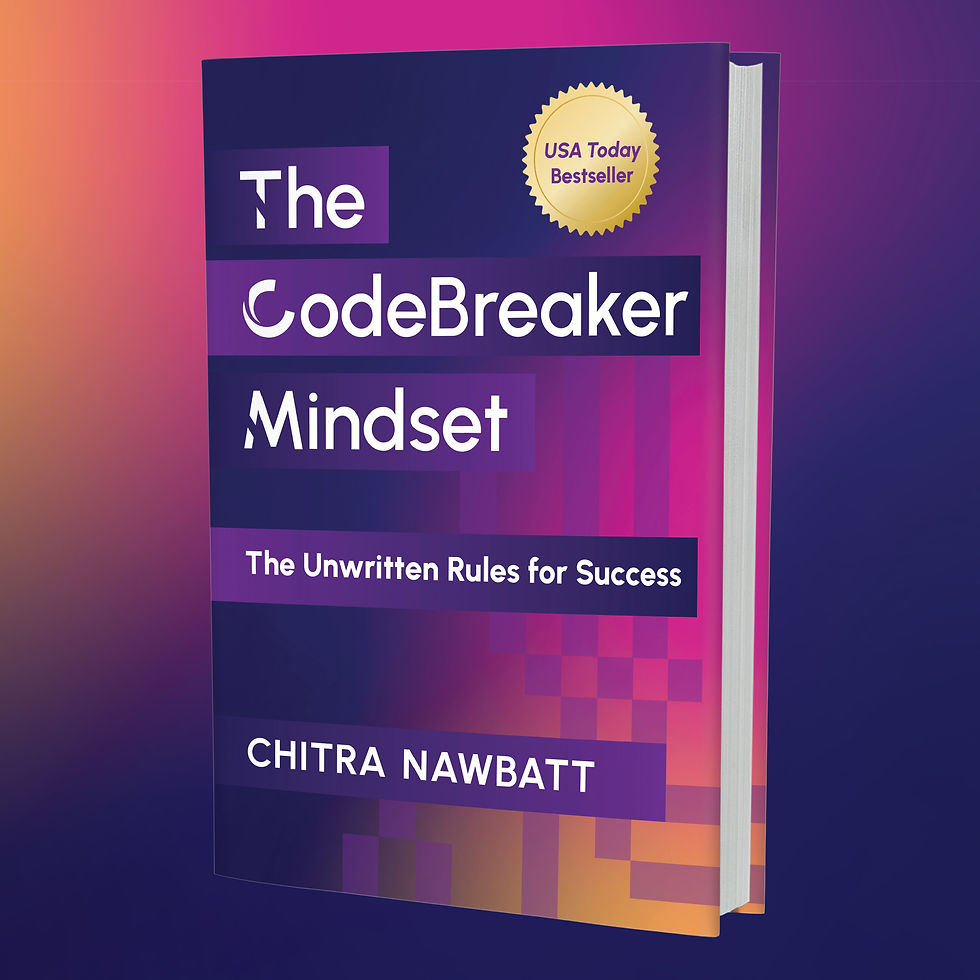
The CodeBreaker Mindset™ book order here: Amazon | Barnes & Noble
The CodeBreaker Mindset™ Ft. Reshma Saujani, Girls Who Code and Moms First, Founder
Chitra Nawbatt (00:10)
Welcome to The CodeBreaker Mindset™, where leaders and influencers share their path to achieving goals and dreams. I'm your host, Chitra Nawbatt Joining us today is Reshma Saujani Saujani, founder of Girls Who Code and Moms First. Reshma Saujani, welcome. Thank you for joining us
Reshma Saujani (00:26)
Thank you so much for having me.
Chitra Nawbatt (00:29)
Reshma Saujani, I'm grateful to have known you for about 15 years. We first met when you ran for Congress in New York City. You were a trailblazer as the first Indian American woman to run for Congress. Take us through your journey of running for Congress, to pivoting to run for New York City Public Advocate, then becoming Deputy Public Advocate, to founding Girls Who Code and Moms First.
Reshma Saujani (00:51)
Oh my God, That's a big question that's gonna take up like all the time that we have. You know, basically I grew up as, you know, the daughter of refugees. I've always been really passionate about making a difference and making change. I thought that the way that I would do that is through politics and through public service. I found myself though graduating with like $300,000 in student loan debt. And so I was working in a corporate job, you know, in a job I hated, like in a life I didn't want.
And I finally found the courage to actually quit one day. And instead of getting another job that I was probably going to hate, I ran for United States Congress. I was the first South Asian American woman to ever run for United States Congress. And it was like the scariest thing, but the best thing I've ever done because I had no idea what I was doing. And every day was like, you know, jumping off a building, right? It was just...I'd never built a campaign before, I'd never done like a stump speech before, I'd never spoken in front of a senior setting before, I'd never gone on television before.
And it was the most powerful, impactful 10 months of my life. I lost that race kind of spectacularly, but as part of that experience, I witnessed the technology divide in computer science and in coding. It was 2010, so that was when tech was starting to be hot like Twitter, Instagram, Facebook. And so many of these applications, the user base was female, but the founders were men. And you know, women were not a part of the conversation. And when you looked at who was graduating in computer science, you know, it less than 19%, 18 % were women. And so I realized that we needed to fill the gap, right? We needed to kind of build that type, you that pipeline of talent. And that's what really inspired me to start, you know, Girls Who Code, which was, you know the goal was to close the gender gap in technology jobs. And so I know I've built that organization over the past 10 to 12 years. And yeah, and here we are.
Chitra Nawbatt (02:55)
You talked about a number of different things there about jumping off buildings, the courage, scared. Let's get into the rules of the game or this notion of rules, because you've worked now and been a leader in different industries and contexts from public office, business, nonprofit, education. How did you figure out the written and unwritten rules of the game in each of these sandboxes.
The Rules of the Game
Reshma Saujani (03:20)
I mean, I don't know if I ever did. I feel like I kind of made my own rules. Like I always joked that like if I had applied for the job for the Girls Who Code CEO, I would never have gotten it. I didn't have the quote qualifications. You know, even for running for office, there wasn't a lot of women, there still isn't a lot of women who look like me who have my background that are in politics. So I think part of what I know I'm good at is I'm good at building. And I tell people like, you know, if you have an idea, maybe instead of trying to go apply and get that job, build it, you know. And so I feel like I made up the rules as I went along. I found people that believed in me a little bit more than I believed in myself. I always hired people and I still always hire people that are smarter than me. I know what I'm good at, and then I know what I need. I mean to build a team and to build a movement.
So I think the expertise that I've built...you know, over the past 15 years or whatever, is the expertise in building movements and being able to communicate and translate kind of complicated issues, whether it's girls in coding, whether it's now childcare and paid leave and get regular people to believe in it and to fight for it .
Chitra Nawbatt (04:34)
So now that you've built in those different contexts, and as you said, you've kind of come up with your own rules as you've gone along, looking back and even now, you know what do you think are the most important rules, principles if you will, when it comes to succeeding in politics and public office
Reshma Saujani (04:51)
Well, I think one is like, one, never give up, you know, and don't always listen to the naysayers. I think sometimes, especially as women, we want affirmation. We want people to be like, is this a good idea? And you want people to say yes, and they need to say yes a million times before you then jump, leap, and build. But I think sometimes you need to be comfortable with like listening to your own inner voice. I have learned to listen to my own instincts and my own gut, and not necessarily to listen to what other people think I should do. And in fact, when people tell me I can't do something, or there's a roadblock, right? I'm actually more driven towards it. I think the second thing, whether you're a founder or you're in public service or in politics, I think you need to learn how to be a good storyteller. And you know I always tell people when I meet them, I'm like, every opportunity that you have to public speak, take it. Every opportunity that you have to raise your hand, raise it. Because, the best thing I ever did for myself and the gifts that God has given me is that I gave my first, I started public speaking when I was 13 years old. And so like I'm watching the Olympics right now, right? And you're looking at Simone Biles and you're like, my God, but she did 10,000 hours plus. Like when you look at great athletes, they're constantly, constantly working on their craft. And it's no different when you're a movement builder or an activist or a social entrepreneur, it's like you have to kind of build that muscle and build that craft of whatever it is that you, know, again, the gift, the talent that you have that allows you to bring about change. And for me, you know, I realized after a long time, that was really my, it was really my voice, right? It was really my ability to translate topics and get people and to tell stories not about me, but about other people, right? And to get people emotionally connected and moved by those stories.
Chitra Nawbatt (06:55)
Bring that to life for us using Girls Who Code and Moms First, because that's a different sandbox than politics and public office, but it also requires using your voice to storytelling. So how did you think about the ingredients and creating new ingredients and orchestrating in a different way when you created Girls Who Code and then Moms First?
Reshma Saujani (07:15)
Well, I'll bring up moms first. like, you know, I was, I built moms first after my own personal experience as a mother in the pandemic. And, you know, the pandemic for a lot of moms was just crushing. And it was also eye opening. You know, I think for so many of us, we felt that we were personal failures. If we weren't able to keep our jobs and excel at our jobs and excel at raising our children, we were to blame. We just weren't, you know we married the wrong person or we weren't color, you know, color coding our calendar right. Or we just, you know, we were just personal failures. And I think society made you feel that way. But then the pandemic rolls around and you see a collective sense of just, you know, oh my God, like I'm drowning and something's broken here. Something structurally is, I'm not broken. Structurally something is broken. And it was to me, you know, that realization that I was having that allowed me to translate my personal experience to the collective experience of American mothers and led me to kind of really build a campaign and a movement around fighting for affordable childcare and paid leave. And so that was a big, you know, I think, again, lesson and eye -opener, you know, and we've really shifted the conversation in the country around childcare based upon being able to communicate what was a universal experience.
And also talk about it in a way that explains that we were talking about child care as a personal problem that families had to solve and not as an economic issue that the country needed to fix. And that clarity in saying that message over and over and over and over and over again, I think is very much going to lead to this moment where even I think in this presidential campaign, child care, you know, is being elevated. At the last presidential debate, we ran a petition to get child care asked as a question.
There were 21 questions asked at the presidential debate and childcare got asked. You know what I mean? Because of the movement that not only we've built, but that so many other organisations have been pushing for. But that is a lot about communication and the ability to talk about an issue in a way that makes it mainstream.
Chitra Nawbatt (09:37)
In everything you're talking about, it requires relationships, building relationships and networks, which you've done and you've excelled at with some top world leaders and influencers, whether it's former Secretary of State Hillary Clinton or Jack Dorsey, founder of Twitter and Block, which is formerly known as Square. How do you think about building relationships and networks and the rules or the unwritten rules when it comes to that? Because some of these folks that you have deep relationships with can be perceived as very complex to get to and to pierce through to build a real sticky relationship.
Reshma Saujani (10:12)
Well, I think it's a long-standing relationship. You Know I met Hillary when I was in college. You know, I met Jack, you know, when I just started my campaign in 2010. So, and you know, I think also it's like developing these relationships also on a personal level too. But I think at the core, at the end of the day, you got to find people who believe in you more than you believe in yourself and who see something in you that they...can see, can help accelerate something that they care about. So I think Hillary very much sees in me her legacy and wants to impart the wisdom and the knowledge that she's had on fighting for women and girls, which is what I do, so that I can get closer to progress. And I feel the same way when I meet young women that are entrepreneurs or activists and who are trying to make real change, figure out, you know, to me it's about, it's why I'm on this call with you today, right? We met each other and like, I'm not gonna lie, my schedule's insane. Like, you know today's a crazy day. And, but like, even if you can kind of find a little bit of time, right? To kind of help someone materialize their own dream and their own voice, you know? I think that that's your obligation and responsibility.
And look, you can’t do it for everybody. Like I could just spend my whole life just responding to my LinkedIn messages. And so one of the things I think I remember, won't, you very early, you when I was maybe 15 years ago, I was kind of blown off by someone who I admired and I was so upset about it. And someone said something to me. They said, you know, one day you're going to be that powerful that someone's going to feel exactly how you feel.
And that really made an impression on me, because it's true. It's like, I also think that we have to think about, like, I don't call Hillary Clinton every day. I don't text her every day, like, hey, you want to have coffee? You want to have lunch? Like, you know, I'm very, very judicious with her time. And she knows when I'm asking for something, I actually really need it. You know, and so I think that that's the other thing that we have to kind of recognize is in those people who can open up doors. They have a lot of people asking them to open up doors.
So how are you specific on your ask and judicious with your asks?
The Pivots
Chitra Nawbatt (12:41)
You've talked about a lot of pivots in your journey, so let's come to the pivots. Your journey has been far from linear. How do you think about when something doesn't turn out the way you expect, how you recover and how you pivot? And maybe let's start with when you first applied to Yale Law School, you weren't admitted. That was an experience that happened you know relatively earlier in your journey. In that moment, how did you feel? And then how did you recover?
Reshma Saujani (13:09)
Yeah, I mean you feel like shit, right? When you get rejected, when you fail at something, it never feels good. I think that my hack on failure though is that you have to give yourself a finite time to grieve over it and then just move on. So I don't really revisit the things that didn't work out for me. You know, I don't like sit there and still think about the 2010 campaign. Now I actually may think about it in times in order for it to fuel me.
You know, they say sometimes, like again with athletes, that like LeBron James or Kobe Bryant, you know, there was a moment in their career where they weren't picked for something. They didn't get the first draft or they didn't make the team. And that created this like chip on their shoulder that led to an enormous amount of drive. I have that with my 2010 campaign, right? I didn't win. I didn't get elected. And now every moment since then has been like, I'm going to show you that I can make a difference.
And look, I think that there's some positive aspects to that, right? But there's some negative aspects to that too, right? Because you don't want to constantly be driven by the sense of having to prove something. So, you know, as I've gotten older, I've really tried to like reach into different ways or different aspects, different tools of like motivation.
So now I'm more motivated, I think by, and I'm on my own spiritual journey of like, what's my purpose in this life? How can I, in every day, in everything that I do, be closer to fulfilling what I feel like God has put me on this earth to do? And it's less about I'm gonna show you. I'm gonna prove that I can do this. And that is a much more freeing energy because I'm at a stage in my life where there's nothing I'm really chasing.
And sometimes that feels weird because I've lived most of my life chasing a trophy, chasing a title, chasing a recognition. And now I feel a lot more free. Now that doesn't mean that I'm cured. That doesn't mean that like there are no not moments where I have to kind of catch myself. But now I have more of the tools to know when I'm moving in that direction, which is both unhealthy and unhelpful.
Chitra Nawbatt (15:32)
How do you think about though, accessing what has happened or what didn't work out to your expectation and post morteming that to inform how you may operate differently going forward? Cause you talked earlier.
Reshma Saujani (15:49)
Yeah. Yeah, no, I was just gonna say, look, I think I'm able, I've built Moms First into a massive movement of over 1 .1 million members in less than three years. And so I learned from my mistakes as the girls who code. I learned from my failures. I learned from, you know, the knowledge and the wisdom. And so now I can build faster. And so I can, I still will reach into or access those moments of failure and do the, you know, do the, you know, do the reliving of that when it's helpful and healthy.
Chitra Nawbatt (16:20)
Is there something tangible that you can give us an example of? Is there something consistent throughout each of those moments of quote unquote failure or pivots? Something consistent where it's like, hey, that's the learning. And this is how now I'm operating, thinking, navigating differently.
Reshma Saujani (16:35)
Well, I've had the same coach since 2010. So, Ra Gaudis is a huge resource for me. She'll be like, remember when we talked about this in 2016 and you were going through this? And I'll be like, yes. And we've taped all of our conversations. I still journal. So, think having my husband as well, Nihal, has a good memory. So, I think it's like you can tap into people that remember when you've gone through something similar, whether it's friends, whether it's a partner, whether it's a coach.
The Magic
Chitra Nawbatt (17:08)
Let's get into ah, let’s get into the magic because I do believe in our journey and you talked a little bit about it, maybe not as explicitly, that sometimes there's magic or serendipity which plays in. How do you define serendipity?
Reshma Saujani (17:24)
I mean, I think everything happens for a reason. That's maybe how I define it. I think we're all, it's all like sliding doors and you make choices, but you end up, I think we all end up exactly where we're supposed to end up. Like I think about this, like had I not lost that congressional race, I never would have started Girls Who Code. Had I not lost my public advocate race, I would have never built Girls Who Code. Had I not had 10 years of fertility challenges, had my son not be born, you know exactly in January 25th, 2020 in the pandemic, I never would have started Moms First because I wouldn't have been a mom trying to raise a newborn in a pandemic, you know, while homeschooling my five -year -old and like I just wouldn't have been at that moment where it would have been so much that I would have seen something that I had never seen before. So I, you know, I don't really have any regrets in my life.
Everything has kind of happened, think, exactly the way that it's supposed to happen. That doesn't mean that I've re that's because I'm saying, I'm so successful and I've gotten everything I've wanted. In fact, I've not gotten everything I've wanted. You know, there's still so much more that I want to do, so much more that I want to create, so much more that I want to build. But I know that, like, it's exactly where it's supposed to be.
Chitra Nawbatt (18:46)
And were there any people that you met in your journey serendipitously that have just been very critical, critical to unlocking different pathways, different altitudes for your life?
Reshma Saujani (19:00)
I mean Hillary Clinton has definitely been a huge, I mean a huge influence in my life. know, and a big person that during big junctures I asked for her advice and counsel. And she's just a role model in terms of like the way that I see her lead and live her life. I mean, think about it. mean, even the fact that she lost the presidential, it was so close. Instead of going to a beach in Bermuda, she's out there every single day working and fighting for a party that wasn't fully with her.
Like that's remarkable because she has that much love, you know what I mean, for our country.
Chitra Nawbatt (19:37)
What's your advice on how to cultivate The CodeBreaker Mindset™ to those of us trying to create our own path of plan to action?
Reshma Saujani (19:46)
I think you just do it. I think there's so much about taking one step and then another step and then another step and then another step and just and just doing it. I think sometimes we make the thing so big that it scares us off. I think the second thing is you have to be disciplined. Like there are, you know, Girls Who Code, I built one product and I built it well. And once that product was sailing, I built the next one. Same thing at Moms First. There's so many things we could be working on but we're really…focused and disciplined on the issues, on the messaging and on like what we're trying to create.
Chitra Nawbatt (20:21)
Reshma Saujani, thank you so much for joining us
Reshma Saujani (20:23)
Thank you, Chithra, it's so great to be here.
The CodeBreaker Mindset™ Ft. Reshma Saujani, Girls Who Code and Moms First, Founder
Chitra Nawbatt (00:10)
Welcome to The CodeBreaker Mindset™, where leaders and influencers share their path to achieving goals and dreams. I'm your host, Chitra Nawbatt Joining us today is Reshma Saujani Saujani, founder of Girls Who Code and Moms First. Reshma Saujani, welcome. Thank you for joining us
Reshma Saujani (00:26)
Thank you so much for having me.
Chitra Nawbatt (00:29)
Reshma Saujani, I'm grateful to have known you for about 15 years. We first met when you ran for Congress in New York City. You were a trailblazer as the first Indian American woman to run for Congress. Take us through your journey of running for Congress, to pivoting to run for New York City Public Advocate, then becoming Deputy Public Advocate, to founding Girls Who Code and Moms First.
Reshma Saujani (00:51)
Oh my God, That's a big question that's gonna take up like all the time that we have. You know, basically I grew up as, you know, the daughter of refugees. I've always been really passionate about making a difference and making change. I thought that the way that I would do that is through politics and through public service. I found myself though graduating with like $300,000 in student loan debt. And so I was working in a corporate job, you know, in a job I hated, like in a life I didn't want.
And I finally found the courage to actually quit one day. And instead of getting another job that I was probably going to hate, I ran for United States Congress. I was the first South Asian American woman to ever run for United States Congress. And it was like the scariest thing, but the best thing I've ever done because I had no idea what I was doing. And every day was like, you know, jumping off a building, right? It was just...I'd never built a campaign before, I'd never done like a stump speech before, I'd never spoken in front of a senior setting before, I'd never gone on television before.
And it was the most powerful, impactful 10 months of my life. I lost that race kind of spectacularly, but as part of that experience, I witnessed the technology divide in computer science and in coding. It was 2010, so that was when tech was starting to be hot like Twitter, Instagram, Facebook. And so many of these applications, the user base was female, but the founders were men. And you know, women were not a part of the conversation. And when you looked at who was graduating in computer science, you know, it less than 19%, 18 % were women. And so I realized that we needed to fill the gap, right? We needed to kind of build that type, you that pipeline of talent. And that's what really inspired me to start, you know, Girls Who Code, which was, you know the goal was to close the gender gap in technology jobs. And so I know I've built that organization over the past 10 to 12 years. And yeah, and here we are.
Chitra Nawbatt (02:55)
You talked about a number of different things there about jumping off buildings, the courage, scared. Let's get into the rules of the game or this notion of rules, because you've worked now and been a leader in different industries and contexts from public office, business, nonprofit, education. How did you figure out the written and unwritten rules of the game in each of these sandboxes.
The Rules of the Game
Reshma Saujani (03:20)
I mean, I don't know if I ever did. I feel like I kind of made my own rules. Like I always joked that like if I had applied for the job for the Girls Who Code CEO, I would never have gotten it. I didn't have the quote qualifications. You know, even for running for office, there wasn't a lot of women, there still isn't a lot of women who look like me who have my background that are in politics. So I think part of what I know I'm good at is I'm good at building. And I tell people like, you know, if you have an idea, maybe instead of trying to go apply and get that job, build it, you know. And so I feel like I made up the rules as I went along. I found people that believed in me a little bit more than I believed in myself. I always hired people and I still always hire people that are smarter than me. I know what I'm good at, and then I know what I need. I mean to build a team and to build a movement.
So I think the expertise that I've built...you know, over the past 15 years or whatever, is the expertise in building movements and being able to communicate and translate kind of complicated issues, whether it's girls in coding, whether it's now childcare and paid leave and get regular people to believe in it and to fight for it .
Chitra Nawbatt (04:34)
So now that you've built in those different contexts, and as you said, you've kind of come up with your own rules as you've gone along, looking back and even now, you know what do you think are the most important rules, principles if you will, when it comes to succeeding in politics and public office
Reshma Saujani (04:51)
Well, I think one is like, one, never give up, you know, and don't always listen to the naysayers. I think sometimes, especially as women, we want affirmation. We want people to be like, is this a good idea? And you want people to say yes, and they need to say yes a million times before you then jump, leap, and build. But I think sometimes you need to be comfortable with like listening to your own inner voice. I have learned to listen to my own instincts and my own gut, and not necessarily to listen to what other people think I should do. And in fact, when people tell me I can't do something, or there's a roadblock, right? I'm actually more driven towards it. I think the second thing, whether you're a founder or you're in public service or in politics, I think you need to learn how to be a good storyteller. And you know I always tell people when I meet them, I'm like, every opportunity that you have to public speak, take it. Every opportunity that you have to raise your hand, raise it. Because, the best thing I ever did for myself and the gifts that God has given me is that I gave my first, I started public speaking when I was 13 years old. And so like I'm watching the Olympics right now, right? And you're looking at Simone Biles and you're like, my God, but she did 10,000 hours plus. Like when you look at great athletes, they're constantly, constantly working on their craft. And it's no different when you're a movement builder or an activist or a social entrepreneur, it's like you have to kind of build that muscle and build that craft of whatever it is that you, know, again, the gift, the talent that you have that allows you to bring about change. And for me, you know, I realized after a long time, that was really my, it was really my voice, right? It was really my ability to translate topics and get people and to tell stories not about me, but about other people, right? And to get people emotionally connected and moved by those stories.
Chitra Nawbatt (06:55)
Bring that to life for us using Girls Who Code and Moms First, because that's a different sandbox than politics and public office, but it also requires using your voice to storytelling. So how did you think about the ingredients and creating new ingredients and orchestrating in a different way when you created Girls Who Code and then Moms First?
Reshma Saujani (07:15)
Well, I'll bring up moms first. like, you know, I was, I built moms first after my own personal experience as a mother in the pandemic. And, you know, the pandemic for a lot of moms was just crushing. And it was also eye opening. You know, I think for so many of us, we felt that we were personal failures. If we weren't able to keep our jobs and excel at our jobs and excel at raising our children, we were to blame. We just weren't, you know we married the wrong person or we weren't color, you know, color coding our calendar right. Or we just, you know, we were just personal failures. And I think society made you feel that way. But then the pandemic rolls around and you see a collective sense of just, you know, oh my God, like I'm drowning and something's broken here. Something structurally is, I'm not broken. Structurally something is broken. And it was to me, you know, that realization that I was having that allowed me to translate my personal experience to the collective experience of American mothers and led me to kind of really build a campaign and a movement around fighting for affordable childcare and paid leave. And so that was a big, you know, I think, again, lesson and eye -opener, you know, and we've really shifted the conversation in the country around childcare based upon being able to communicate what was a universal experience.
And also talk about it in a way that explains that we were talking about child care as a personal problem that families had to solve and not as an economic issue that the country needed to fix. And that clarity in saying that message over and over and over and over and over again, I think is very much going to lead to this moment where even I think in this presidential campaign, child care, you know, is being elevated. At the last presidential debate, we ran a petition to get child care asked as a question.
There were 21 questions asked at the presidential debate and childcare got asked. You know what I mean? Because of the movement that not only we've built, but that so many other organisations have been pushing for. But that is a lot about communication and the ability to talk about an issue in a way that makes it mainstream.
Chitra Nawbatt (09:37)
In everything you're talking about, it requires relationships, building relationships and networks, which you've done and you've excelled at with some top world leaders and influencers, whether it's former Secretary of State Hillary Clinton or Jack Dorsey, founder of Twitter and Block, which is formerly known as Square. How do you think about building relationships and networks and the rules or the unwritten rules when it comes to that? Because some of these folks that you have deep relationships with can be perceived as very complex to get to and to pierce through to build a real sticky relationship.
Reshma Saujani (10:12)
Well, I think it's a long-standing relationship. You Know I met Hillary when I was in college. You know, I met Jack, you know, when I just started my campaign in 2010. So, and you know, I think also it's like developing these relationships also on a personal level too. But I think at the core, at the end of the day, you got to find people who believe in you more than you believe in yourself and who see something in you that they...can see, can help accelerate something that they care about. So I think Hillary very much sees in me her legacy and wants to impart the wisdom and the knowledge that she's had on fighting for women and girls, which is what I do, so that I can get closer to progress. And I feel the same way when I meet young women that are entrepreneurs or activists and who are trying to make real change, figure out, you know, to me it's about, it's why I'm on this call with you today, right? We met each other and like, I'm not gonna lie, my schedule's insane. Like, you know today's a crazy day. And, but like, even if you can kind of find a little bit of time, right? To kind of help someone materialize their own dream and their own voice, you know? I think that that's your obligation and responsibility.
And look, you can’t do it for everybody. Like I could just spend my whole life just responding to my LinkedIn messages. And so one of the things I think I remember, won't, you very early, you when I was maybe 15 years ago, I was kind of blown off by someone who I admired and I was so upset about it. And someone said something to me. They said, you know, one day you're going to be that powerful that someone's going to feel exactly how you feel.
And that really made an impression on me, because it's true. It's like, I also think that we have to think about, like, I don't call Hillary Clinton every day. I don't text her every day, like, hey, you want to have coffee? You want to have lunch? Like, you know, I'm very, very judicious with her time. And she knows when I'm asking for something, I actually really need it. You know, and so I think that that's the other thing that we have to kind of recognize is in those people who can open up doors. They have a lot of people asking them to open up doors.
So how are you specific on your ask and judicious with your asks?
The Pivots
Chitra Nawbatt (12:41)
You've talked about a lot of pivots in your journey, so let's come to the pivots. Your journey has been far from linear. How do you think about when something doesn't turn out the way you expect, how you recover and how you pivot? And maybe let's start with when you first applied to Yale Law School, you weren't admitted. That was an experience that happened you know relatively earlier in your journey. In that moment, how did you feel? And then how did you recover?
Reshma Saujani (13:09)
Yeah, I mean you feel like shit, right? When you get rejected, when you fail at something, it never feels good. I think that my hack on failure though is that you have to give yourself a finite time to grieve over it and then just move on. So I don't really revisit the things that didn't work out for me. You know, I don't like sit there and still think about the 2010 campaign. Now I actually may think about it in times in order for it to fuel me.
You know, they say sometimes, like again with athletes, that like LeBron James or Kobe Bryant, you know, there was a moment in their career where they weren't picked for something. They didn't get the first draft or they didn't make the team. And that created this like chip on their shoulder that led to an enormous amount of drive. I have that with my 2010 campaign, right? I didn't win. I didn't get elected. And now every moment since then has been like, I'm going to show you that I can make a difference.
And look, I think that there's some positive aspects to that, right? But there's some negative aspects to that too, right? Because you don't want to constantly be driven by the sense of having to prove something. So, you know, as I've gotten older, I've really tried to like reach into different ways or different aspects, different tools of like motivation.
So now I'm more motivated, I think by, and I'm on my own spiritual journey of like, what's my purpose in this life? How can I, in every day, in everything that I do, be closer to fulfilling what I feel like God has put me on this earth to do? And it's less about I'm gonna show you. I'm gonna prove that I can do this. And that is a much more freeing energy because I'm at a stage in my life where there's nothing I'm really chasing.
And sometimes that feels weird because I've lived most of my life chasing a trophy, chasing a title, chasing a recognition. And now I feel a lot more free. Now that doesn't mean that I'm cured. That doesn't mean that like there are no not moments where I have to kind of catch myself. But now I have more of the tools to know when I'm moving in that direction, which is both unhealthy and unhelpful.
Chitra Nawbatt (15:32)
How do you think about though, accessing what has happened or what didn't work out to your expectation and post morteming that to inform how you may operate differently going forward? Cause you talked earlier.
Reshma Saujani (15:49)
Yeah. Yeah, no, I was just gonna say, look, I think I'm able, I've built Moms First into a massive movement of over 1 .1 million members in less than three years. And so I learned from my mistakes as the girls who code. I learned from my failures. I learned from, you know, the knowledge and the wisdom. And so now I can build faster. And so I can, I still will reach into or access those moments of failure and do the, you know, do the, you know, do the reliving of that when it's helpful and healthy.
Chitra Nawbatt (16:20)
Is there something tangible that you can give us an example of? Is there something consistent throughout each of those moments of quote unquote failure or pivots? Something consistent where it's like, hey, that's the learning. And this is how now I'm operating, thinking, navigating differently.
Reshma Saujani (16:35)
Well, I've had the same coach since 2010. So, Ra Gaudis is a huge resource for me. She'll be like, remember when we talked about this in 2016 and you were going through this? And I'll be like, yes. And we've taped all of our conversations. I still journal. So, think having my husband as well, Nihal, has a good memory. So, I think it's like you can tap into people that remember when you've gone through something similar, whether it's friends, whether it's a partner, whether it's a coach.
The Magic
Chitra Nawbatt (17:08)
Let's get into ah, let’s get into the magic because I do believe in our journey and you talked a little bit about it, maybe not as explicitly, that sometimes there's magic or serendipity which plays in. How do you define serendipity?
Reshma Saujani (17:24)
I mean, I think everything happens for a reason. That's maybe how I define it. I think we're all, it's all like sliding doors and you make choices, but you end up, I think we all end up exactly where we're supposed to end up. Like I think about this, like had I not lost that congressional race, I never would have started Girls Who Code. Had I not lost my public advocate race, I would have never built Girls Who Code. Had I not had 10 years of fertility challenges, had my son not be born, you know exactly in January 25th, 2020 in the pandemic, I never would have started Moms First because I wouldn't have been a mom trying to raise a newborn in a pandemic, you know, while homeschooling my five -year -old and like I just wouldn't have been at that moment where it would have been so much that I would have seen something that I had never seen before. So I, you know, I don't really have any regrets in my life.
Everything has kind of happened, think, exactly the way that it's supposed to happen. That doesn't mean that I've re that's because I'm saying, I'm so successful and I've gotten everything I've wanted. In fact, I've not gotten everything I've wanted. You know, there's still so much more that I want to do, so much more that I want to create, so much more that I want to build. But I know that, like, it's exactly where it's supposed to be.
Chitra Nawbatt (18:46)
And were there any people that you met in your journey serendipitously that have just been very critical, critical to unlocking different pathways, different altitudes for your life?
Reshma Saujani (19:00)
I mean Hillary Clinton has definitely been a huge, I mean a huge influence in my life. know, and a big person that during big junctures I asked for her advice and counsel. And she's just a role model in terms of like the way that I see her lead and live her life. I mean, think about it. mean, even the fact that she lost the presidential, it was so close. Instead of going to a beach in Bermuda, she's out there every single day working and fighting for a party that wasn't fully with her.
Like that's remarkable because she has that much love, you know what I mean, for our country.
Chitra Nawbatt (19:37)
What's your advice on how to cultivate The CodeBreaker Mindset™ to those of us trying to create our own path of plan to action?
Reshma Saujani (19:46)
I think you just do it. I think there's so much about taking one step and then another step and then another step and then another step and just and just doing it. I think sometimes we make the thing so big that it scares us off. I think the second thing is you have to be disciplined. Like there are, you know, Girls Who Code, I built one product and I built it well. And once that product was sailing, I built the next one. Same thing at Moms First. There's so many things we could be working on but we're really…focused and disciplined on the issues, on the messaging and on like what we're trying to create.
Chitra Nawbatt (20:21)
Reshma Saujani, thank you so much for joining us
Reshma Saujani (20:23)
Thank you, Chithra, it's so great to be here.
Disclaimer: the show notes and transcript are powered by artificial intelligence (AI).
Featured Episodes and Insights